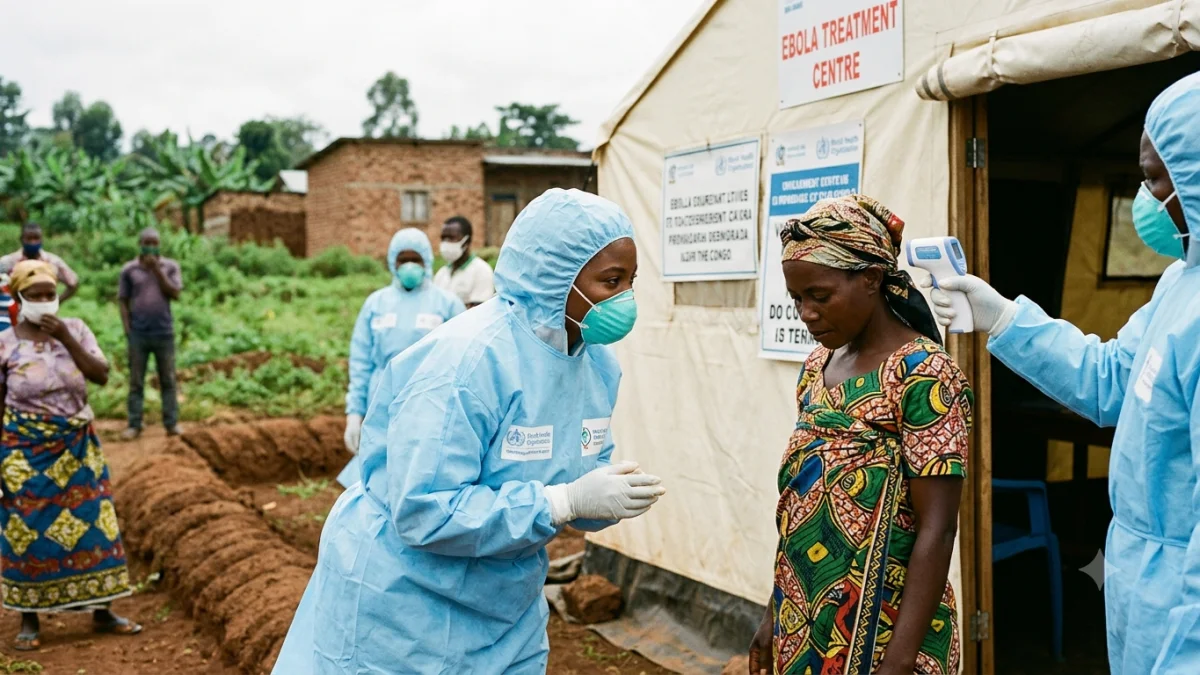


The Democratic Republic of the Congo's Ebola outbreak has become increasingly concentrated in the country's remote eastern provinces, underscoring how geography, insecurity and fragile health systems continue to shape one of the fastest-growing Ebola epidemics on record. While response efforts have expanded, health authorities say transmission remains centered in difficult-to-reach communities where conflict, population displacement and weak infrastructure have complicated containment.
The concentration of cases in eastern provinces, particularly Ituri, is significant because it illustrates that the outbreak is no longer driven primarily by isolated transmission chains but by sustained community spread in areas where public health interventions are hardest to implement. According to the World Health Organization (WHO), the Bundibugyo strain responsible for the outbreak has no licensed vaccine or approved treatment, placing greater emphasis on rapid diagnosis, contact tracing, supportive care and community engagement than in previous outbreaks involving the Zaire strain, for which vaccines are available.


WHO has repeatedly described the operational environment as exceptionally challenging. Eastern Congo has experienced years of armed conflict involving numerous militia groups, disrupting healthcare delivery and limiting access to affected communities. Humanitarian agencies report that insecurity has periodically prevented surveillance teams from reaching villages, delayed laboratory testing and hindered the movement of medical supplies. The combination of violence, displacement and high levels of cross-border mobility with neighboring Uganda has increased the complexity of outbreak control despite strengthened regional preparedness.
Although cases have spread into additional provinces, Ituri continues to account for the overwhelming majority of confirmed infections. WHO situation updates throughout the outbreak have consistently identified Ituri as the epidemic's epicenter, with transmission extending through interconnected health zones rather than shifting decisively toward major urban centers. This geographic concentration has allowed authorities to prioritize resources but has also exposed the limits of response capacity in remote settings where transportation networks are poor and healthcare facilities are limited.
The outbreak has also highlighted the limitations of traditional Ebola control strategies under current conditions. Africa Centres for Disease Control and Prevention officials have warned that community transmission now accounts for most newly detected infections, indicating that contact tracing is failing to capture a substantial proportion of transmission chains. Public health experts generally regard effective contact tracing as one of the most important tools for containing Ebola, making this trend particularly concerning.
Operational challenges have been compounded by labor disputes within the response effort itself. Health workers involved in Ebola control have staged protests over delayed salaries and unpaid allowances, raising concerns about staffing shortages at a critical stage of the epidemic. Reuters reported that payment delays threatened to undermine surveillance, treatment and community outreach activities already constrained by security risks. WHO Director-General Tedros Adhanom Ghebreyesus visited the affected region in early August to reinforce international support while acknowledging the pressures facing frontline workers.
The scientific response has accelerated alongside emergency operations. Because the Bundibugyo virus differs from the more extensively studied Zaire species, researchers have had to launch new clinical studies rather than rely on existing licensed countermeasures. WHO says experimental therapeutic trials are underway in partnership with humanitarian organizations, while vaccine candidates developed by Oxford University, the Serum Institute of India and Moderna have entered early-stage testing. These efforts reflect lessons learned from previous Ebola outbreaks, in which research platforms established during emergencies later contributed to approved vaccines and treatments. However, none of the investigational products is yet available for routine outbreak control.
The outbreak's concentration in eastern Congo also carries regional implications. WHO has maintained that the risk remains very high within the Democratic Republic of the Congo and high for neighboring countries sharing land borders because of extensive cross-border trade and population movement. Imported cases linked to the Congolese outbreak have already been detected in Uganda, while isolated international cases involving aid workers have demonstrated that international surveillance remains necessary even though WHO continues to assess the broader global risk as relatively low.
Historically, the Democratic Republic of the Congo has experienced repeated Ebola outbreaks since the virus was first identified in 1976. However, the current epidemic differs in important respects. It has become the second-largest Ebola outbreak on record and one of the fastest-growing, while occurring in a region already affected by armed conflict and humanitarian pressures. Those conditions distinguish it from several earlier outbreaks that were brought under control more rapidly through intensive case finding, isolation and vaccination.
The confirmed picture remains one of sustained transmission concentrated in eastern Congo despite an expanding international response. Authorities continue to monitor trends in community transmission, the effectiveness of contact tracing, the impact of health worker shortages, the progress of experimental vaccines and treatments, and whether intensified surveillance and community engagement can slow the outbreak's trajectory. While public health agencies report incremental operational gains, they continue to emphasize that the epidemic remains active and that containment efforts face significant logistical and security challenges.