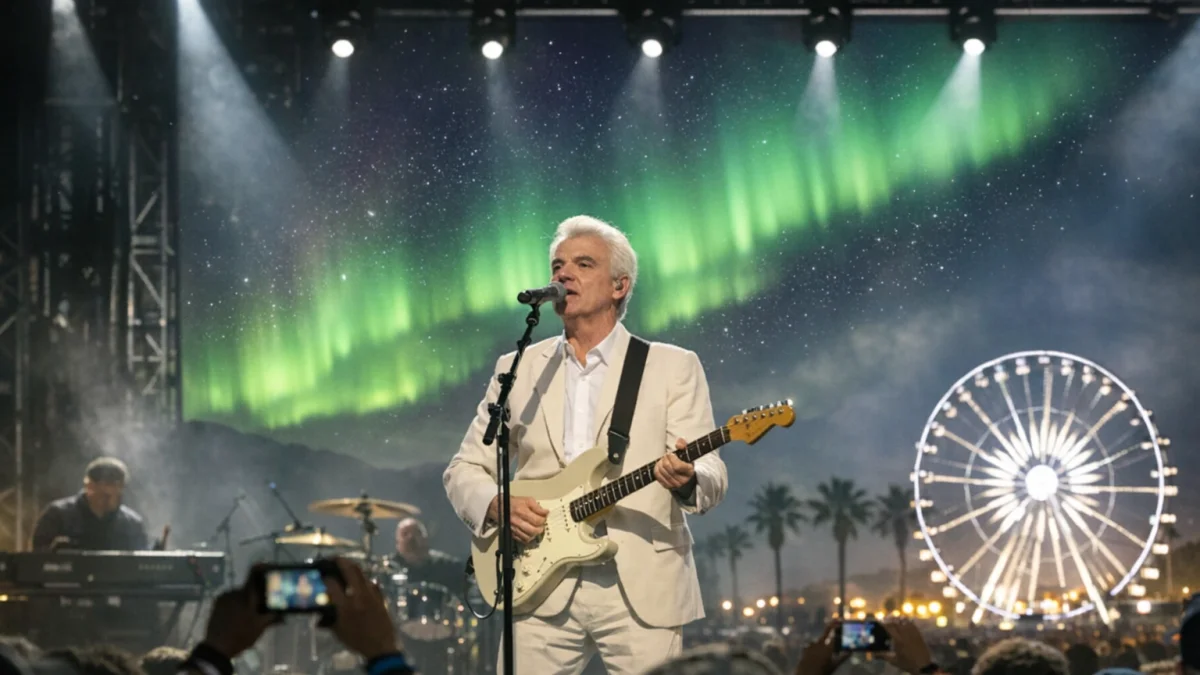


INDIO, CALIFORNIA — David Byrne is scheduled to perform at the Coachella Valley Music and Arts Festival in April 2026 in Indio, California, while U.S. space weather forecasters have issued a geomagnetic storm watch that could bring more active aurora borealis conditions this week, although there are no verified reports of northern lights visible over the festival grounds.
Byrne, the former Talking Heads frontman and solo artist, appears on the official Coachella 2026 lineup, which runs April 10–12 and April 17–19 at the Empire Polo Club, with headliners including Sabrina Carpenter, Justin Bieber and Karol G.


Separately, NOAA’s Space Weather Prediction Center issued a G2 (Moderate) geomagnetic storm watch for the UTC day of March 31 in anticipation of a coronal mass ejection (CME) from the Sun, raising the likelihood of enhanced geomagnetic activity on Earth. The forecast update says “a G2 (Moderate) Watch is in effect for the March 31st UTC‑day in anticipation of any CME influences,” while noting the CME’s direction and impact remain under assessment.
The term geomagnetic storm refers to disturbances in the Earth’s magnetic field caused by charged particles from solar eruptions reaching the planet, which can lead to auroral displays at high latitudes, NOAA and space weather sources explain. Auroras are more commonly visible in regions nearer the Arctic Circle and typically appear between about 10 p.m. and 2 a.m. local time under favourable conditions.
There are no official or media reports confirming that auroras were observed over Southern California or at Coachella during Byrne’s scheduled performances. Long‑distance aurora visibility at lower latitudes depends on the strength of geomagnetic storms and atmospheric conditions, and forecasters have not issued a direct forecast tying the March 31 geomagnetic storm watch to visible auroras as far south as Indio.
Coachella’s organisers, managed by Goldenvoice, have not released information linking the musical performances to space weather phenomena, and festival schedules remain centred on the announced artist sets and installations.
An official NOAA forecaster said in background briefings that space weather watches are intended to inform the public about conditions that might increase auroral activity, but cautioned that “forecast models can change as new data arrives,” underscoring the uncertainty inherent in such predictions.
Festival preparations are ongoing ahead of the April dates, with Byrne’s set among the featured performances, and space weather agencies continuing to monitor solar activity for further updates that could affect aurora forecasts.