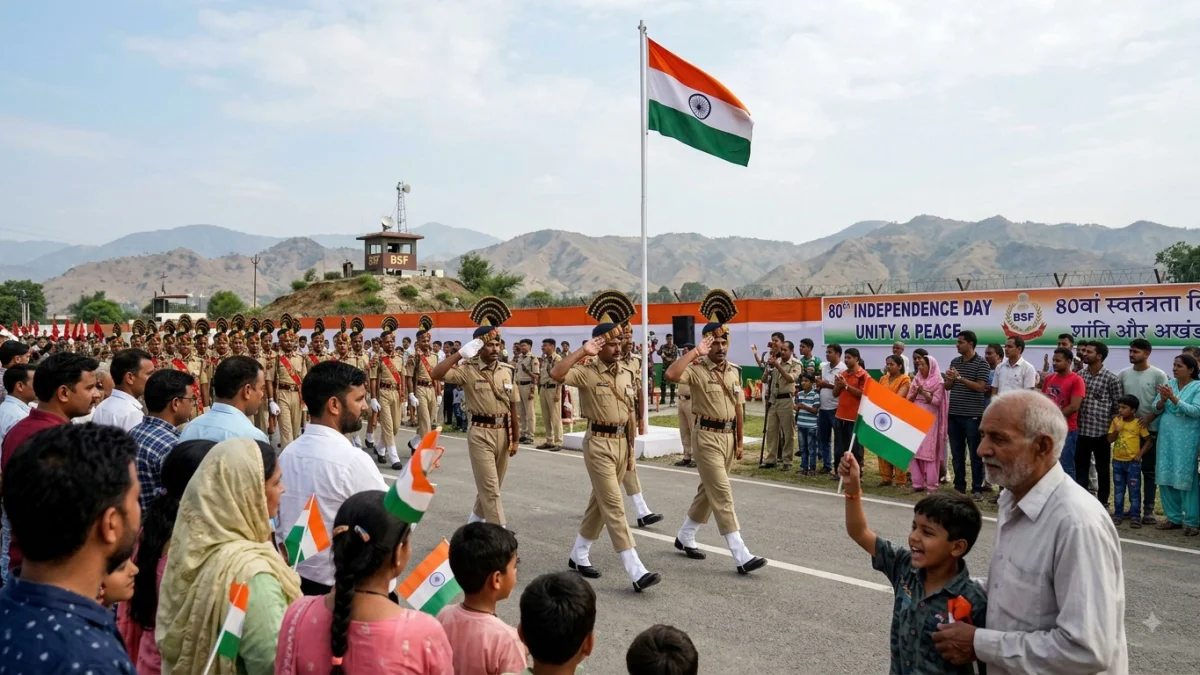


India is marking its 80th Independence Day on Aug. 15 with Prime Minister Narendra Modi due to lead celebrations from New Delhi’s Red Fort, as the government presents the milestone around a longer-term vision of a developed India while regional security pressures remain a central concern. Official preparations have placed “Yuva Shakti for Viksit Bharat@2047” — youth power for a developed India by 2047 — at the center of this year’s celebrations, alongside a commemoration of 150 years of the national song “Vande Mataram.”
The anniversary comes at a more complicated strategic moment than its ceremonial setting might suggest. India has spent the past year managing the consequences of its most serious military confrontation with Pakistan in decades while simultaneously trying to stabilize relations with China after years of military tension along their disputed Himalayan border. The result is a security environment in which New Delhi is pursuing economic development and diplomatic engagement while maintaining a stronger emphasis on military preparedness.


President Droupadi Murmu, in her address on the eve of Independence Day, framed the anniversary around national strength and the country's development ambitions. The official government account of the celebrations says Modi's Red Fort programme is intended to connect the independence milestone with the country's longer-term development objectives.
The immediate regional backdrop is particularly important. India and Pakistan fought a four-day conflict in May 2025 after a deadly militant attack in Indian-administered Kashmir. The confrontation involved missile, drone and other strikes before a ceasefire was reached. India attributed the initial attack to Pakistan-backed militants, while Pakistan denied the accusation. The episode demonstrated how quickly a dispute rooted in Kashmir can escalate between two nuclear-armed states.
That confrontation continues to shape the political meaning of India's security policy. At last year's Independence Day address, Modi strongly emphasized the military's response under Operation Sindoor and warned Pakistan against what he described as nuclear threats. The government subsequently described the operation as part of a broader shift toward stronger deterrence and greater domestic defence capability.
Pakistan's own Independence Day, celebrated on Aug. 14, provided a parallel reminder of the unresolved relationship. Prime Minister Shehbaz Sharif said Pakistan wanted peace but would not regard that preference as weakness. Pakistan also continues to face political instability in Pakistan-administered Kashmir, where regional elections have been disrupted by deadly protests, security concerns and accusations of electoral manipulation.
China presents a different but equally significant strategic challenge. India and China have made progress toward restoring diplomatic and economic contacts following the military confrontation that began in 2020. Indian and Chinese officials reaffirmed in May that maintaining peace and tranquillity along the border had enabled gradual normalization of relations.
But that normalization remains conditional. On Aug. 12, India's foreign ministry again stressed that peace along the disputed border was essential to broader bilateral relations after reports of renewed military activity near Taksing in Arunachal Pradesh. Indian defence officials rejected claims that Chinese troops had entered Indian-controlled territory, while Beijing described the situation as generally stable. The episode illustrates the continuing gap between diplomatic normalization and the unresolved territorial dispute.
The broader strategic calculation is therefore one of balancing deterrence with engagement. New Delhi has sought to improve ties with Beijing, including restoring border mechanisms and commercial links, while insisting that stability along the frontier is a prerequisite for normal relations. At the same time, its experience with Pakistan has reinforced the government's emphasis on military readiness, domestic defence production and the ability to respond rapidly to security threats. The resumption of India-China border trade through the Lipulekh Pass in June was one tangible sign that economic and local contacts can resume even while the territorial dispute remains unresolved.
For India, the 80th Independence Day consequently carries two parallel messages. Domestically, it is being used to reinforce the government's development agenda and its target of building a “Viksit Bharat” by 2047. Strategically, the anniversary falls in a period when India's relations with both major continental neighbours remain defined by a mixture of confrontation, deterrence and selective diplomatic engagement.
The confirmed situation is that India enters the anniversary with its ceasefire with Pakistan holding while political and security tensions connected to Kashmir remain significant, and with India-China relations showing signs of normalization but continuing to face unresolved border disputes. The immediate developments to monitor are the substance of Modi's Independence Day address, official assessments of the regional security environment, and whether the recent India-China border tensions remain contained as both countries pursue broader diplomatic engagement.