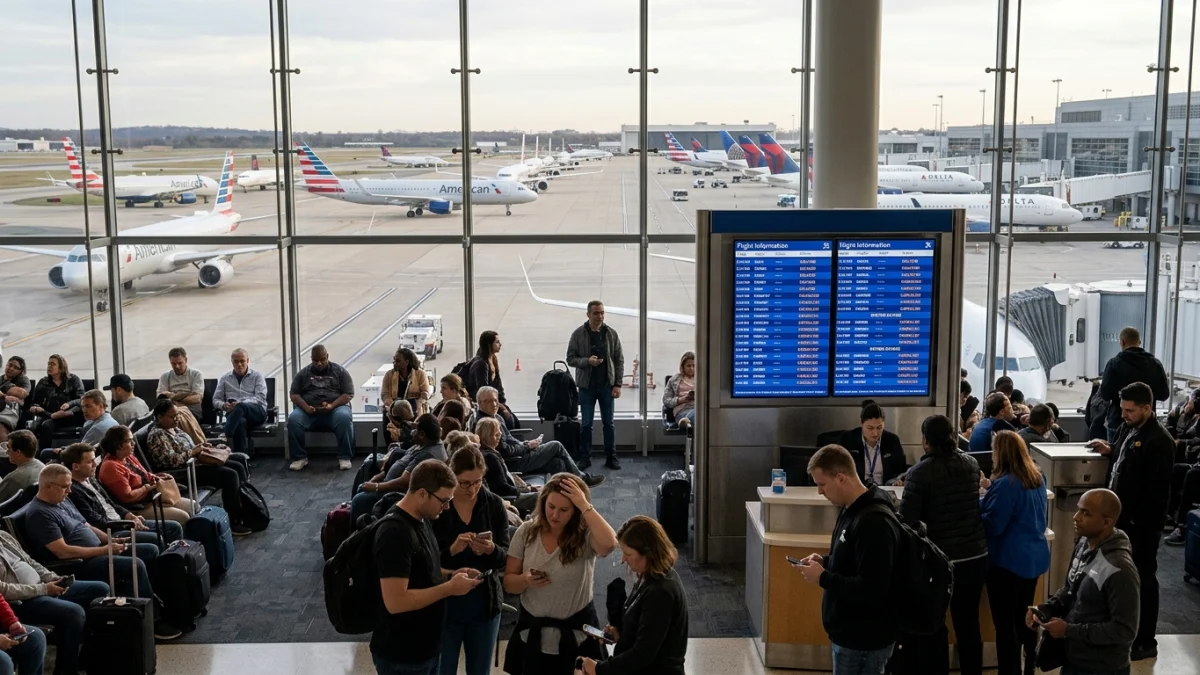


MINNEAPOLIS — A major air traffic control outage disrupted flights across nine U.S. states on Thursday, forcing ground stops, flight diversions and widespread delays after the Minneapolis Air Route Traffic Control Center lost radar and communications capabilities, according to federal aviation authorities and airport officials.
The disruption affected airspace managed by the Minneapolis Air Route Traffic Control Center, which oversees high-altitude traffic across Minnesota and parts of Wisconsin, North Dakota, South Dakota, Iowa, Nebraska, Michigan, Montana and Wyoming. The outage prompted the Federal Aviation Administration to implement traffic management measures, including temporary ground stops at Minneapolis–Saint Paul International Airport and restrictions on flights transiting the affected airspace.


Airlines reported cascading delays throughout the afternoon as aircraft already in the air were rerouted around the affected region while departures bound for or through the Minneapolis center's airspace were held at airports across the country. Some inbound flights diverted to alternate airports until controllers restored services.
The FAA said safety procedures remained in effect throughout the incident and that traffic restrictions were imposed to maintain safe separation between aircraft while technicians worked to restore affected systems. Flight operations resumed gradually after radar and communications services were restored, although delays continued into the evening as airlines repositioned aircraft and crews.
Authorities did not immediately identify the cause of the outage or indicate whether it stemmed from equipment failure, telecommunications problems or another technical issue. The FAA said it was investigating the incident and would continue reviewing the system failure after normal operations resumed.
Minneapolis–Saint Paul International Airport advised passengers to check directly with their airlines, warning that flight schedules could remain disrupted even after the airspace reopened. Flight-tracking services showed numerous cancellations and delays across the Upper Midwest as the interruption rippled through airline networks.
The incident renewed attention on the resilience of the U.S. air traffic control system, which has experienced several high-profile operational disruptions in recent years linked to technical failures and infrastructure issues. While Thursday's outage was regional rather than nationwide, the disruption underscored how problems at a major air route traffic control center can quickly affect flights far beyond the immediate area because of the interconnected nature of the national airspace system.
By late Thursday, the FAA said normal traffic flows were being restored, but warned that residual delays were expected as airlines worked through backlogs created during the outage.