

SEOUL — North Korea conducted tests this week of ballistic missiles equipped with cluster-bomb warheads, state media reported on Thursday.
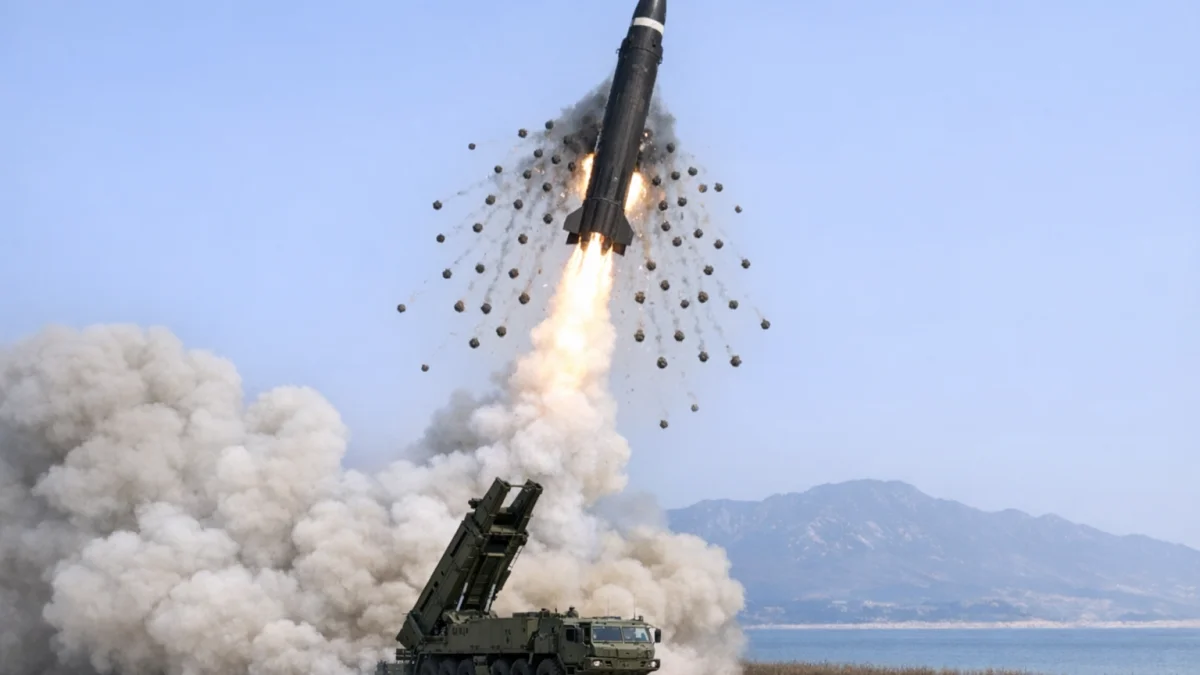
The Korean Central News Agency (KCNA) said the tests, carried out from Monday to Wednesday, included a surface-to-surface tactical ballistic missile known as the Hwasong-11Ka, or Hwasongpho-11 Ka, fitted with a cluster-munition warhead. The agency claimed the warhead demonstrated the ability to “reduce to ashes any target” covering an area of about 6.5 to 7 hectares (roughly 16 to 17 acres).


South Korea’s Joint Chiefs of Staff confirmed that North Korea fired multiple short-range ballistic missiles into the East Sea (Sea of Japan) during the period, including launches detected on Wednesday from the Wonsan area. Details on the exact number of missiles and precise flight paths remained limited in public statements from Seoul.
KCNA reported that the tests aimed to verify the combat effectiveness and destructive power of the cluster warhead system mounted on the nuclear-capable Hwasong-11 series missiles. These missiles are designed for low-altitude, maneuverable flight to evade missile defenses, resembling Russia’s Iskander system.
The tests formed part of a broader series that also involved electromagnetic weapons and other systems, according to KCNA. North Korean leader Kim Jong Un was not mentioned as directly overseeing the latest firings in the available reports.
Cluster munitions disperse multiple smaller bomblets over a wide area, a capability that has drawn international scrutiny due to risks to civilians, though North Korea is not a party to the Convention on Cluster Munitions.
South Korean and U.S. officials have routinely condemned such launches as destabilizing. No immediate comment was available from the United States or South Korea specifically addressing the cluster warhead aspect on Thursday.
The tests occurred amid ongoing regional tensions on the Korean peninsula, where North Korea has accelerated development of tactical nuclear-capable systems in recent years.
As of Thursday, no further missile activity was reported. South Korean military authorities continued monitoring North Korean forces, while diplomats urged restraint to avoid further escalation. Details on the full results of the tests and any technical assessments remained unclear.