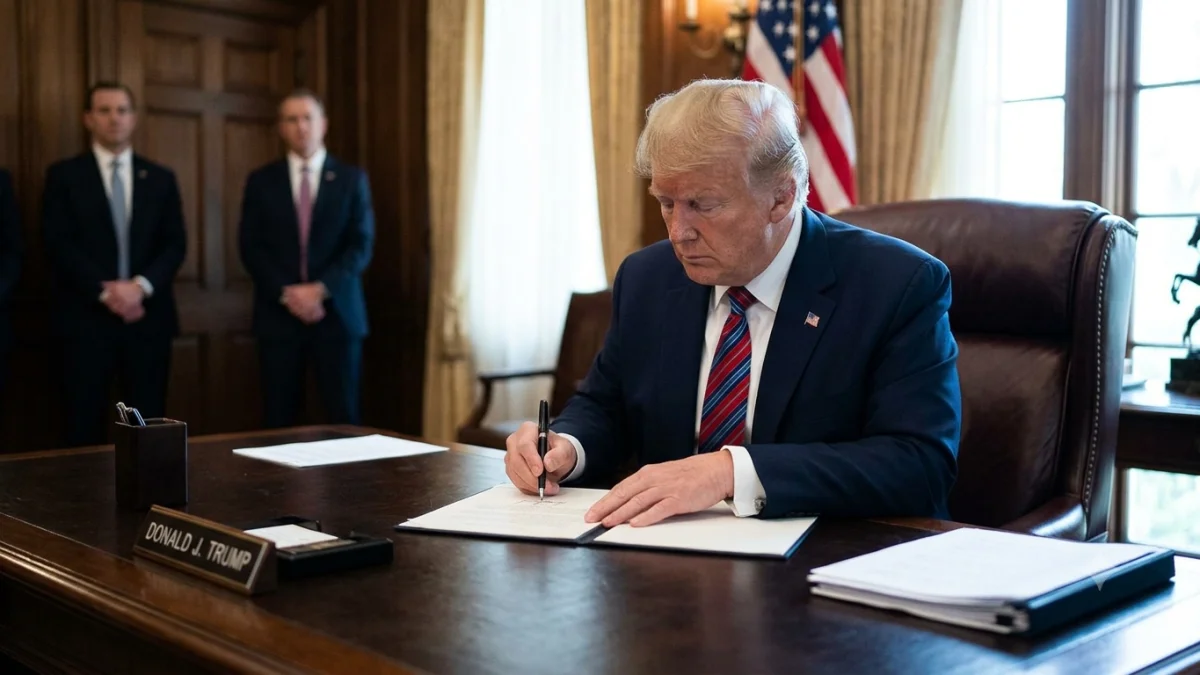


President Donald Trump’s decision to sign two new executive orders restricting birthright citizenship marks a significant shift in strategy after the U.S. Supreme Court rejected his administration’s broader effort to narrow the constitutional guarantee of citizenship under the 14th Amendment. Rather than attempting to revive the sweeping policy struck down in June, the White House is pursuing narrower categories that it argues fall within longstanding legal exceptions, setting the stage for another round of constitutional litigation while seeking to preserve a central element of Trump’s immigration agenda.
The move matters because it illustrates how the administration is adapting after a major judicial setback instead of abandoning the policy objective. The Supreme Court ruled that Trump’s earlier executive order conflicted with the Citizenship Clause of the 14th Amendment, reaffirming the long-established principle that nearly everyone born on U.S. soil is a U.S. citizen. The new executive actions seek to distinguish themselves from that rejected approach by targeting specific categories of parents, including certain foreign government employees, individuals associated with designated foreign terrorist organizations or enemy classifications, and cases involving what the administration characterizes as commercial “birth tourism.”


The administration argues these measures address situations that historically have not been treated as falling fully within the constitutional phrase “subject to the jurisdiction” of the United States. White House officials contend the Supreme Court’s ruling left room for narrower executive action addressing limited exceptions rather than broadly denying citizenship based on parents’ immigration status. A separate executive order directs federal agencies to intensify efforts against birth tourism by increasing visa scrutiny and strengthening enforcement against individuals suspected of traveling to the United States primarily to give birth.
Whether those legal distinctions withstand judicial review remains uncertain. Constitutional scholars and civil rights organizations have argued that the Supreme Court’s decision reaffirmed a broad understanding of birthright citizenship rooted in both the text of the 14th Amendment and more than a century of legal precedent. Critics contend the administration is attempting to accomplish indirectly what the Court already rejected directly, while supporters argue that narrowly defined exceptions involving diplomats, foreign government officials or other limited categories deserve separate constitutional consideration.
The legal debate also reflects a broader constitutional question regarding executive authority. Immigration enforcement has traditionally given presidents substantial discretion over border security, visa policy and removal priorities. Citizenship, however, occupies a different constitutional category because it is expressly addressed in the Constitution itself. That distinction has consistently made executive attempts to redefine birthright citizenship more vulnerable to judicial scrutiny than changes involving immigration enforcement alone.
Politically, the executive orders demonstrate that immigration continues to occupy a central place in Trump’s governing agenda despite adverse court rulings. Restricting birthright citizenship has been one of Trump’s signature policy objectives across multiple campaigns, and renewed action allows the administration to argue it is continuing to pursue that commitment while adapting to judicial constraints. The narrower approach may also seek to strengthen the administration’s position in future litigation by focusing on categories it believes present stronger constitutional arguments than its earlier, more expansive policy.
The emphasis on birth tourism also reflects an effort to frame part of the issue as preventing fraud rather than redefining citizenship more broadly. Federal agencies have previously taken administrative steps to discourage foreign nationals from obtaining visas primarily to give birth in the United States, although the practice has represented a relatively small share of total births. By combining visa enforcement with citizenship-related directives, the administration links immigration enforcement tools that are generally recognized as executive powers with constitutional questions that are likely to receive closer judicial examination.
The practical impact of the orders is likely to depend less on their immediate implementation than on the speed and outcome of expected court challenges. Immigration advocacy organizations and legal experts have indicated that lawsuits are likely to be filed quickly, arguing that the new directives remain inconsistent with the Supreme Court’s interpretation of the Citizenship Clause. Federal judges will likely examine whether the revised orders genuinely address narrow constitutional exceptions or instead represent another attempt to limit birthright citizenship beyond what existing precedent permits.
The dispute also carries implications beyond immigration policy. It highlights the continuing interaction between presidential policymaking and judicial review, particularly when executive actions address constitutional rights rather than statutory authority. The administration’s response to the Supreme Court ruling demonstrates how presidents may seek alternative legal pathways after losing major constitutional cases, while opponents continue to rely on the courts to test the legality of revised policies.
For now, the confirmed position is that the Trump administration has replaced its broader birthright citizenship initiative with more narrowly targeted executive orders focused on specified categories and on birth tourism enforcement. The administration maintains that the measures are consistent with constitutional limits established by the Supreme Court, while opponents argue they remain incompatible with the 14th Amendment. The next phase of the dispute will depend on forthcoming federal court challenges, judicial interpretation of the revised orders, and any subsequent guidance issued by the agencies responsible for implementing the new directives.