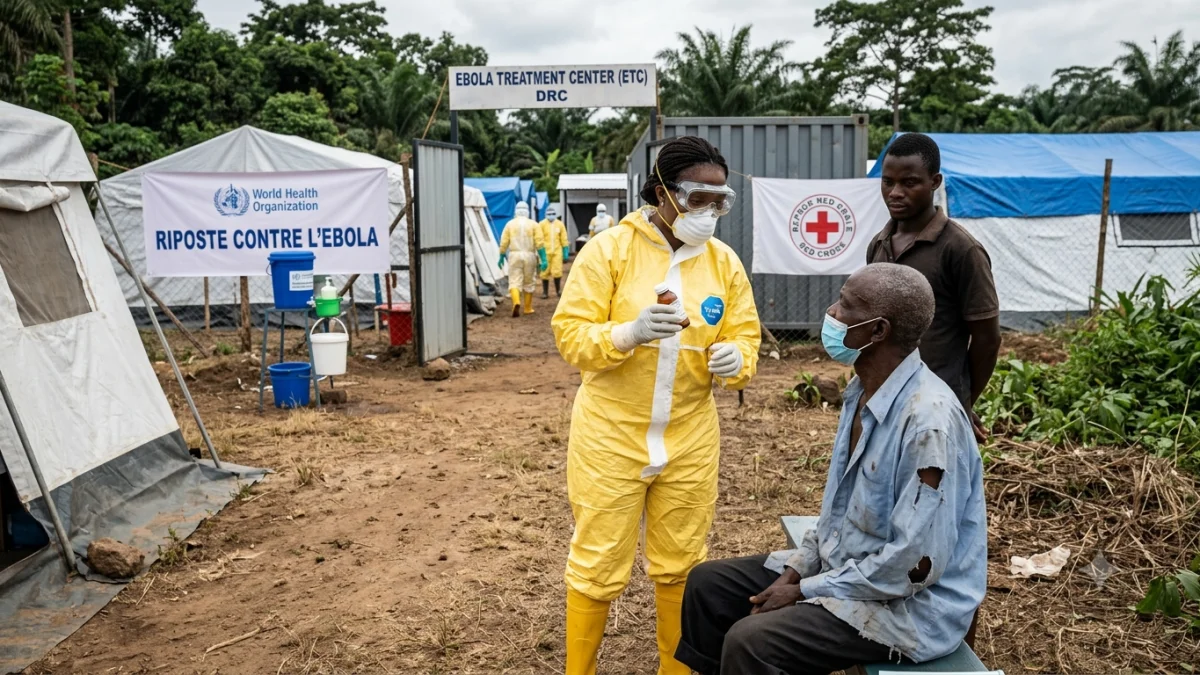


KINSHASA—The World Health Organization on Thursday appealed for stronger international support to contain the rapidly expanding Ebola outbreak in the Democratic Republic of Congo, warning that the response is failing to keep pace with transmission as health authorities confront funding shortages, insecurity and the absence of an approved vaccine or treatment for the virus strain involved.
WHO Director-General Tedros Adhanom Ghebreyesus said the outbreak, centered in the eastern province of Ituri, required a significantly larger and better coordinated response to prevent further spread. Speaking during a visit to affected areas, Tedros said international solidarity was essential to strengthen surveillance, laboratory testing, patient care and community engagement.


According to WHO and Congolese health authorities, the outbreak has grown into the fastest-spreading Ebola epidemic on record. As of early August, more than 3,800 confirmed cases and over 1,700 deaths had been reported, although WHO has warned the true toll could be substantially higher because many infections are not detected or reported promptly.
Health officials said the outbreak is caused by the Bundibugyo strain of Ebola, for which there is currently no approved vaccine or specific treatment. The absence of established medical countermeasures has complicated efforts to contain transmission, leaving supportive care, rapid diagnosis, contact tracing and infection prevention as the principal tools available to health workers.
WHO and partner organizations said response efforts have also been hindered by armed conflict, population displacement, delayed detection of infections, community mistrust and strikes by some health workers over unpaid wages. Officials said many new infections are occurring outside known transmission chains, making contact tracing increasingly difficult.
International partners have begun increasing assistance. The United States announced an additional $242 million for the Ebola response, bringing its total support for outbreak control and related humanitarian assistance to more than $500 million, according to the U.S. State Department. WHO welcomed the commitment while emphasizing that broader donor support remains necessary to sustain operations.
WHO continues to support the Congolese government through the deployment of emergency specialists, medical supplies, surveillance teams and community outreach programs while working with regional partners to strengthen preparedness in neighboring countries. The agency has also supported research into candidate vaccines and treatments for the Bundibugyo virus, although none has yet been approved for widespread use.
The organization said containing the outbreak will depend on sustained international financing, stronger protection for health workers and continued cooperation with affected communities as response operations expand across eastern Congo.