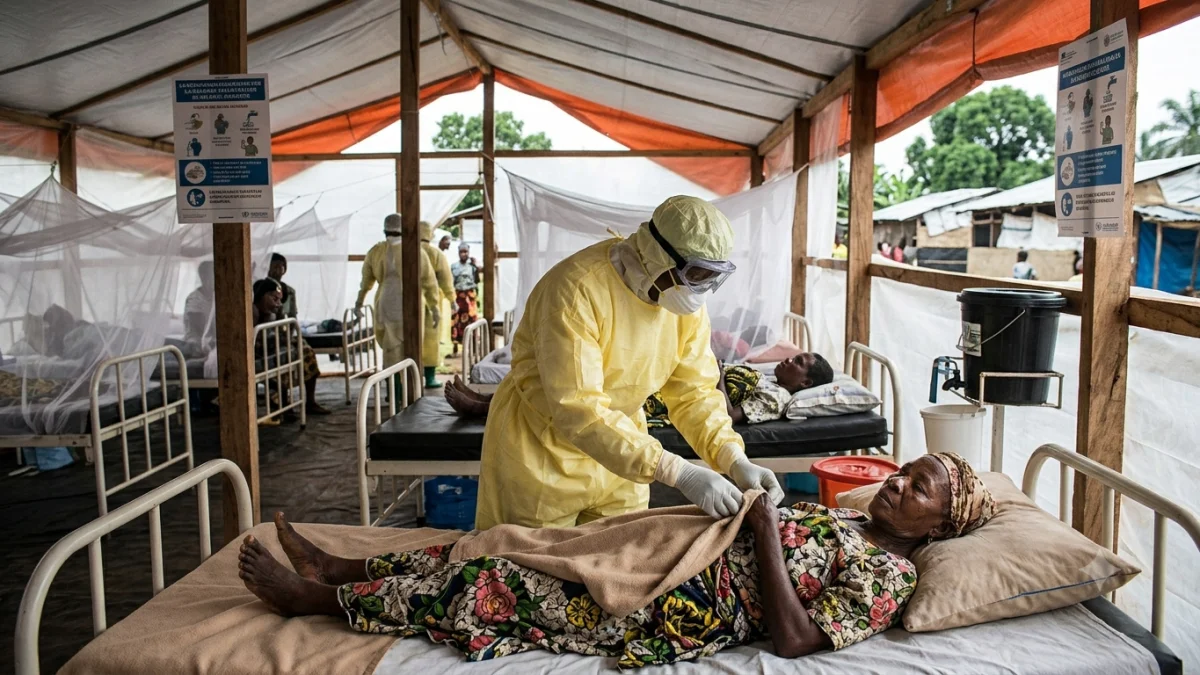


At the Ebola treatment centre in Bunia, frontline workers move through routines that have become both familiar and increasingly dangerous: disinfecting rooms after patients leave, putting on and removing protective equipment with painstaking care, and trying to reassure frightened families while keeping a deadly virus at bay. The work has intensified as the Democratic Republic of Congo confronts what health authorities say is the country's largest Ebola outbreak and the second-largest ever recorded worldwide.
For many responders, the challenge extends well beyond the virus itself. Some have continued reporting for duty despite months of delayed salaries, shortages of supplies and the constant risk of infection. Their experience reflects the strain on a public health response that international officials say has struggled to keep pace with an epidemic spreading faster than surveillance systems can fully track.


The outbreak, officially declared on May 15, was likely circulating for months before it was detected, according to health authorities and the World Health Organization. By early August, Congo had reported more than 4,000 confirmed infections and 1,850 deaths across five provinces, while experts warned that the true number of cases was probably much higher because many infections were never identified or tested. The epidemic is caused by the Bundibugyo strain of Ebola, for which there are no approved vaccines or specific treatments, making traditional public health measures—rapid diagnosis, isolation, contact tracing and safe burials—even more critical.
Those measures have become increasingly difficult to sustain.
Eastern Congo has long battled overlapping crises, including armed conflict, mass displacement and fragile healthcare infrastructure. WHO officials have repeatedly said insecurity, population movement and weakened health services continue to fuel transmission, while treatment centres in some areas have approached capacity.
The burden falls heavily on healthcare workers, many of whom encounter Ebola before anyone realizes a patient is infected. Early symptoms often resemble malaria or other common illnesses, exposing nurses and clinicians in ordinary hospitals and clinics before protective protocols are activated. Health officials have reported infections among dozens of healthcare workers during the outbreak, underscoring the occupational hazards faced by staff throughout the response.
Among those continuing to work is Wiza Bondele, a sanitation worker at an Ebola treatment centre in Bunia. Bondele told the Associated Press he remained committed to protecting patients and colleagues even after going unpaid for months. His situation mirrors that of many responders whose promised compensation has been delayed amid administrative and logistical problems acknowledged by Congolese authorities. Officials have said they are shifting to mobile money payments in an effort to resolve the backlog.
The financial uncertainty has contributed to strikes and protests among some Ebola responders, adding another obstacle to containment efforts. Yet many workers have continued returning to treatment centres despite personal hardship, reflecting both professional commitment and recognition of the consequences if response activities slow further.
Containment efforts have also been complicated by mistrust in some communities. Previous Ebola outbreaks in eastern Congo demonstrated that fear, misinformation and conflict can undermine contact tracing and safe burial practices. During the current epidemic, health officials have described incidents in which response teams were unable to monitor contacts after local resistance prevented access to affected communities. Without timely identification of exposed individuals, chains of transmission become harder to interrupt.
International health officials increasingly worry that many infections are spreading outside known transmission networks. WHO emergencies chief Dr. Chikwe Ihekweazu said modelling suggests the actual number of infections could be two to four times the official count. He also noted that a large proportion of new patients were not previously identified through contact tracing, an indication that substantial community transmission is occurring beyond the reach of surveillance systems.
Authorities continue trying to prevent the virus from reaching densely populated urban centres. Earlier this week, Congolese officials intercepted a passenger boat travelling toward Kinshasa after a traveller died from a suspected Ebola infection. More than 300 passengers underwent health screening, seven symptomatic travellers tested negative for Ebola, and the vessel was disinfected before continuing its journey. Officials subsequently ordered enhanced screening for boats arriving in the capital, reflecting concern that Congo's extensive river transport network could accelerate geographic spread if undetected cases travel downstream.
The outbreak has also crossed international borders. Uganda has reported imported cases linked to Congo, prompting heightened surveillance and reinforcing WHO's assessment that regional transmission remains a significant risk. Even so, public health experts emphasize that rapid detection and coordinated response can still reduce wider spread when surveillance systems function effectively.
For responders in Bunia and other affected communities, however, the crisis is measured less by epidemiological models than by daily routines that continue without certainty about when the outbreak will peak. Every patient safely isolated, every clinic disinfected and every suspected infection investigated represents another opportunity to slow a virus that has repeatedly outpaced expectations.
As Congo's case count passes another grim milestone, the work of those on the front lines remains both indispensable and precarious. Their efforts continue under conditions shaped not only by a dangerous pathogen but also by conflict, resource shortages and public mistrust—factors that health officials say will determine whether one of the world's largest Ebola outbreaks can finally be brought under control.