

For evacuees returning to communities around Spokane, Washington, the end of an evacuation order does not necessarily mean the end of the wildfire’s health effects. After more than a week away, residents were beginning to return on Sunday as firefighters worked through hot spots in neighborhoods damaged by three fires that had burned about 10,000 acres and destroyed or heavily damaged more than 900 homes. At the height of the fires, about 64,000 people were under evacuation orders.
For some, the next stage is recovery. For public health officials, it is also another period of exposure — to lingering smoke, ash and contaminated debris, and to the uncertainty of living near fires that have not fully disappeared.


“People have been out of their homes for over a week now. That's a long time,” Spokane County Sheriff John Nowels said Sunday. He added that many people did not know whether their homes were still standing or whether they would be safe to occupy.
The distinction matters because wildfire health risks do not stop when flames are contained.
The U.S. Environmental Protection Agency says wildfire smoke can travel hundreds or even thousands of miles. Fine particulate matter, known as PM2.5, is the pollutant in smoke of greatest health concern. Short-term exposure can cause coughing, wheezing and difficulty breathing and can worsen asthma and other lung diseases. It can also aggravate cardiovascular conditions and has been associated with emergency department visits, hospital admissions and, in some circumstances, more serious outcomes.
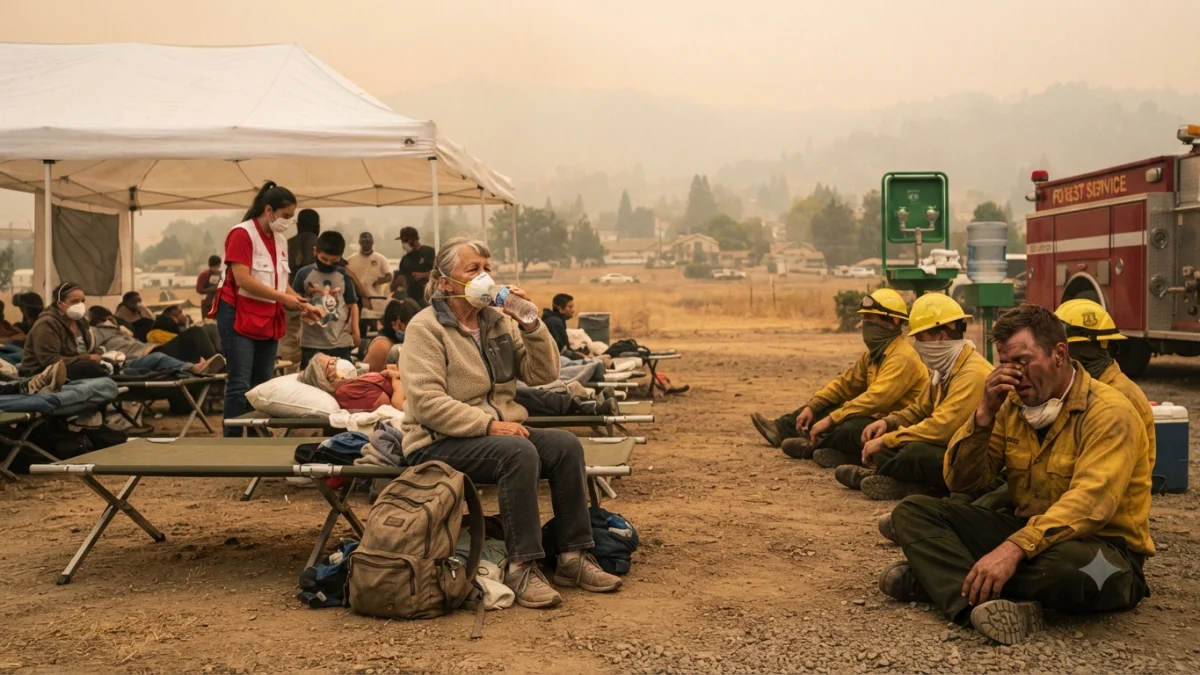
Children, older adults, pregnant women and people with heart or lung disease face greater risks. Outdoor workers, including firefighters, can also experience greater exposure because of the amount of time they spend in smoky conditions.
That makes the western fire season a health problem as well as an emergency-management challenge.
In Spokane, crews were still working in the remains of the hardest-hit neighborhoods on Sunday, extinguishing hot spots and restricting access to areas where authorities had not yet determined that conditions were safe. Elsewhere, roads reopened and evacuation orders were lifted, allowing displaced residents to begin returning. Nearly 1,700 firefighters were involved in containing the three fires.
For those crews, exposure is not limited to the smoke they breathe while fighting flames.
In June, the U.S. Wildland Fire Service announced new measures aimed at reducing firefighters’ exposure to smoke and other contaminants. Federal wildland firefighters were authorized to use N95 respirators on the fireline after completing training, while agencies expanded access to showers, gear cleaning and clean-air recovery periods. The service also introduced standardized decontamination practices and paid firefighters for time spent carrying them out.
The changes reflect a growing understanding that the hazards of firefighting can persist after a crew leaves the immediate fire environment.
The National Institute for Occupational Safety and Health says firefighters can encounter hundreds of chemicals at fire incidents. Some are generated when materials burn, including benzene, formaldehyde and polycyclic aromatic hydrocarbons. Others, including asbestos, can be released when buildings are damaged or destroyed. Those contaminants can remain on protective clothing and equipment and can be transferred to firefighters’ skin, vehicles and stations.
NIOSH recommends cleaning gear and skin at the scene, carefully removing protective equipment, bagging contaminated gear and keeping it away from living and office areas. The agency says some contaminants can enter the body through inhalation, ingestion or skin absorption.
The longer-term questions are more difficult.
In February, the Centers for Disease Control and Prevention said more than 40,000 firefighters had joined its National Firefighter Registry for Cancer, created to study occupational cancer risks and improve prevention. The agency says firefighters are exposed to smoke and toxic chemicals that can increase their risk of certain cancers, while the registry collects work histories and links them with cancer records to improve understanding of those risks.
Wildland firefighters face a particularly complicated exposure environment because conditions can change rapidly. NIOSH says smoke composition varies with fire behavior, weather, vegetation and whether structures or other manufactured materials are burning. The agency also says scientists do not yet fully understand the health effects of repeated, high-concentration exposure to wildland fire smoke over long periods.
For evacuees, the health burden can be less visible but similarly persistent.
Leaving home interrupts medication routines, access to medical equipment and normal sleeping and eating arrangements. Washington's health department advises residents with special medical needs to plan for adequate medication and supplies during an evacuation and warns that people with heart and lung diseases need to be especially careful around wood smoke.
And returning home can introduce a new set of hazards. Federal health guidance advises people not to return until authorities say it is safe. Smoke and ash can remain after flames disappear, while damaged buildings and debris may contain hazardous substances.
The broader western fire season has made those concerns increasingly difficult to contain geographically. While Spokane firefighters worked to stabilize their fires, a separate blaze in British Columbia had burned more than 10,300 hectares and prompted the evacuation of about 18,000 people. Heavy smoke and turbulence were also complicating aerial firefighting operations there, according to Canadian officials.
The fires therefore leave two populations facing different versions of the same problem: evacuees trying to determine when it is safe to go home, and firefighters trying to limit the health consequences of spending days in the conditions that make that return possible.
In Spokane, authorities have begun reopening communities beyond the immediate fire footprint. But in the most heavily damaged areas, residents remain barred while crews deal with hot spots and officials assess safety.
The flames may be receding. The work of protecting health — for the people going home and those who made it possible for them to return — continues long after the evacuation order is lifted.