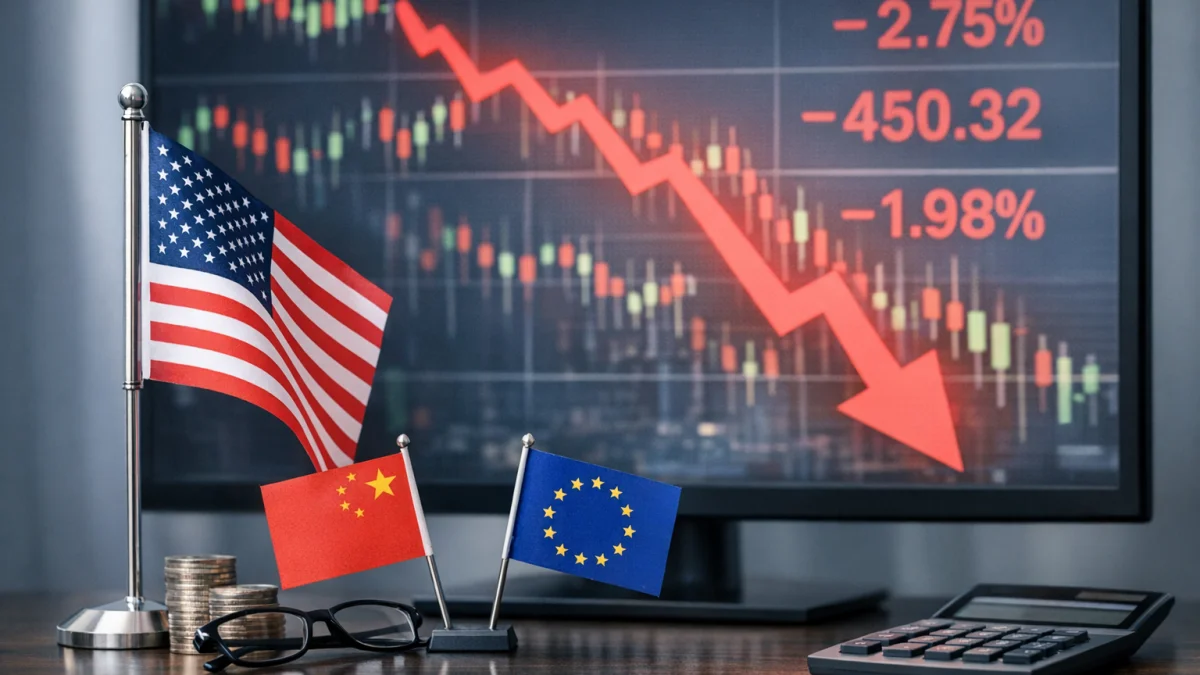


NEW YORK — Global stock markets fell sharply on Thursday after the Trump administration announced new tariff measures aimed at addressing ongoing trade imbalances, traders and analysts said.
Major U.S. indexes declined as investors reacted to the latest developments in U.S. trade policy. The S&P 500 dropped more than 1%, while the Dow Jones Industrial Average and Nasdaq Composite also posted losses, according to preliminary market data. European and Asian markets closed lower earlier in the session amid similar concerns over potential disruptions to global supply chains.


The announcement follows a series of tariff actions implemented throughout 2025 and early 2026, including a temporary 10% ad valorem duty on most imports under Section 122 of the Trade Expansion Act of 1962, which took effect in February 2026. White House officials have described the measures as part of efforts to rectify persistent U.S. goods trade deficits and encourage reciprocal trade practices.
Administration spokespeople said the new announcements build on prior reciprocal tariff initiatives first outlined in 2025, targeting countries with high barriers to U.S. exports. Details on the exact scope, timing and affected sectors of the latest measures were not immediately fully specified in public statements.
“These actions are designed to protect American workers and strengthen our economy by addressing unfair trade practices,” a White House official said in a statement released ahead of the market open.
Major trading partners have expressed concerns. Officials in the European Union and China have previously indicated they would consider retaliatory measures if U.S. tariffs escalate further, though specific responses to Thursday’s announcement were not immediately available. Trade ministers from several countries have called for negotiations to avoid broader disruptions.
The declines came against the backdrop of other economic pressures, including elevated oil prices linked to disruptions in the Strait of Hormuz amid ongoing U.S. military operations in Iran. Energy stocks showed mixed performance, with some companies benefiting from higher crude prices while broader industrials and importers faced selling pressure.
Economists at major banks noted that repeated tariff adjustments have contributed to uncertainty in global trade flows. Some sectors, including semiconductors, automobiles and consumer goods, have been particularly sensitive to policy shifts over the past year, with companies reporting higher input costs or supply chain adjustments.
U.S. Treasury yields edged lower as investors sought safer assets, while the dollar weakened against several major currencies. Gold prices rose modestly as a traditional hedge against trade and geopolitical risks.
As of late afternoon trading in New York, losses moderated slightly from session lows but remained broad-based across sectors. Volume was elevated as traders repositioned portfolios.
No immediate comment was available from the Office of the U.S. Trade Representative on potential exemptions or timelines for implementation of the new measures. Market participants said they were awaiting further clarification from officials in coming days on the precise impact.
Trading is expected to remain volatile in the near term as investors assess the latest policy developments alongside corporate earnings and other economic data.