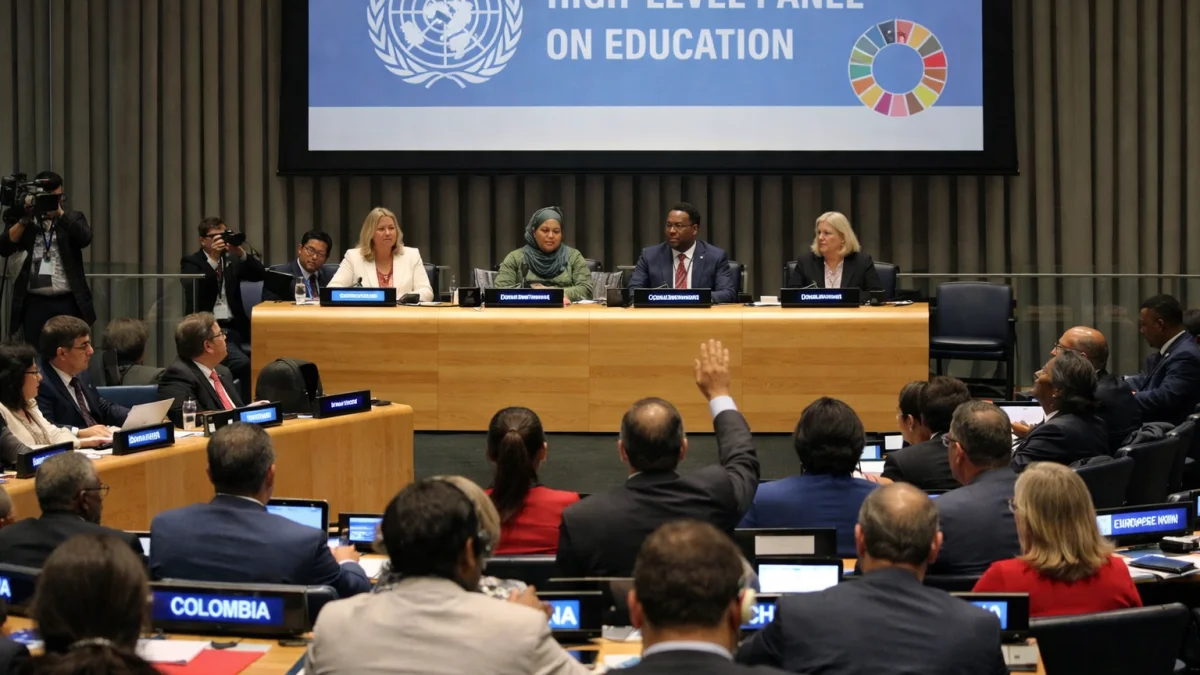


NEW YORK — Governments, United Nations agencies and international partners on Tuesday reviewed global progress toward achieving the Sustainable Development Goal on quality education, warning that faster action and stronger financing will be needed if the world is to meet its 2030 commitments.
Education featured prominently during discussions held alongside the final day of the 2026 High-level Political Forum on Sustainable Development (HLPF) at U.N. headquarters, where ministers and senior officials assessed implementation of the 2030 Agenda and broader efforts to accelerate progress across the Sustainable Development Goals. The forum brought together representatives from governments, civil society, international organizations and development institutions to evaluate achievements and remaining challenges.


Participants highlighted Sustainable Development Goal 4, which calls for inclusive and equitable quality education and lifelong learning opportunities for all, as a foundation for progress across multiple development objectives, including poverty reduction, health, gender equality and economic growth. Officials said disruptions caused by conflict, climate-related disasters, economic pressures and widening fiscal constraints continue to affect education systems in many countries.
U.N. Secretary-General António Guterres told the ministerial segment of the forum that countries had achieved measurable gains in several development areas over the past decade but stressed that progress remained uneven and required greater political commitment. He said voluntary national reviews presented by member states demonstrated that advances were possible where governments invested in people and partnerships.
Separately, UNESCO used a global education meeting in Paris last week to warn that financing shortfalls remain one of the largest obstacles to achieving SDG 4. The agency said 113 countries now spend more servicing public debt than on education and projected that international aid for education could decline by as much as 30% between 2023 and 2027 unless funding trends improve. UNESCO called for broader use of debt-for-education swaps and other innovative financing mechanisms to help countries strengthen schools, teacher training and student support.
The SDG 4-Education 2030 High-Level Steering Committee has identified resilient and well-financed education systems as priorities for 2026-2027, saying coordinated international action is needed to accelerate implementation before the 2030 deadline. The committee, co-chaired by South African President Cyril Ramaphosa and UNESCO Director-General Khaled El-Enany, said its work would focus on supporting countries in translating global commitments into national reforms.
The High-level Political Forum is scheduled to conclude with the adoption of a ministerial declaration intended to provide policy guidance for member states as they continue efforts to advance the Sustainable Development Goals before 2030.