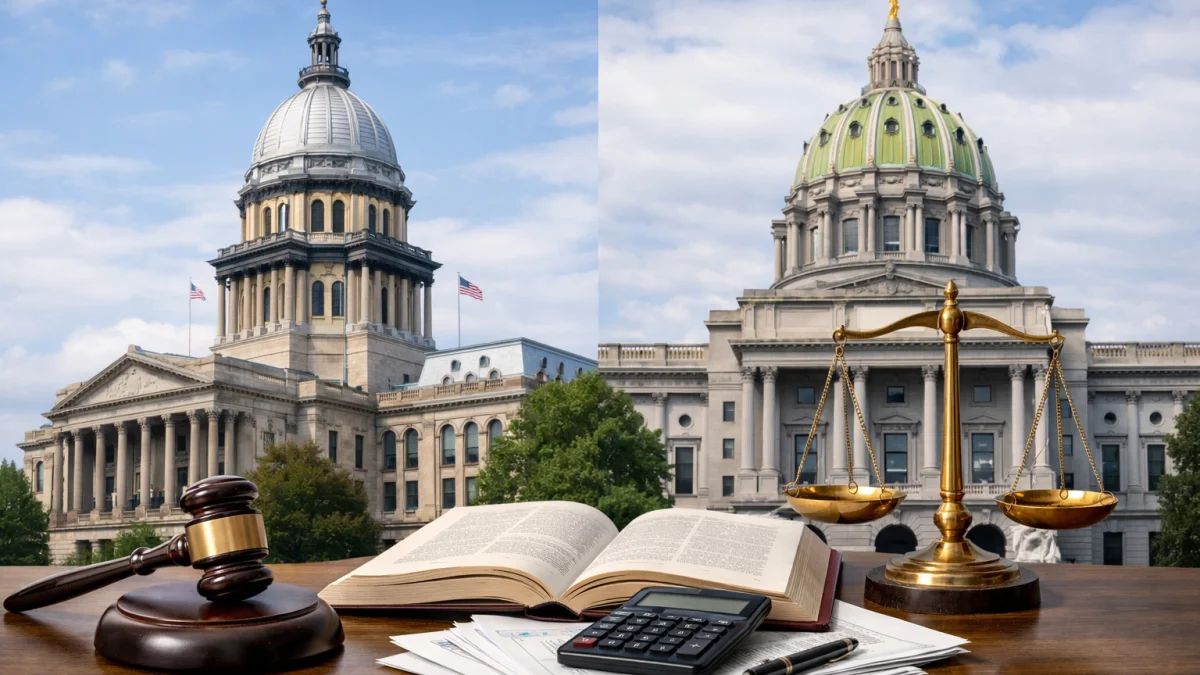


SPRINGFIELD, Ill. — Illinois and Pennsylvania have moved to further separate portions of their state tax systems from recent federal tax law changes, reflecting a broader trend among states seeking to limit the fiscal effects of federal tax provisions, according to state legislation, tax policy organizations and tax advisers.
Illinois enacted legislation in late 2025 that decouples parts of its tax code from certain provisions of the federal Internal Revenue Code that would otherwise have flowed automatically into state law under the state’s rolling conformity system. State officials said the changes were intended to protect state revenues and address budgetary concerns tied to federal tax revisions.


Under the Illinois measure, signed by Governor J.B. Pritzker, the state decoupled from a federal provision allowing full deductions for certain qualified production property investments. Illinois also modified the treatment of some international corporate income provisions. State officials said the changes would help reduce projected revenue losses associated with federal tax legislation.
Pennsylvania, which already operates under a selective conformity system rather than broad adoption of the federal tax code, has also taken steps to limit the impact of certain federal tax provisions on state revenues, according to tax policy analysts and state tax advisers. Pennsylvania’s approach generally requires lawmakers to determine individually which federal provisions should be incorporated into state law.
“The state formally decoupled” from specific federal provisions to mitigate revenue impacts, the Civic Federation said in an analysis of Illinois’ legislation.
The actions come as states across the country assess the consequences of recent federal tax changes. The National Conference of State Legislatures reported in May that several states have adopted measures to limit revenue losses stemming from federal tax legislation, while others have reviewed conformity rules during their 2026 legislative sessions.
Tax policy experts note that conformity with federal law can simplify compliance and administration because many state tax systems use federal income calculations as a starting point. At the same time, states may choose to decouple from federal provisions when lawmakers determine that automatic conformity could significantly affect state revenues.
Business groups and tax professionals have said that differing state responses may increase compliance complexity for companies operating in multiple jurisdictions. Some state officials, however, have argued that selective conformity allows states to maintain greater control over their tax bases and budget planning.
As of June 12, Illinois’ conformity changes were in effect, while Pennsylvania continued to apply its selective conformity framework. State officials had not announced major additional conformity legislation on Friday, and details of any further proposals remained unclear.