BANGKOK — Health authorities and meteorological agencies in multiple countries on Sunday urged the public to take precautions against ultraviolet (UV) radiation exposure as peak summer conditions increase UV index levels across large parts of the Northern Hemisphere.
Officials from national public health agencies, including the UK Health Security Agency and other government health bodies cited in seasonal guidance, advised residents to reduce direct sun exposure during midday hours, use sunscreen, and wear protective clothing as UV levels typically peak between late morning and mid-afternoon. The guidance comes as weather forecasts in several regions indicate sustained high temperatures and elevated UV readings associated with summer conditions.
Public health agencies emphasize that UV radiation can cause skin damage even on cloudy days and that cumulative exposure increases risks of sunburn, premature skin aging, and skin cancer. The US Environmental Protection Agency notes that protective measures are recommended when the UV Index reaches 3 or higher, including seeking shade and applying broad-spectrum sunscreen.
The UK Health Security Agency and partner health services recommend a combination of protective steps known in public health messaging as “sun safety,” including staying in shade during peak UV hours, wearing protective clothing, using sunglasses with UV protection, and applying sunscreen with a sun protection factor of at least 30.
“Everyone is at risk of sun damage,” the Public Health Agency of Northern Ireland said in seasonal guidance, adding that children, people with fair skin, outdoor workers, and individuals with a family history of skin cancer face higher risk and should take additional precautions.
Health authorities also stress correct sunscreen application. Guidance from public health agencies recommends using adequate amounts of sunscreen and reapplying regularly, particularly after swimming or sweating, to maintain protection.
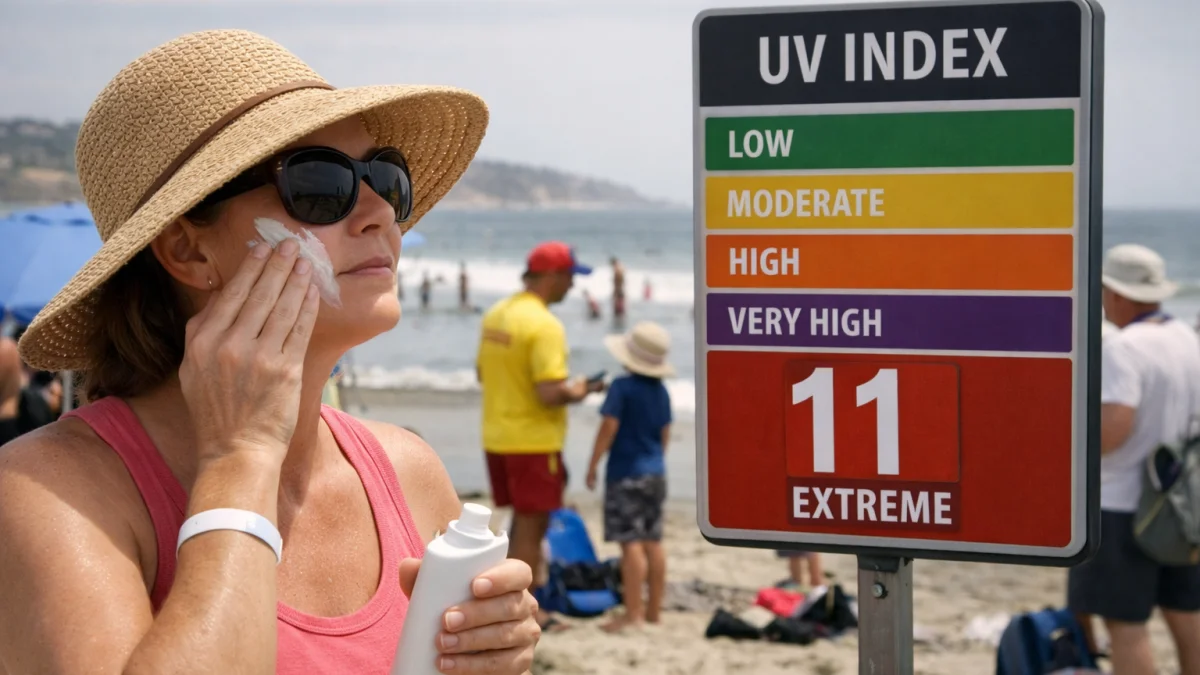
The UV Index, used internationally in weather forecasting, is a standardized measure of solar ultraviolet radiation intensity. Levels are typically categorized from low to extreme, with higher readings indicating greater risk of skin and eye damage during outdoor exposure.
In updated seasonal advice issued earlier this year, public health agencies reiterated that sun protection should be used consistently during periods of elevated UV exposure, particularly during late spring and summer when UV levels are highest in many regions.
As of Sunday, meteorological services continue to monitor UV forecasts and temperature conditions, with public health authorities advising residents to follow daily UV Index updates and apply protective measures when spending extended time outdoors.