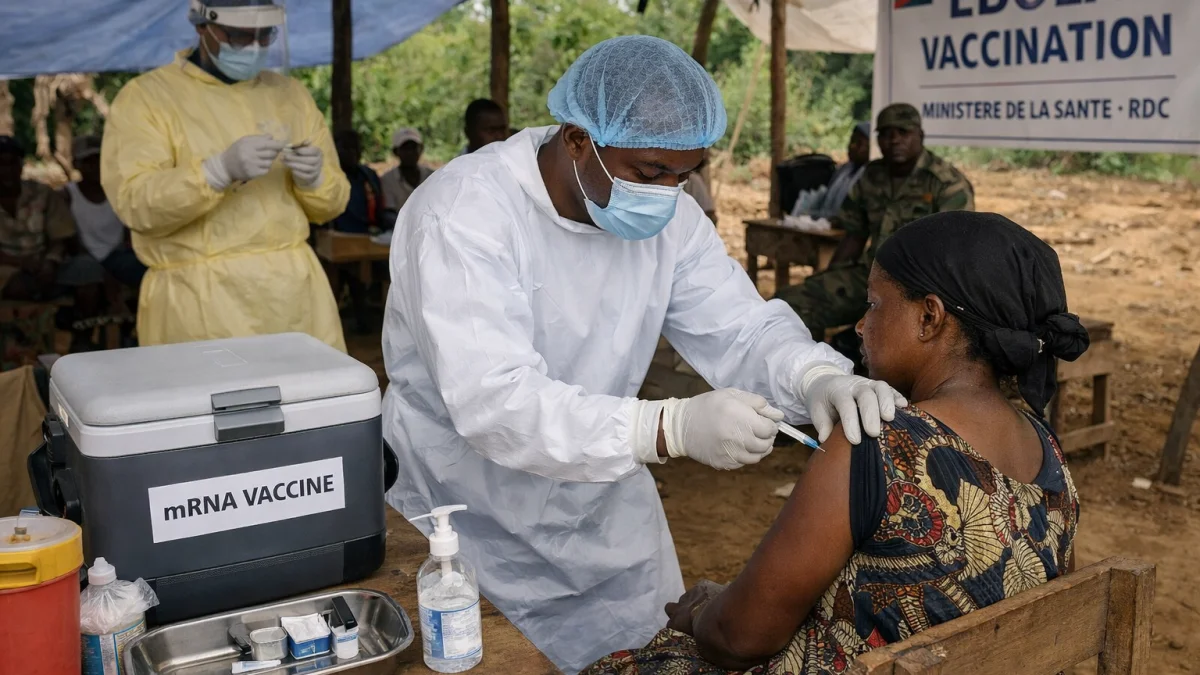


The race to develop an mRNA vaccine against the Bundibugyo strain of Ebola has accelerated as health authorities confront an outbreak in the Democratic Republic of Congo (DRC) where existing Ebola vaccine tools do not provide a targeted solution. International vaccine developers, including Moderna, are moving to advance candidates for a virus strain that has historically received limited research attention because outbreaks have been rare compared with the more common Zaire Ebola strain.
The significance of the effort is that it highlights a remaining gap in global epidemic preparedness: while the world has a licensed vaccine for Zaire Ebola virus disease, there is no licensed vaccine or specific approved treatment for Bundibugyo virus disease. The current outbreak has tested whether newer vaccine platforms, particularly mRNA technology, can shorten the timeline between identifying a threat and developing a potential countermeasure.


The DRC outbreak was confirmed in May 2026 after laboratory testing identified Bundibugyo virus in Ituri Province. The World Health Organization (WHO) reported sustained transmission in the DRC, with cases also linked to Uganda, and classified the event as a public health emergency requiring international coordination. WHO said the outbreak presents additional challenges because Bundibugyo differs from the Ebola strain for which existing vaccine infrastructure was built.
Unlike the Zaire Ebola outbreaks that drove development of the widely used Ervebo Ebola vaccine, Bundibugyo Ebola has remained without a licensed preventive tool. The distinction is scientifically important because Ebola is not a single uniform target; different viral species can require separate vaccine approaches. WHO has noted that available Ebola vaccination strategies are designed for Ebola virus disease caused by the Zaire species and do not represent a licensed solution for Bundibugyo.
The mRNA approach has become central to the emergency response because the platform can be adapted more rapidly than some traditional vaccine technologies. The Coalition for Epidemic Preparedness Innovations (CEPI) announced support for accelerating several Bundibugyo vaccine candidates, including an mRNA candidate from Moderna, alongside programs led by other developers. The funding is intended to support early development, clinical evaluation and manufacturing preparation rather than provide an immediately deployable vaccine.
For Moderna and other developers, the challenge is not only scientific but operational. Vaccine candidates must still demonstrate safety and immune responses in human testing before they can advance toward wider trials or emergency use. The speed of mRNA development during the COVID-19 pandemic increased confidence in the platform, but experts and public health agencies continue to emphasize that rapid development does not remove the need for clinical evidence.
The outbreak also exposes broader weaknesses in global vaccine preparedness for lower-frequency pathogens. The international health system has historically focused resources on diseases with frequent outbreaks or large populations at risk. Bundibugyo Ebola illustrates the difficulty of maintaining vaccine pipelines for threats that may appear sporadically but can become severe when transmission occurs in regions with limited health infrastructure.
The public health response is occurring alongside major logistical challenges in eastern DRC, including insecurity, difficult access and the need to expand surveillance, contact tracing and treatment capacity. WHO has said that controlling the outbreak requires strengthening traditional outbreak measures, including testing, isolation, infection prevention and community engagement, while vaccine research continues.
The vaccine race therefore represents both an emergency response and a test of a new model for outbreak preparedness: maintaining adaptable platforms that can be rapidly redirected toward emerging pathogens. However, the current confirmed situation remains that Bundibugyo Ebola has no approved vaccine, and candidate programs are still in development. Health authorities are monitoring case trends, clinical trial progress, manufacturing readiness and whether vaccine candidates can move quickly enough to contribute to outbreak control efforts.