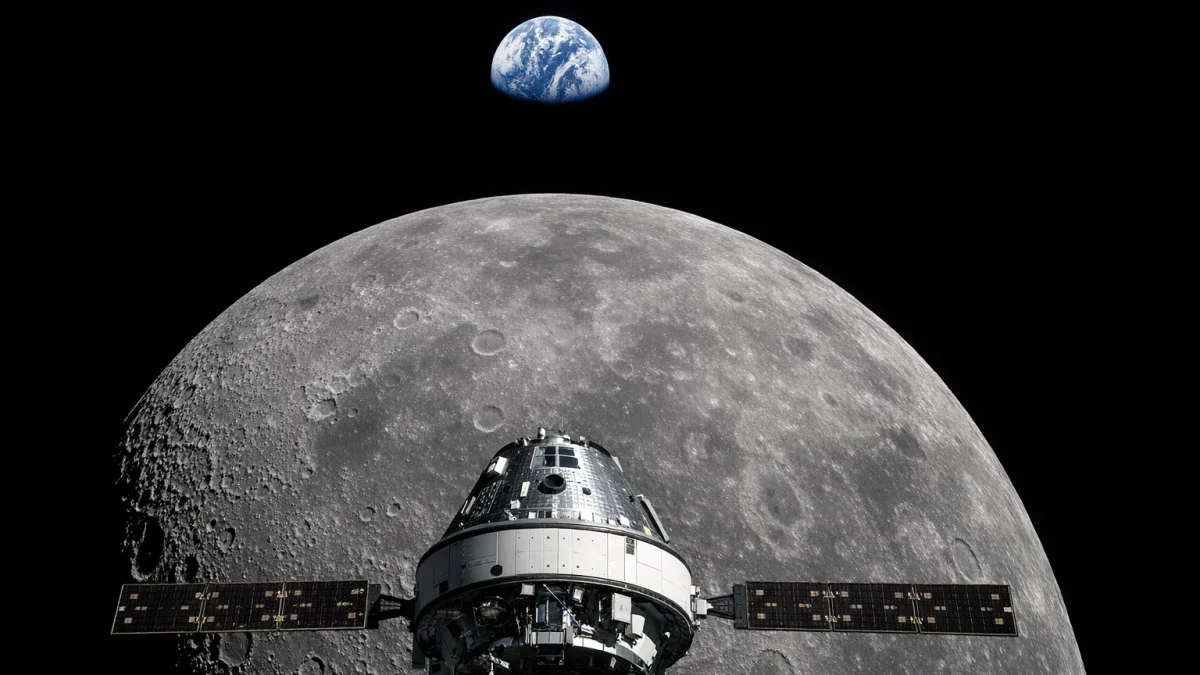


WASHINGTON — NASA released images Tuesday captured by the Artemis II crew during their flyby of the far side of the Moon, showing previously unseen lunar terrain and a total solar eclipse viewed from space.
The four astronauts aboard the Orion spacecraft — NASA astronauts Reid Wiseman, Victor Glover and Christina Koch, and Canadian Space Agency astronaut Jeremy Hansen — took the photographs on Monday while passing behind the Moon, NASA said. The images include views of the lunar far side, an Earthset with the planet appearing to set behind the cratered horizon, and the Moon fully eclipsing the Sun.


The release came a day after the crew completed the lunar flyby portion of the approximately 10-day test flight, which launched on April 1 from Kennedy Space Center in Florida. During the flyby, the spacecraft passed roughly 4,000 miles above the lunar surface and the crew traveled farther from Earth than any humans in history, breaking the record set by Apollo 13 in 1970, according to NASA officials.
The mission marks the first time astronauts have flown around the Moon since the Apollo era more than 50 years ago. While behind the Moon, the crew experienced a planned communications blackout of about 40 minutes as the spacecraft lost line-of-sight with Earth.
One image released by NASA shows the Moon as a dark orb backlit by the Sun during the total solar eclipse observed from the Orion spacecraft. Another captures a crescent Earth setting on the Moon’s limb, with the planet’s blue hues and white clouds visible against the lunar surface. Additional photographs depict detailed cratered landscapes on the far side, including features such as terraced crater edges and central peaks.
NASA posted the images on its website and shared them via official channels on Tuesday. The agency described the photographs as providing new views of regions no humans had previously seen up close from crewed spacecraft.
“These images represent humanity’s return to the vicinity of the Moon,” a NASA release stated, without providing further details on specific scientific findings from the visuals.
The Artemis II mission is a crewed test flight intended to verify Orion’s systems in deep space ahead of future Artemis landings. The spacecraft is now on its return journey to Earth, with splashdown scheduled for Friday off the coast of San Diego, NASA said.
Mission officials have held daily briefings from Johnson Space Center in Houston to provide updates. No immediate issues with the spacecraft were reported following the flyby.
The crew is expected to continue downlinking additional images and data as the mission progresses toward re-entry. Details on the full set of photographs and any preliminary scientific analysis remain under review by NASA teams.