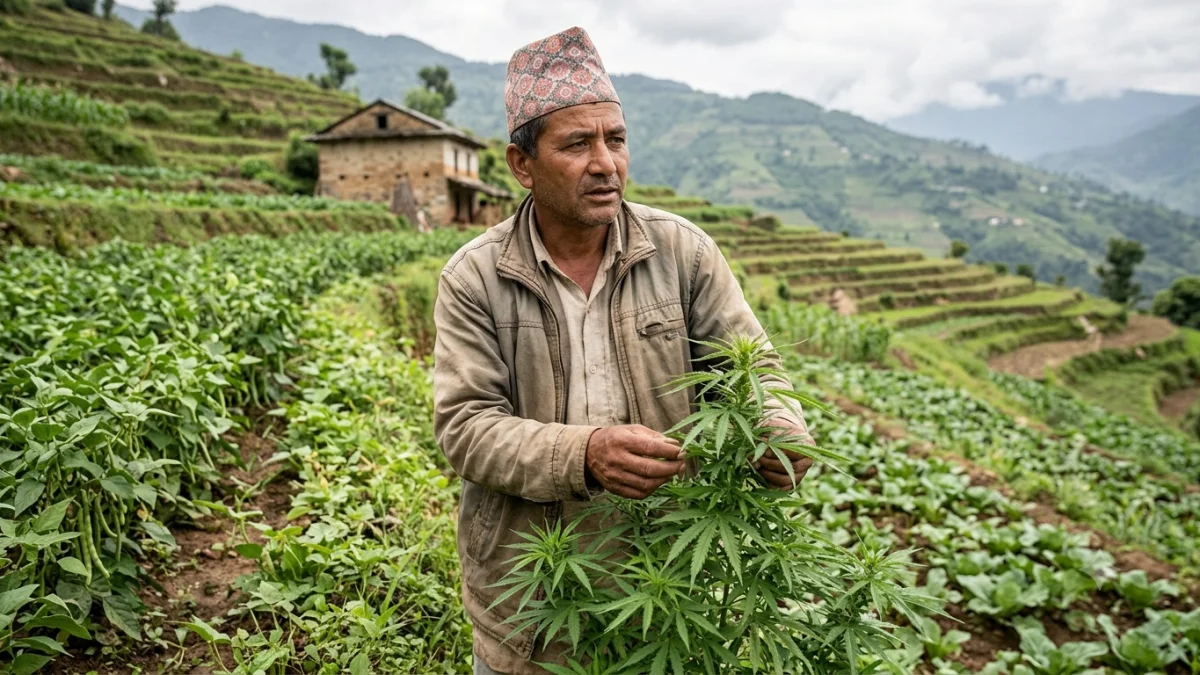


In Nepal's Gandaki Province, where cannabis has long grown wild on hillsides and in fields despite decades of prohibition, farmers are confronting an unfamiliar question: how to prepare for a legal market that exists locally but remains prohibited under national law.
The province this week became the first in Nepal to authorize the licensed cultivation and medical use of cannabis, a landmark shift that supporters say could create new opportunities for rural communities while placing strict limits on who may grow the crop and under what conditions. The provincial law took effect after receiving formal approval from the province's chief, even as Nepal's national ban on cannabis cultivation, possession and distribution remains in force.


For farmers, the legislation offers possibility rather than certainty.
Under the new framework, growers must first obtain official authorization from provincial authorities, and cultivation will be subject to close monitoring. The measure is limited to medical and industrial purposes, leaving recreational use outside its scope. Provincial officials say the licensing system is intended to balance economic opportunity with public health safeguards while remaining focused on regulated production.
The development marks a significant moment in a country where cannabis has occupied an unusual place in both culture and law.
Cannabis is indigenous to Nepal and has been intertwined with religious traditions for generations. During the annual Shivaratri festival, devotees of the Hindu god Shiva openly consume cannabis at temples, a practice authorities have generally tolerated despite the country's broader prohibition. Yet the national government outlawed cannabis cultivation and trade in the late 1970s as Nepal aligned itself with international anti-drug policies, ending an era when the country was known among foreign travelers for legal hashish shops.
Nearly five decades later, advocates for legalization argue that regulated cultivation could provide farmers with a valuable cash crop while supporting medical research and industrial production. Those discussions have gained momentum as provincial governments began exploring new approaches, with Gandaki moving furthest by adopting a comprehensive legal framework.
Provincial leaders have pointed to the region's geography as one reason for the policy change.
According to officials who promoted the legislation, Gandaki's climate is well suited to cannabis cultivation. They argue the crop requires comparatively little water, is resistant to some pests that damage other agricultural products and could offer farmers an alternative source of income if managed through a regulated licensing system. The law also establishes oversight provisions, including government-designated cultivation areas and testing requirements for cannabis intended for medical or industrial use.
Yet the measure also illustrates the complexities of Nepal's federal system.
While Gandaki has created a provincial legal framework, national narcotics laws remain unchanged. Under federal legislation, cannabis cultivation, possession and sale continue to carry criminal penalties that vary according to the quantity involved. The coexistence of provincial authorization and national prohibition means implementation will require careful coordination between different levels of government.
For prospective growers, that legal overlap means optimism is tempered by caution.
Farmers interested in participating cannot simply begin planting cannabis for commercial purposes. They must wait for licensing procedures and regulatory mechanisms to be fully implemented, while remaining mindful that national laws continue to apply. Provincial authorities have emphasized that only approved cultivation under official supervision will be permitted.
Researchers and policy specialists say the discussion extends beyond economics.
Some have argued that Nepal should document its indigenous cannabis landraces before any large-scale commercial expansion. Those locally adapted varieties, developed over generations across different ecological regions, represent genetic resources that could be altered or displaced if commercial cultivation relies heavily on imported strains. Scientists have suggested preserving that biodiversity alongside any future legalization efforts.
The provincial law has also revived broader national debate over whether Nepal should revisit legislation first enacted nearly half a century ago.
Supporters view regulated medical and industrial cannabis as an opportunity to generate rural income, encourage research and participate in a growing international market for medical cannabis products. Others continue to emphasize the importance of strict regulation and public health protections, reflecting concerns that any relaxation of restrictions should not contribute to misuse. The Gandaki legislation attempts to address those competing priorities by limiting cultivation to licensed operations under government oversight.
For now, the significance of the new law lies less in fields already planted than in expectations taking shape across rural communities.
The hills of Gandaki have not changed overnight, nor has Nepal's national legal framework. But for farmers who have watched cannabis grow as an untended wild plant while cultivating other crops for their livelihoods, the province's decision signals that a plant once defined almost entirely by prohibition may, under carefully regulated conditions, become part of a different agricultural future. Whether that future expands beyond Gandaki will depend on decisions still to be made in Kathmandu, where national lawmakers retain the authority to determine how far Nepal's evolving cannabis policy ultimately goes.