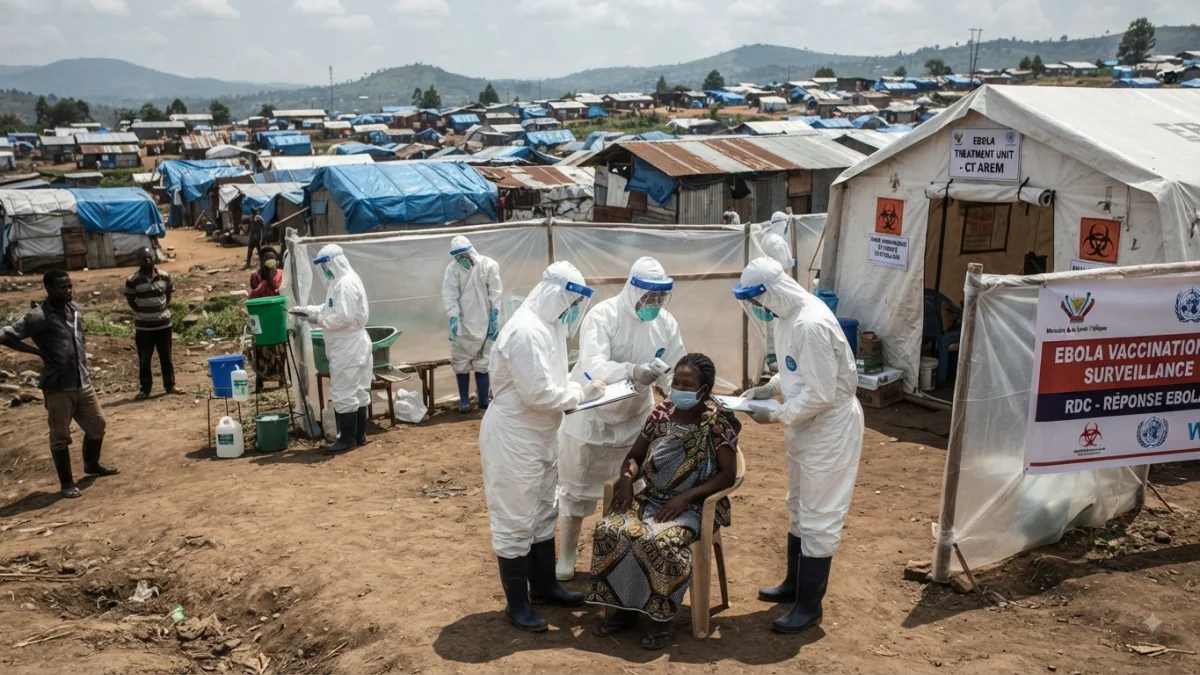


KINSHASA — Confirmed cases of Ebola caused by the rare Bundibugyo virus have been reported in at least 16 displacement camps in eastern Democratic Republic of Congo, highlighting the challenge of containing an outbreak that has spread through communities already affected by conflict and mass displacement, the United Nations said.
The camps are in Ituri province, the epicentre of the outbreak, and together shelter more than 270,000 displaced people, according to the U.N. Office for the Coordination of Humanitarian Affairs (OCHA). Overcrowding and limited access to water, sanitation and other basic services are increasing the risk of transmission, the agency said.


The outbreak has expanded rapidly since it was officially identified in May. The World Health Organization said that as of July 15, Congo had recorded 2,124 confirmed cases and 828 deaths, with infections detected across 46 health zones in five provinces.
More recent reporting indicates the outbreak has since passed 4,000 confirmed cases and 1,800 deaths, making it the second-largest Ebola outbreak recorded globally, according to health officials and international reporting.
The spread into displacement camps has complicated efforts to identify and isolate cases. In June, Reuters reported that Kpangba camp in Ituri had recorded Ebola-related deaths, while health workers attempting to trace contacts faced resistance from some residents who disputed the diagnoses.
Humanitarian agencies have also warned that basic infection-control measures remain difficult in crowded camps. Earlier reporting from Bunia described a camp housing about 10,000 people with limited handwashing facilities and shortages of clean water and soap.
The outbreak is being driven by Bundibugyo virus, a less common Ebola species first identified in Uganda in 2007. Unlike the Zaire strain responsible for most previous major Ebola outbreaks, Bundibugyo does not have an approved vaccine specifically targeting it. Moderna began a first-in-human trial of an experimental Bundibugyo vaccine in Canada this month.
WHO has said the virus was likely circulating in Congo for months before the outbreak was formally recognized. Genetic sequencing and investigations have indicated transmission may have begun as early as February, with some early illnesses initially diagnosed as other diseases.
Uganda, which reported linked cases earlier in the outbreak, declared itself free of Ebola in early August after completing the required monitoring period without further transmission. The outbreak remains active in Congo, where health authorities and humanitarian partners continue surveillance, testing, isolation and community-based response measures.