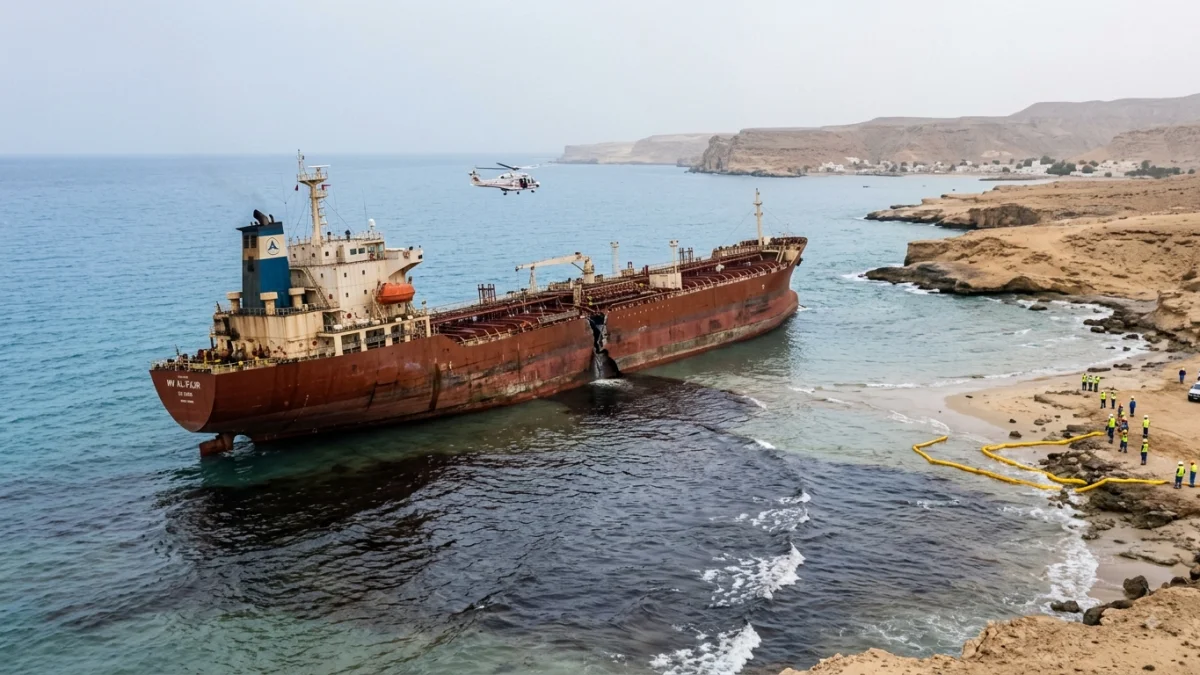


The oil spill from the grounded tanker Caroline Bezengi has become a growing economic and environmental risk for Oman after crude reached the country’s coastline and satellite imagery showed the slick expanding across a large area of the Arabian Sea. The incident is significant not only because of the potential ecological damage, but because it is unfolding along a coast where fisheries, tourism and other marine-dependent activities form part of Oman’s strategy to diversify its economy beyond oil and gas.
The vessel, a sanctioned tanker linked to Russia’s so-called shadow fleet, ran aground near Al-Qibliyah Island in Oman’s Hallaniyat archipelago after reporting an unexplained incident in June. The tanker had been carrying hundreds of thousands of barrels of Russian crude. By Aug. 14, Reuters reported that the slick was estimated at about 2,000 square kilometres, while a salvage operation coordinated by maritime risk company Ambrey was under way. Omani authorities have confirmed that oil reached the coast, adding a new dimension to the crisis because contamination on shore is generally more difficult to contain than oil remaining offshore.


The economic significance lies in the concentration of vulnerable activities along Oman’s coastline. Fisheries are an established component of the country’s diversification strategy, while tourism has also expanded as the government seeks to reduce dependence on hydrocarbons. Oman’s National Centre for Statistics and Information reported that tourism’s share of GDP reached about 2.7% in 2025, while official economic data show continued growth in the sector. The fisheries sector also supports a substantial network of fishermen, processing facilities and landing ports.
That means the spill’s eventual economic cost will depend less on the size of the surface slick alone than on where the oil ultimately accumulates and how long affected areas remain restricted. Oil reaching beaches, rocky shores or sensitive marine habitats can create costs for cleanup, monitoring and restoration while potentially disrupting fishing and coastal tourism. Oman’s Environment Authority has said it is monitoring the spill and responding with the relevant authorities, while officials have indicated that the pollution has reached Ras Madrakah and could move toward Masirah Island.
The timing and location also matter. The spill is occurring during the Khareef monsoon season in southern Oman, when weather and sea conditions can complicate salvage and containment operations. Ambrey has begun efforts involving specialist equipment and vessels, but Reuters and other reporting have highlighted difficult seasonal conditions around the grounded tanker. The longer the vessel remains a source of leakage, the greater the operational challenge of limiting additional crude entering the sea.
The incident also illustrates a wider problem associated with sanctions and maritime enforcement. Caroline Bezengi has been identified by reporting and sanctions records as a vessel involved in the transportation of Russian oil and associated with the shadow-fleet system used to move sanctioned or price-capped Russian petroleum. Reuters reported that the tanker had loaded Russian crude before its latest voyage. The vessel’s sanctions status adds complexity to questions of ownership, insurance, liability and responsibility for remediation.
Those issues could become economically important if cleanup costs rise or disputes emerge over who must finance them. The precise legal and financial responsibility cannot yet be established solely from the available reporting. The tanker’s ownership structure and insurance status have also been difficult to determine publicly, underscoring a broader challenge created by opaque shipping arrangements. The immediate priority, however, remains containing the leak and preventing further coastal contamination rather than resolving those longer-term questions.
For Oman, the spill comes as the government is pursuing policies that place greater emphasis on non-oil sectors. Its current development strategy identifies tourism, fisheries, logistics and other activities as sources of future growth. Official economic data show that non-oil activities expanded in 2025, including agriculture and fisheries and services. Damage to marine resources therefore has implications beyond environmental protection: it can affect the resilience of sectors that policymakers are trying to expand.
The confirmed situation remains fluid. Oil from Caroline Bezengi has reached Oman’s mainland coastline, the offshore slick has expanded substantially, and salvage and containment efforts are now active. The extent of lasting damage to fisheries, marine habitats and tourism has not yet been established. Authorities and response teams are therefore monitoring the tanker’s condition, the movement of the slick, coastal contamination and the effectiveness of containment measures. Those developments will determine whether the incident remains a costly localized spill or develops into a broader and longer-lasting economic and environmental disruption for Oman.