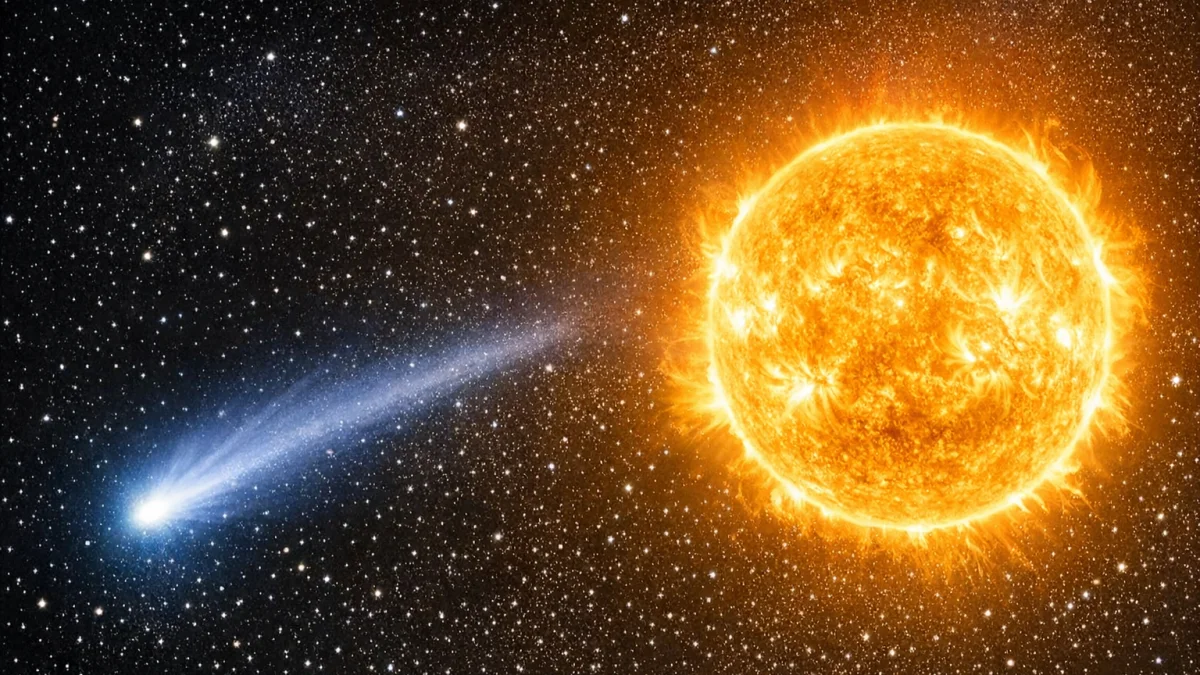


PARIS — A rare sungrazing comet is approaching the Sun this week, with astronomers warning that the object faces a significant risk of disintegration as it passes through extreme solar conditions, according to space agencies and scientific reports.
The comet, designated C/2026 A1 (MAPS), is expected to reach its closest approach to the Sun, known as perihelion, around April 4, space observers said. It belongs to the Kreutz family of sungrazing comets, a group known for passing extremely close to the Sun and, in many cases, breaking apart under intense heat and gravitational forces.


Astronomers said the comet was discovered in January by a team of amateur observers and has since drawn global attention due to its unusual trajectory and potential visibility from Earth. Early observations suggest the comet could become visible to the naked eye if it survives its close solar passage, though its behavior remains unpredictable.
According to recent observations reported by space scientists, the comet will pass extremely close to the Sun’s surface, exposing it to temperatures and tidal forces that could cause fragmentation or complete disintegration. Estimates cited by researchers indicate the comet’s nucleus may be relatively small, increasing the likelihood that it may not remain intact through perihelion.
“There are several possible outcomes, including total disintegration or partial fragmentation,” astronomers said in research summaries cited by space media, noting that similar sungrazing comets in the past have often broken apart before or shortly after reaching their closest approach.
However, scientists cautioned that comets are inherently unpredictable. In some cases, even if the core is destroyed, debris and dust tails can remain visible from Earth for several days after perihelion, potentially creating a brief but notable display in the night sky.
The comet’s trajectory and brightness have led to comparisons with historical sungrazers, some of which became exceptionally bright, while others faded or disappeared entirely. Experts said outcomes depend on factors including the comet’s size, composition, and structural integrity, which remain difficult to determine with precision before perihelion.
Space agencies and observatories worldwide are continuing to monitor the object closely using ground-based telescopes and space instruments. Observers have been advised to follow official guidance when attempting to view the comet, particularly due to its proximity to the Sun, which can pose risks to eyesight.
As of Thursday, the comet remains on its inbound path toward the Sun, with its survival or disintegration expected to become clearer in the days surrounding its perihelion, according to astronomers.