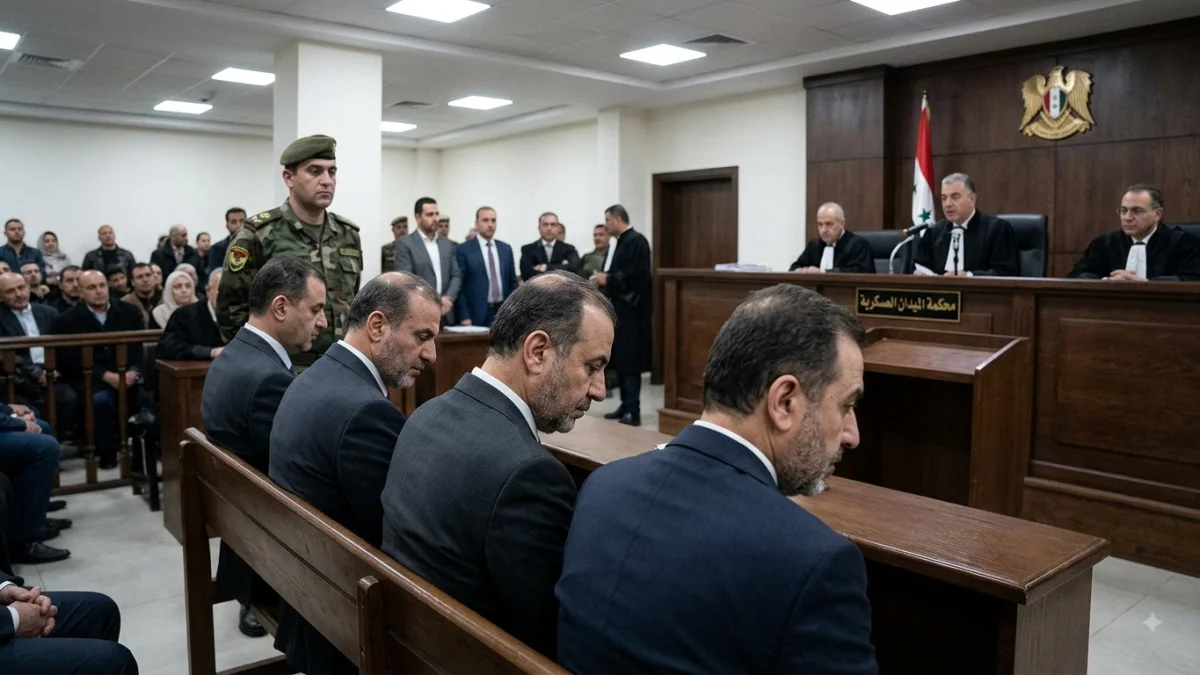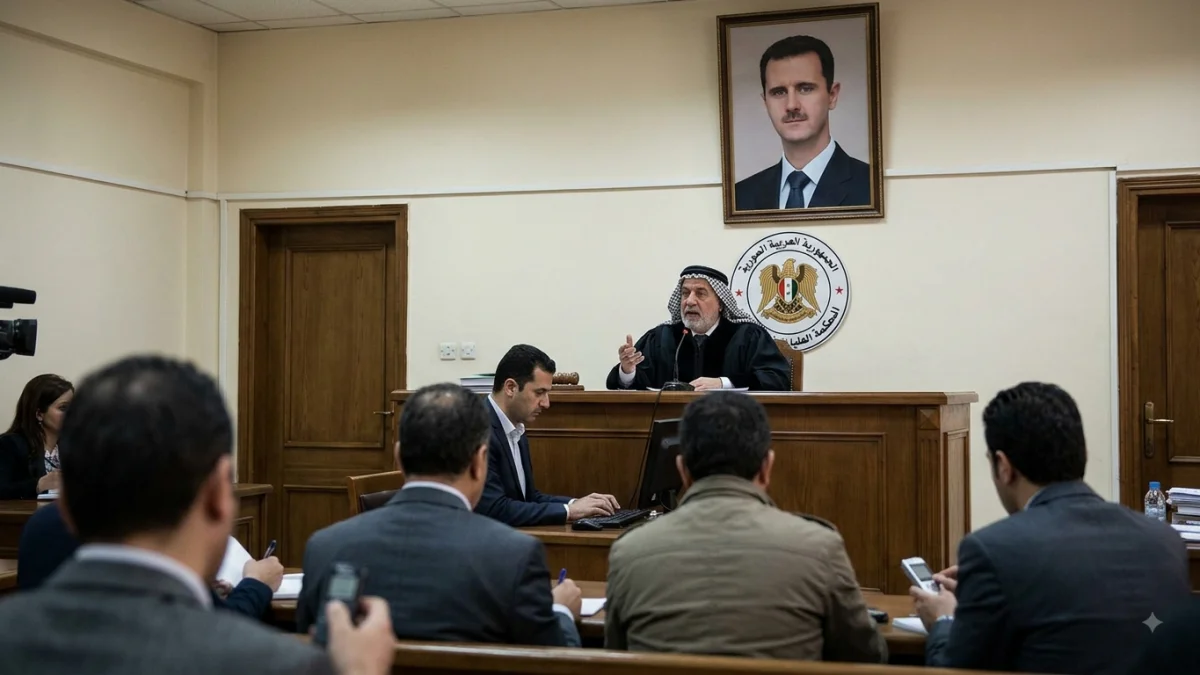


Syria’s decision to sentence former President Bashar al-Assad to death in absentia marks the most consequential domestic judicial action yet against the leadership of the regime that ruled the country for more than two decades. A Damascus criminal court on Aug. 11 convicted Assad of offenses including premeditated murder, torture and arbitrary detention linked to abuses committed during the civil war. His brother, Maher al-Assad, also received a death sentence, while their cousin Atef Najib was sentenced after appearing in court.
The immediate significance is less the prospect of Assad being executed than the establishment of a formal Syrian judicial record against the former president. Assad fled to Russia after opposition forces overthrew his government in December 2024, and Moscow granted him asylum. Because he remains outside Syrian custody, the sentence cannot currently be enforced against him. The ruling therefore represents primarily an assertion of accountability by Syria’s post-Assad authorities, while leaving the practical question of whether Assad can ever face punishment unresolved.


The case also represents a test for Syria’s effort to move from the collapse of the old regime toward transitional justice. The first major proceedings against former regime officials began in Damascus in April, including the trial of Najib, a former political-security chief in Daraa. His role in the repression of protests there in 2011 links the proceedings directly to the events that helped trigger the uprising and the conflict that followed. The Syrian Network for Human Rights has argued that prosecuting senior figures is important for establishing responsibility through the chain of command, but has also raised concerns about whether ordinary Syrian criminal law is adequate for crimes whose scale and institutional character are more appropriately addressed through international criminal-law standards.
That legal question is central to the credibility of the verdict. Human rights organizations have welcomed the fact that former regime figures are being brought before courts, while also questioning the fairness and speed of some proceedings and the adequacy of legal representation. The Associated Press reported that observers identified procedural shortcomings in Najib’s trial, including concerns about witness testimony and defense safeguards. Those concerns matter because transitional justice is not only about imposing punishment; it is also about establishing a judicial process whose findings can withstand scrutiny inside and outside Syria.
The death penalty adds another layer of complexity. For victims and families seeking accountability, a capital sentence can carry powerful symbolic significance after years in which senior officials of the Assad government avoided domestic prosecution. But international justice experts have long emphasized the importance of due process and preservation of evidence when prosecuting mass atrocities. Syria’s authorities therefore face a broader institutional challenge: demonstrating that the new judiciary is fundamentally different from the coercive legal structures used under the Assad government, including military field courts associated with executions and arbitrary detention.
The verdict also intersects directly with Syria’s relationship with Russia. Assad’s physical absence means enforcement depends on cooperation from Moscow. Syria has previously sought his extradition, while Russian officials have not indicated that they are prepared to surrender him. Russia’s continuing engagement with the new Syrian authorities has instead been shaped by negotiations over its military presence at Tartous and Hmeimim. A memorandum announced on Aug. 11 envisaged Syria assuming control of civilian portions of those facilities while some Russian military personnel remain for joint training arrangements.
That combination creates a clear distinction between legal accountability and physical custody. The Syrian court can establish a domestic judgment and impose a sentence, but enforcement depends on circumstances beyond the court’s immediate control. The verdict may nevertheless have consequences for future diplomatic efforts to secure Assad’s extradition and for attempts to pursue other former officials who remain outside Syria.
For the new Syrian authorities, the case also carries a broader institutional burden. The Assad government’s collapse left a country seeking accountability for mass killings, disappearances, torture and displacement while simultaneously rebuilding state institutions. The proceedings now underway can help create an official record of those abuses, but their legitimacy will depend on consistent procedural standards, credible evidence and equal application of the law.
The confirmed position is therefore that Assad and Maher al-Assad have been sentenced to death in absentia, while Atef Najib received the same punishment after being tried in custody. Assad remains in Russia, meaning the sentence has not translated into physical detention or execution. The key issues now being monitored are the Syrian authorities’ efforts to pursue former officials, the development of a broader transitional-justice framework, the treatment of defendants’ legal rights, and whether Damascus can obtain meaningful Russian cooperation concerning Assad himself.