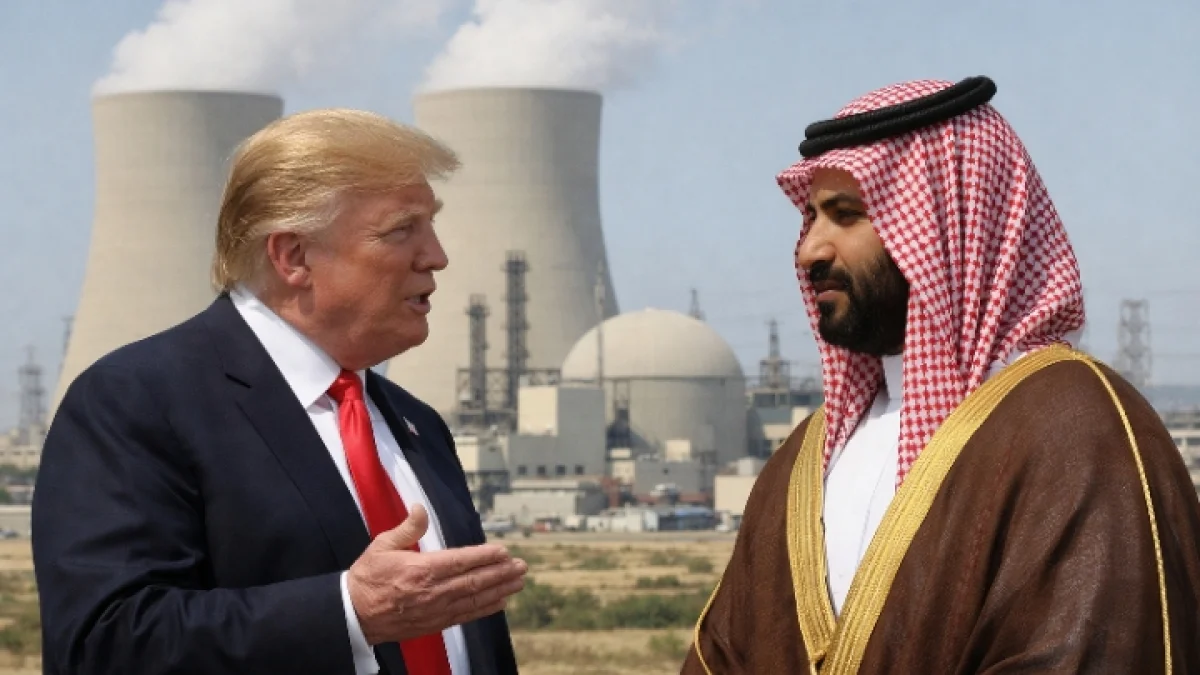


WASHINGTON — U.S. President Donald Trump has approved a civil nuclear cooperation agreement with Saudi Arabia that could allow the kingdom to develop uranium enrichment capabilities, a significant shift in U.S. nonproliferation policy that is expected to face close scrutiny in Congress, according to people familiar with the matter.
The proposed 30-year agreement, expected to be formally announced and submitted to Congress, would permit U.S. companies to participate in the development of Saudi Arabia's civilian nuclear energy program. According to people briefed on the arrangement, the accord could pave the way for a joint U.S.-Saudi study into domestic uranium enrichment and, if approved, the eventual construction of an enrichment facility in the kingdom.


The agreement is structured under Section 123 of the U.S. Atomic Energy Act, which governs civilian nuclear cooperation with foreign countries. However, unlike several previous U.S. nuclear accords, it reportedly does not require Saudi Arabia to permanently forgo uranium enrichment or plutonium reprocessing, provisions widely regarded as the "gold standard" of nonproliferation safeguards. It also omits adoption of the International Atomic Energy Agency's Additional Protocol, which expands international inspection authorities.
U.S. Energy Secretary Chris Wright has defended the proposed agreement, saying it complies with robust nonproliferation standards, according to Reuters. Critics, including nonproliferation experts and some lawmakers from both parties, argue that permitting enrichment technology could increase the risk of future weapons development, even if the program is intended for civilian energy production.
Saudi Arabia has long sought to establish a domestic nuclear power industry as part of its broader economic diversification plans. Crown Prince Mohammed bin Salman has previously said the kingdom would seek nuclear weapons if Iran were to obtain one, a statement that has fueled concerns among arms-control advocates. Saudi officials have consistently maintained that the country's nuclear ambitions are peaceful.
The proposed accord differs from the 2009 U.S.-United Arab Emirates nuclear agreement, under which Abu Dhabi accepted a permanent prohibition on uranium enrichment and reprocessing in exchange for U.S. nuclear cooperation. Supporters of that framework have cited it as a model for preventing the spread of sensitive nuclear technologies.
Once formally transmitted, the agreement will enter a 90-day congressional review period. Under U.S. law, Congress may seek to block the accord, although doing so over a presidential veto would require a two-thirds majority in both chambers. As of Wednesday, the administration had not publicly released the final text of the agreement.