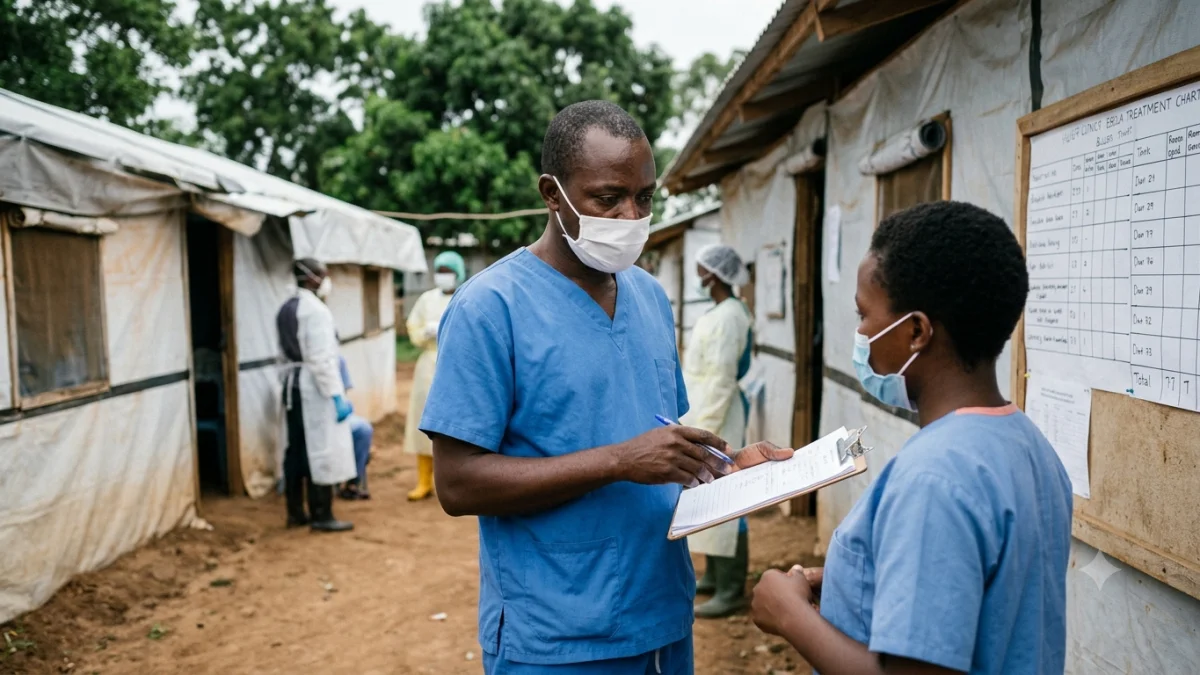


BUNIA, Democratic Republic of Congo — An unpaid health worker has become part of a frontline effort to contain the Democratic Republic of Congo’s fastest-growing Ebola outbreak, as medical teams in the country’s eastern provinces struggle with rising infections, delayed payments and difficult operating conditions.
Wiza Bondele, who works at an Ebola treatment center in Ituri province, has continued disinfecting contaminated areas and enforcing infection-control measures despite not receiving promised wages, according to reports from the outbreak response. Health workers involved in the emergency response said many staff members have gone unpaid since the outbreak was declared in May, creating additional pressure on teams already facing exposure risks and shortages.


The outbreak, caused by the Bundibugyo strain of Ebola virus, has surpassed 4,000 confirmed cases and more than 1,800 deaths, according to Congolese government data cited in recent reporting. The outbreak is now the second-largest Ebola outbreak recorded globally, behind the 2014-2016 West Africa epidemic.
The World Health Organization said the outbreak was officially confirmed in May after laboratory analysis identified Bundibugyo virus disease in Ituri province. The agency said the response has included deploying rapid response teams, strengthening surveillance, establishing treatment facilities and supporting infection prevention measures.
Health officials have linked the rapid spread to multiple challenges, including delayed detection, limited contact tracing, insecurity in affected areas and difficulties accessing some communities. WHO said the outbreak has unfolded in a complex humanitarian environment, with conflict and population movement complicating response operations.
The lack of timely payment for some responders has also affected morale. Authorities have attributed payment delays to administrative and logistical problems and have moved toward alternative payment methods to address outstanding wages, according to reports.
The Bundibugyo strain presents additional challenges because there is no licensed vaccine or specific approved treatment designed for the strain, although supportive medical care remains an important part of patient management, WHO said.
Health authorities continue to expand surveillance and response operations across affected provinces as they work to identify cases earlier and reduce transmission. The latest confirmed government figures show the outbreak remains active, with responders continuing efforts to contain infections in eastern Congo.