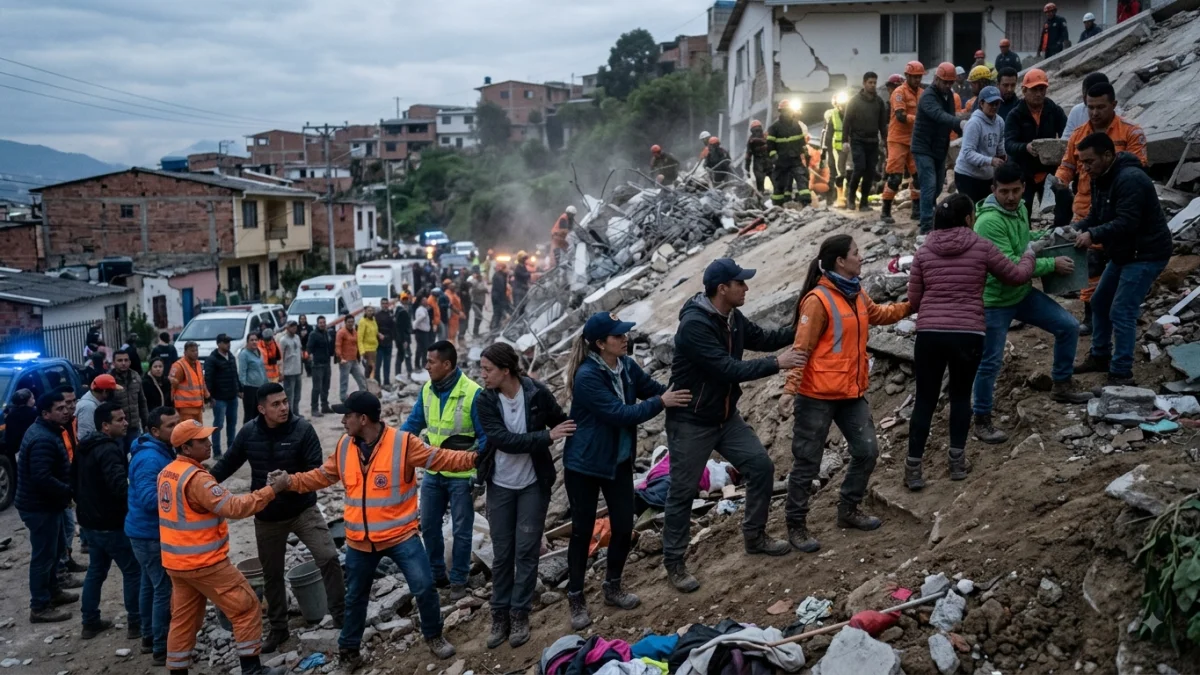


In Cali, volunteers and rescuers worked through the rubble with picks, basic tools and their bare hands after a powerful earthquake struck western Colombia, forming human chains to move bricks and masonry away from collapsed buildings.
They stopped at intervals to listen for signs of life beneath the debris, according to reporting from the scene. In one rescue effort, Andres Felipe Mejia told Agence France-Presse that a rescuer asked anyone trapped below to whistle. Someone answered. A man and a baby were pulled from the wreckage, while a woman believed to be the man’s wife remained trapped.


The improvised rescue lines became one of the clearest expressions of how ordinary Colombians responded in the first hours after the disaster: shoulder to shoulder, passing fragments of buildings away from places where people might still be alive.
The 7.4-magnitude earthquake struck on Monday near San José del Palmar in the Chocó region, about 400 km west of Bogotá, according to Colombian and international reports. It caused widespread damage across western Colombia, including in Cali, Pereira, Quibdó and Manizales. By Tuesday, authorities and news organizations were reporting more than 100 deaths, while the scale of the missing and the damage remained subject to continuing assessment.
For the volunteers, the first task was immediate and physical. Where buildings had collapsed, people used whatever was available to clear paths through the wreckage. In Cali, Juan Carlos Osorio told Caracol Television that neighbors were working together in human chains and that heavy equipment was urgently needed because people remained trapped.
The need for speed was matched by the danger of the work. Aftershocks continued after the main earthquake, while damaged structures presented additional risks to those entering or working around them. Emergency authorities therefore faced the difficult task of balancing the need to reach survivors quickly with the safety of rescuers and volunteers. Reuters reported that 21 aftershocks had been recorded by Monday night.
Mauricio Andrade, a firefighter in Cali, described the continuing search to Reuters as his team prepared to enter damaged structures. “They are alive,” he said. “We are making space so we can free them and get them out.”
That work unfolded alongside a formal emergency response. President Abelardo de la Espriella declared a national emergency and ordered the mobilization of military and police resources for rescue and relief operations. International assistance was also being offered as authorities assessed the destruction and struggled to reach some of the more remote areas near the epicenter.
The earthquake struck a country that had already been tested by a major regional disaster only weeks earlier. In June, Colombia sent its specialized USAR COL-1 search-and-rescue team to neighboring Venezuela after two powerful earthquakes there. The Colombian government said the team included dozens of specialists and canine units and spent eight days carrying out search operations, including the rescue of an 11-year-old boy trapped beneath rubble.
Colombia's specialized rescue capacity had also undergone an international review shortly before the domestic earthquake. The country's disaster-risk agency said in June that USAR COL-1 had retained its international accreditation under the United Nations' INSARAG system after an exercise simulating a magnitude 7.3 earthquake.
But the scenes in Cali showed that professional rescue teams were not the only people entering the disaster zone. Neighbors were already clearing debris, passing material from one person to another and listening for the sounds of people who might still be alive.
The human chains could not replace cranes, excavators, trained structural specialists or other equipment required for complex urban search and rescue. They could, however, begin moving smaller pieces of debris while trained rescuers assessed structures and searched for survivors. Their work also reflected a familiar feature of earthquake disasters: in the crucial early period after a collapse, people closest to the wreckage are often the first to respond.
Across western Colombia, the rescue effort remained unfinished as Tuesday began. In Chocó, communications problems complicated assessments around the epicenter, while larger cities confronted collapsed and damaged buildings and families waited for information about relatives who had not been accounted for.
For those working in the rubble, the objective was narrower than the scale of the catastrophe: clear one section, listen again, and make enough space to reach whoever might be underneath.
Andrade, the Cali firefighter, captured that immediate priority in his message to Reuters. “They are alive,” he said, as rescuers prepared to continue working. “We are making space so we can free them and get them out.”