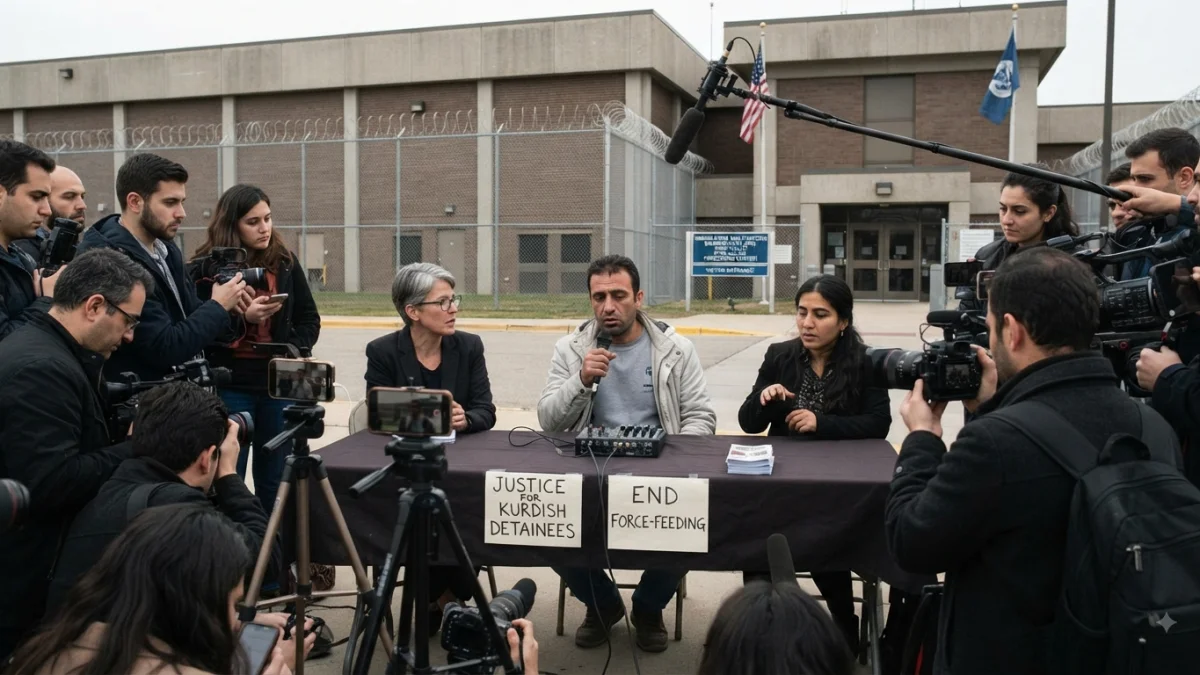


LOS FRESNOS, Texas — A Kurdish filmmaker and activist says U.S. immigration authorities repeatedly force-fed him through a nasal tube during an eight-month hunger strike in detention, an account supported in part by federal court records and reviewed in a recent investigation.
Gabar Choli, who was detained by U.S. Immigration and Customs Enforcement (ICE) in 2025 after his U.S. asylum case was denied, said he was subjected to involuntary feeding at the Port Isabel detention facility in southern Texas from late May 2025 until his deportation to Canada in January 2026.


Choli told the Guardian that guards restrained him during the procedures, which he said occurred as often as twice a day. He described lasting physical and psychological effects, saying the experience had “mentally broke” him.
Federal court records confirm that the U.S. Department of Homeland Security sought judicial authorization to administer hydration, nutrients and other medical measures to Choli against his wishes. The case, Homeland Security v. Choli, was filed in the U.S. District Court for the Southern District of Texas in May 2025. Court records show that a judge granted an emergency order permitting involuntary treatment and later denied Choli's request for appointed counsel.
The full details of the medical procedures remain partly unclear because some court records are sealed. The Guardian reported that Choli's account of injuries and some other aspects of the treatment could not be independently corroborated.
ICE has not publicly confirmed the details of Choli's treatment. A Department of Homeland Security spokesperson told the Guardian that ICE respects detainees' right to refuse medical treatment where appropriate, but may seek court authorization when a person's medical condition poses a serious risk of death or permanent harm. The agency said involuntary treatment is carried out under legal authority and by qualified medical professionals.
The case comes amid broader scrutiny of involuntary medical treatment in ICE detention. DHS sources told the Guardian that, between January 2025 and Aug. 4, 2026, ICE obtained court orders for involuntary treatment involving 18 hunger strikers. Earlier reporting had identified at least 10 such cases.
Human rights and medical groups have criticized force-feeding of hunger strikers, while U.S. authorities have argued that intervention may be necessary when detainees face serious medical risks.
Choli is now in Canada following his deportation. His case remains part of a wider debate over the treatment of hunger strikers in U.S. immigration detention and the legal limits of involuntary medical intervention.