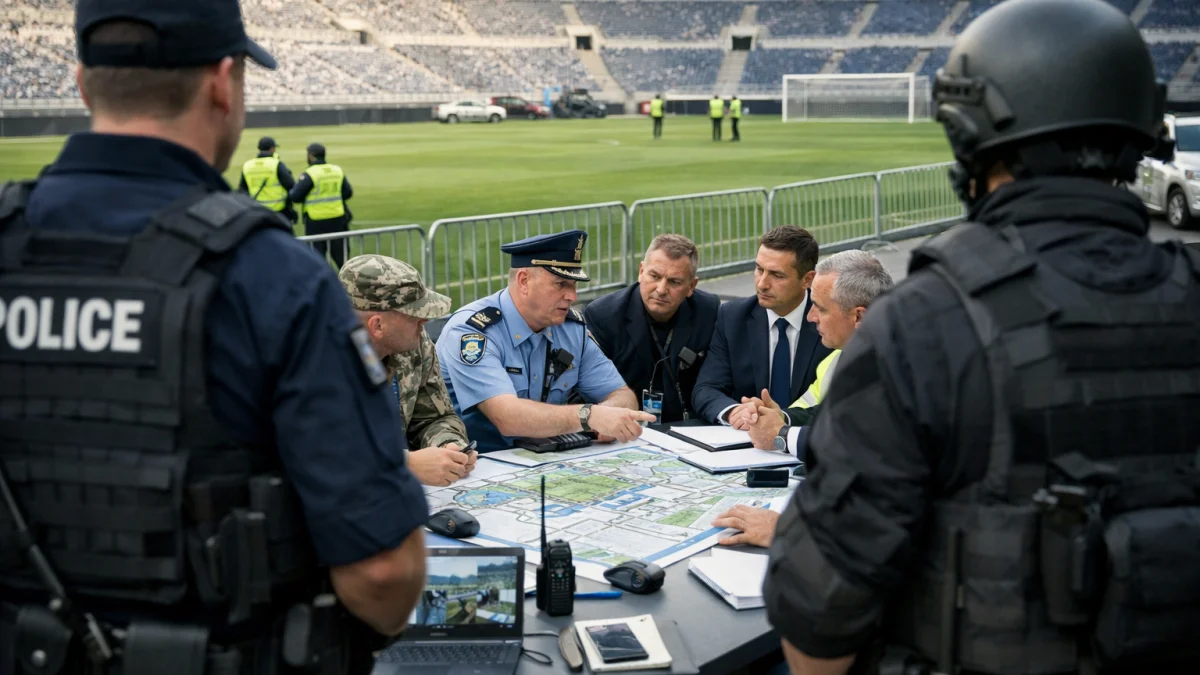


MEXICO CITY — Host cities across the United States, Canada and Mexico finalized security and public safety plans this week as the 2026 FIFA World Cup got underway, with officials deploying enhanced measures around stadiums, transportation hubs and fan gathering areas.
The tournament opened on Thursday in Mexico City and is being staged across 16 host cities in the three North American countries. Organizers and government agencies said years of planning culminated this week with the implementation of coordinated security operations involving local, national and international authorities.


Officials in host cities said preparations focused on crowd management, transportation, cybersecurity and the growing threat posed by unauthorized drones. Security planners have identified drone activity as a significant concern because small aircraft can bypass traditional perimeter protections, according to law enforcement officials and security experts involved in tournament planning.
“This is not just one national or one continental event,” Andrew Giuliani, executive director of the White House Task Force on the World Cup, said during a briefing in Miami Beach last week. “For us in the United States, these are 11 regional events.” Authorities said federal, state and local agencies have been coordinating intelligence-sharing and operational planning for months ahead of the tournament.
The expanded World Cup features 48 teams and more than 100 matches over several weeks, making it the largest tournament in FIFA history. Security operations extend beyond stadiums to include team hotels, training sites, fan festivals and major transit corridors, officials said.
Host cities have also introduced temporary flight restrictions around venues on match days. U.S. aviation authorities said drones will be prohibited within a designated radius of stadiums during games, while specialized detection systems have been deployed in several locations. Security experts said the preferred response is identifying and locating drone operators rather than attempting to disable aircraft over crowded areas.
In Canada, officials in Toronto said transportation and security systems were ready ahead of the city’s first matches. “We are ready to welcome the world,” Sharon Bollenbach, executive director of Toronto’s World Cup organizing efforts, said during a recent briefing.
Los Angeles County Sheriff Robert Luna said this month that federal authorities had informed local officials that civil immigration enforcement operations were not expected at World Cup matches or related events, while emphasizing that broader security measures would remain in place.
As matches began on Thursday, authorities reported no major security incidents. Officials across the host cities said security plans remained active and would be adjusted as needed throughout the tournament, which is scheduled to continue through July.