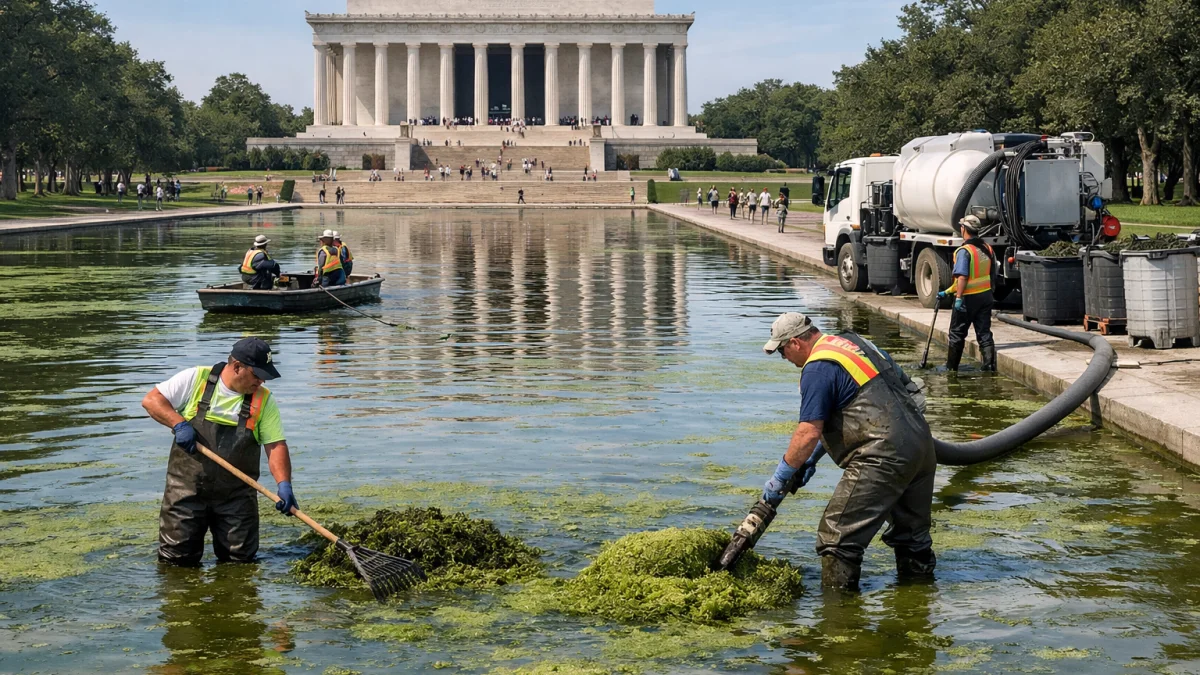


WASHINGTON — Crews continued cleanup operations at the Lincoln Memorial Reflecting Pool this week after algae blooms spread across portions of the landmark water feature, prompting federal officials to deploy chemical treatments and water-quality technology to restore its appearance, according to the U.S. Department of the Interior and the National Park Service.
The cleanup effort began days after the Reflecting Pool was reopened following a renovation project completed earlier this month. Workers were observed on Tuesday pouring hydrogen peroxide into sections of the pool and operating equipment designed to combat algae growth, according to Reuters and National Park Service officials. The algae bloom turned parts of the pool visibly green, drawing public attention to one of Washington's most recognizable landmarks.


An Interior Department spokesperson said the pool was being treated with “high-tech nanobubble ozone technology” intended to kill algae and other contaminants. Officials also described hydrogen peroxide as a milder treatment than chlorine and said it is commonly used in water-management applications.
The nearly century-old Reflecting Pool stretches between the Lincoln Memorial and the Washington Monument on the National Mall. The renovation project involved draining, cleaning and resurfacing the basin before it was refilled earlier in June. Shortly after reopening, however, algae became visible in several areas of the water feature.
Interior Department officials attributed the outbreak in part to what they described as residual algae remaining in supply lines that had been dormant during construction. “What you are seeing is residual algae from the supply lines,” an Interior spokesperson said in comments reported by local media. Officials said the growth was being removed and that mitigation measures were already in place.
Environmental experts said algae growth is a recurring challenge in shallow bodies of water, particularly during warm weather. Christopher Gobler, a professor at Stony Brook University who studies algal blooms, told Reuters that hydrogen peroxide is a common short-term treatment. “It's usually a good short-term fix,” Gobler said, while noting that algae can return after treatment.
Satellite imagery analyzed by independent researchers and reported by media outlets indicated elevated algae levels in the Reflecting Pool during June, though officials have not released their own comprehensive assessment of the bloom.
As of Friday, cleanup operations were continuing, and the Reflecting Pool remained open to visitors. Federal officials said efforts to reduce algae levels and improve water quality were ongoing, while details regarding any additional maintenance measures remained unclear.