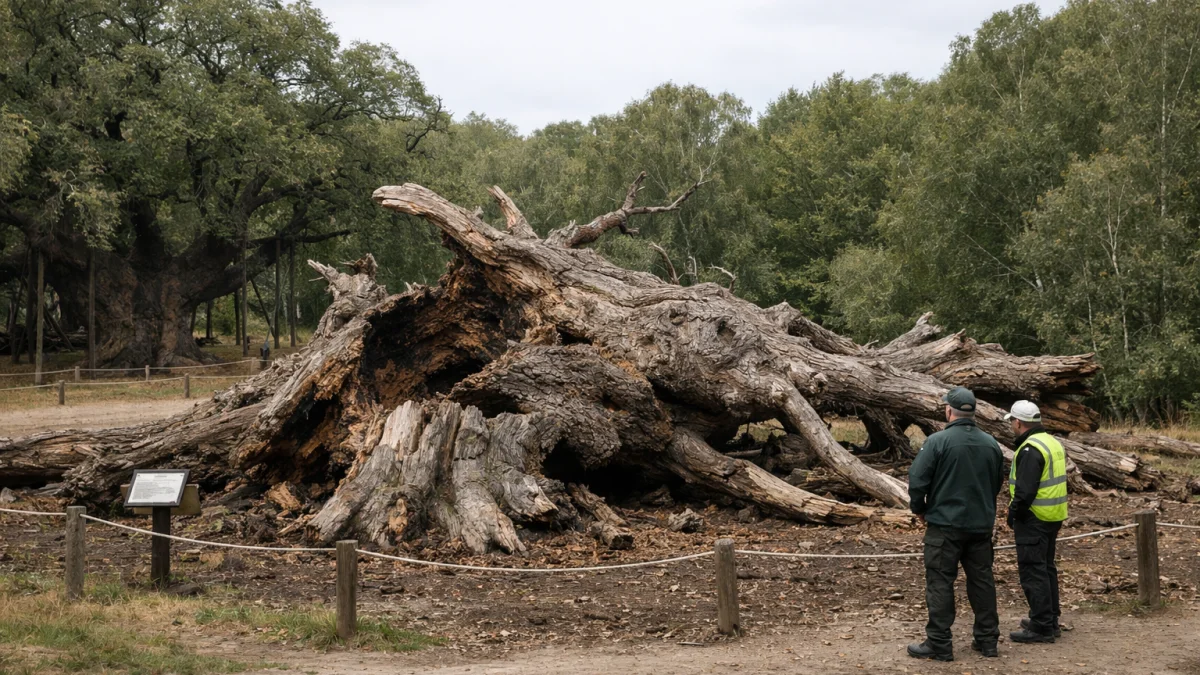


NOTTINGHAM, England — The Major Oak, an ancient tree in Sherwood Forest long linked to the legend of Robin Hood, has died, according to experts.
The Royal Society for the Protection of Birds (RSPB), which manages Sherwood Forest in Nottinghamshire, announced on Thursday that the tree had died after failing to produce leaves this spring. Scientific assessments confirmed no remaining biological activity in the iconic English oak.


The Major Oak, estimated to be between 1,000 and 1,200 years old, is one of Britain’s largest and most famous ancient trees. Local folklore holds that the outlaw Robin Hood and his Merry Men sheltered in its hollow trunk, though the cavity was caused by fungi.
The tree has drawn millions of visitors over centuries. Factors contributing to its decline include prolonged stress from hot, dry summers, soil compaction from tourism and foot traffic, structural supports that altered natural growth processes, and historical changes to the local water table.
“The tree’s failure to produce leaves this year is heartbreaking for everyone,” Hollie Drake, senior site manager for the RSPB, said in a statement.
The RSPB has managed the site since 2018 and had previously installed scaffolding and other measures to support the tree’s large branches. Despite these efforts, the tree reached the end of its natural lifespan.
Sherwood Forest contains a high concentration of ancient oaks, many of which support rare ecosystems. Standing deadwood like the Major Oak provides valuable habitat for specialized wildlife species even after the tree dies.
The Major Oak will remain in place as a monument. Saplings have been planted nearby to help continue the forest’s legacy, the RSPB said. Details on any additional conservation or memorial plans remain unclear.
The tree’s death marks the end of a living landmark that has stood for centuries amid changing landscapes, while its cultural and ecological importance endures. The full impact on visitor numbers and local tourism will become clearer in coming months.