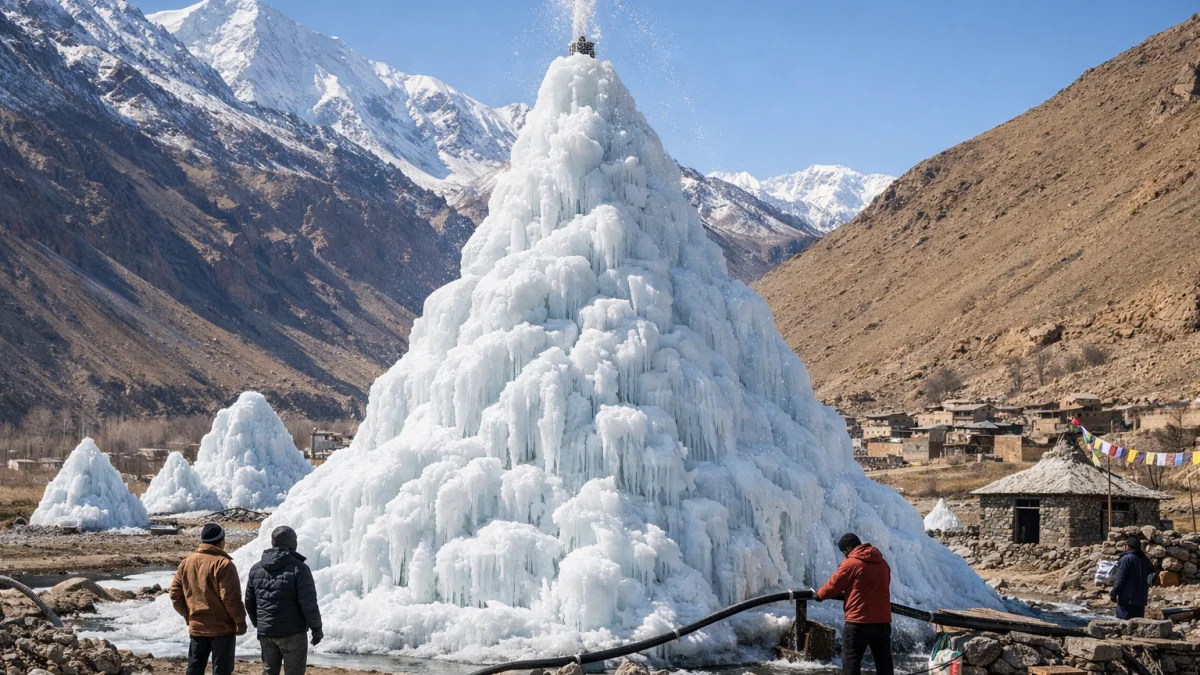


LEH, India — Communities in the Himalayan region of Ladakh are expanding the use of artificial ice reservoirs known as “ice stupas” to help address seasonal water shortages that have become more acute as glaciers retreat and weather patterns change, according to local project organizers, researchers and development agencies.
The cone-shaped ice structures, built during winter by spraying water into freezing air through gravity-fed pipe systems, store water that would otherwise flow unused during colder months. As temperatures rise in spring, the ice melts gradually, providing irrigation water for villages before natural glacier runoff reaches lower-altitude farming areas. Project leaders said the technology is being used in several communities across Ladakh, a high-altitude desert region in northern India.


The initiative was pioneered by Ladakhi engineer and educator Sonam Wangchuk, who developed and expanded the concept more than a decade ago. Organizers say the structures resemble traditional Buddhist stupas, giving rise to the name “ice stupas.” The system relies primarily on gravity rather than pumps, reducing operating costs and energy requirements.
According to project advocates, many Himalayan villages face a critical gap in water availability during early spring. Winter water supplies are often abundant, but agricultural demand peaks before glaciers begin releasing substantial meltwater. Ice stupas are intended to bridge that period by storing winter water in frozen form and releasing it when crops require irrigation.
“Real glaciers are melting,” Wangchuk said in comments previously cited by development organizations promoting the project. Supporters describe the structures as a locally adapted response to changing environmental conditions affecting mountain communities.
Researchers and environmental groups have noted broader concerns about water security across the Himalayan region, sometimes referred to as the “Third Pole” because of its vast stores of snow and ice. Scientific studies cited by international organizations have warned that continued glacier loss could affect water supplies for large populations across Asia.
Development agencies have reported interest in similar artificial glacier projects beyond Ladakh. Experts involved in water-management programs say the technique may offer benefits for isolated mountain communities facing recurring drought conditions, although they caution that local geography and climate conditions can affect results.
Local residents and project organizers say the structures have helped provide water for crops, tree-planting efforts and village water supplies during critical months. However, officials and researchers note that artificial glaciers are designed as a local adaptation measure and are not considered a substitute for broader efforts to address long-term climate and water challenges.
As of June 2026, construction and maintenance of ice stupas continued in parts of Ladakh, while researchers and community groups evaluated opportunities to expand the approach to additional Himalayan villages facing seasonal water shortages.