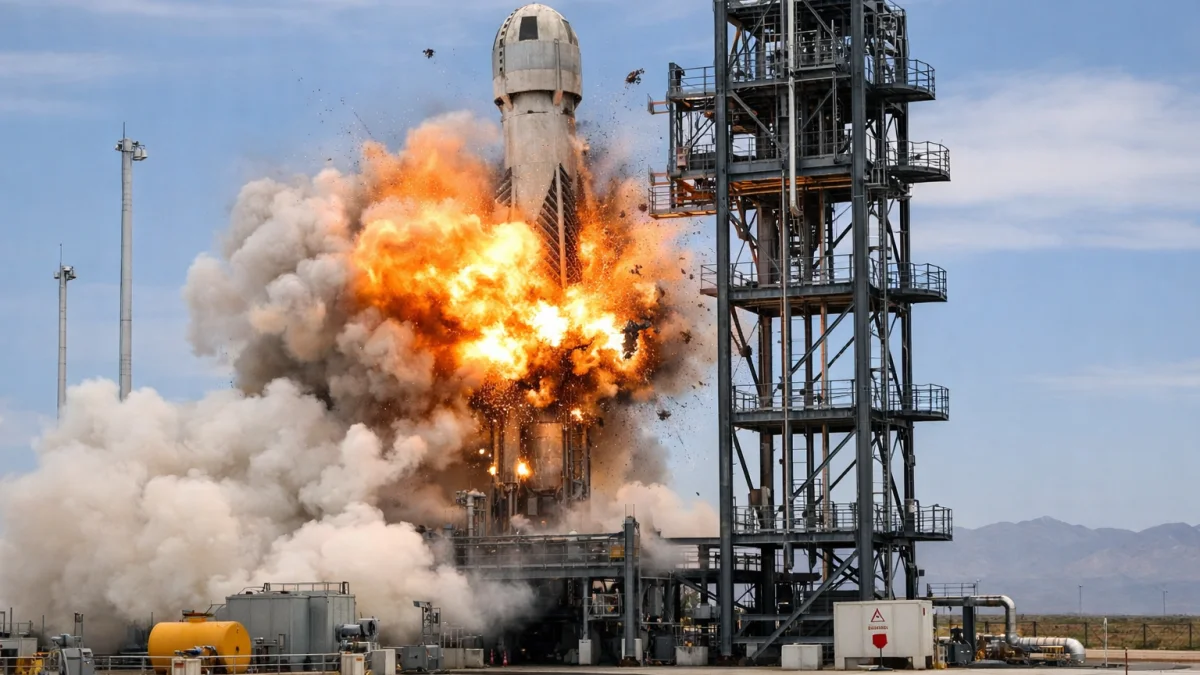


CAPE CANAVERAL, Florida — A Blue Origin New Glenn rocket exploded during an engine-firing test at a launch pad in Florida late Thursday, damaging infrastructure at the site and forcing delays to several planned missions, company officials and U.S. authorities said.
The explosion occurred during a hot-fire test at Launch Complex 36 at Cape Canaveral Space Force Station, where the rocket’s engines were being fired while the vehicle remained secured to the ground. Blue Origin said the test was being conducted ahead of a planned satellite launch scheduled for next week. No injuries were reported.


Video footage circulated online showed the New Glenn rocket igniting before erupting into a large fireball that sent flames and smoke into the night sky. Witnesses in nearby communities reported feeling vibrations from the blast, according to local media reports.
Blue Origin described the incident as an “anomaly,” a term commonly used in the aerospace industry for major test or launch failures. In a statement posted on social media, the company said all personnel had been accounted for and that an investigation was underway.
“It’s too early to know the root cause but we’re already working to find it,” Blue Origin founder Jeff Bezos wrote on X. “Very rough day, but we’ll rebuild whatever needs rebuilding and get back to flying.”
Officials at Cape Canaveral Space Force Station confirmed that no injuries or fatalities were reported. The U.S. Space Force said range officials, Blue Origin engineers and other partners were reviewing available data to determine the cause of the explosion. Details of the investigation remain unclear.
The New Glenn rocket, named after astronaut John Glenn, is Blue Origin’s heavy-lift launch vehicle and is intended to compete with rockets operated by SpaceX and other commercial providers. Standing about 98 meters tall, the vehicle made its debut flight in 2025 and is central to Blue Origin’s commercial satellite launch plans and several NASA-related missions.
Reports indicated that the explosion caused extensive damage to the launch pad and could delay operations for months. The disruption is expected to affect upcoming commercial launches and missions connected to Amazon’s satellite network plans, as well as some NASA lunar programs that rely on New Glenn.
The incident followed an earlier setback for the rocket program after a New Glenn mission in April experienced engine-related problems that left a satellite in an unintended orbit, according to reports from multiple news organizations.
As of Saturday, Blue Origin had not announced a revised launch schedule. Company officials said the investigation was continuing and that additional updates would be released once more information became available.