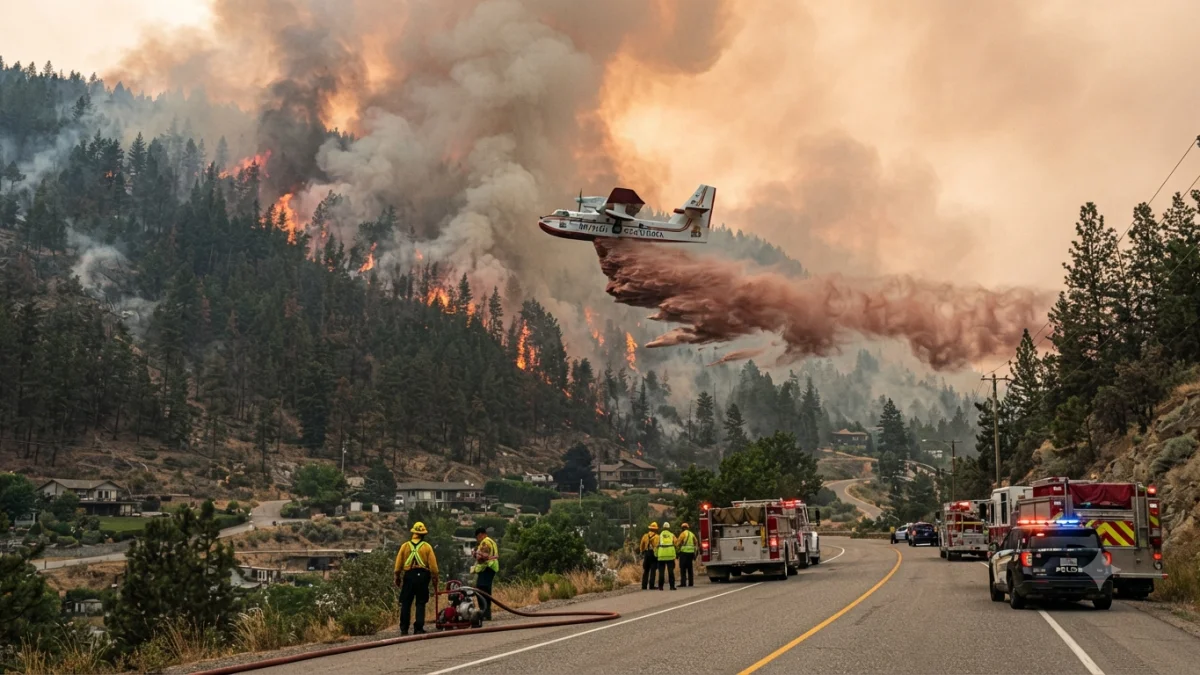


British Columbia’s decision to declare a provincewide state of emergency on Aug. 8, after a fast-moving wildfire forced more than 20,000 people from their homes, underscores how quickly a combination of heat, drought, wind and dry fuels can turn a seasonal hazard into a provincewide emergency. The immediate crisis is centered on the Bald Range wildfire near Summerland and Peachland, but the significance extends beyond one fire: provincial and federal assessments had warned for months that British Columbia was entering the summer with unusually elevated wildfire risk.
The Bald Range fire illustrates the operational challenge. First reported on Aug. 7, it expanded rapidly and reached about 9,500 hectares by Aug. 8, prompting evacuation orders covering Summerland and surrounding communities. Provincial emergency authorities described the fire as posing a significant risk to life, while Premier David Eby said homes had been lost and some residents had to be rescued as conditions changed rapidly. More than 100 wildfires were burning across British Columbia, according to provincial officials, with the emergency response involving about 1,500 firefighters and international assistance.


The speed of the emergency matters because wildfire risk is no longer determined simply by whether a fire starts. Under exceptionally dry conditions, the window for detection, initial attack and evacuation can narrow sharply. The BC Wildfire Service’s June seasonal outlook had already identified the central and southern Interior and South Coast as areas where vigorous and difficult-to-control fires were likely during July and August. It cited low snowpack, precipitation deficits, persistent drought and expectations of a warmer-than-normal summer as contributing factors.
Federal assessments pointed in the same direction. Public Safety Canada said in May that modelling by Natural Resources Canada showed British Columbia facing the highest and most sustained wildfire risk in Canada as the summer progressed. Environment and Climate Change Canada separately forecast warmer-than-normal conditions across most of the country and identified southern British Columbia among the areas experiencing unusually dry conditions.
That does not mean climate change caused the Bald Range fire. Wildfire behaviour is influenced by multiple factors, including ignition source, wind, topography, vegetation, land management and suppression practices. But the broader scientific evidence establishes a clear connection between a warming climate and the conditions that make extreme fires more likely. Natural Resources Canada says warmer and drier conditions make fuels more flammable, allow fires to spread faster and contribute to longer fire seasons. Canada is warming at roughly twice the global average rate, according to the federal agency.
British Columbia provides an important historical benchmark. Federal scientists examining the province’s severe 2017 wildfire season concluded that human-induced climate change substantially increased the likelihood and scale of the extreme conditions. Their analysis found that extreme summer temperatures were made more than 20 times more likely by human influence, while the area burned was estimated to have been seven to 11 times larger than it would have been without that influence. The 2017 season displaced about 65,000 people and burned roughly 1.2 million hectares.
The comparison is important because the province has repeatedly had to manage wildfire as a major emergency rather than an isolated forestry problem. In 2023, British Columbia recorded 2,245 wildfires, with approximately 48,000 people affected by evacuation orders and an estimated wildfire-suppression cost of about C$1.1 billion. The province remained under a state of emergency for 28 days that year.
The consequences extend beyond firefighting. Large fires disrupt transportation, housing, tourism, forestry, utilities and local economies while smoke can affect communities far from the flames. Natural Resources Canada identifies infrastructure, public health, forests, carbon emissions and resource availability among the areas affected by changing fire regimes. The federal government also notes that First Nations communities can be disproportionately affected by wildfire emergencies.
The policy challenge is therefore shifting from responding to individual fires toward managing cumulative wildfire risk. Governments have expanded emergency-response capacity, fuel-reduction programs and preparedness measures, while researchers and officials continue to examine prescribed fire, forest management, evacuation planning and community resilience. Those measures do not remove the underlying climatic drivers, but they can influence how quickly fires spread and how effectively communities respond.
The immediate situation remains dynamic. British Columbia’s emergency authorities have ordered evacuations in areas affected by the Bald Range fire, while provincial crews and outside personnel continue response operations. The number of homes destroyed and the full extent of damage remain subject to assessment. Authorities are continuing to monitor fire growth, evacuation orders and alerts, road closures, weather conditions and the availability of firefighting resources as the province moves through the peak summer wildfire period.