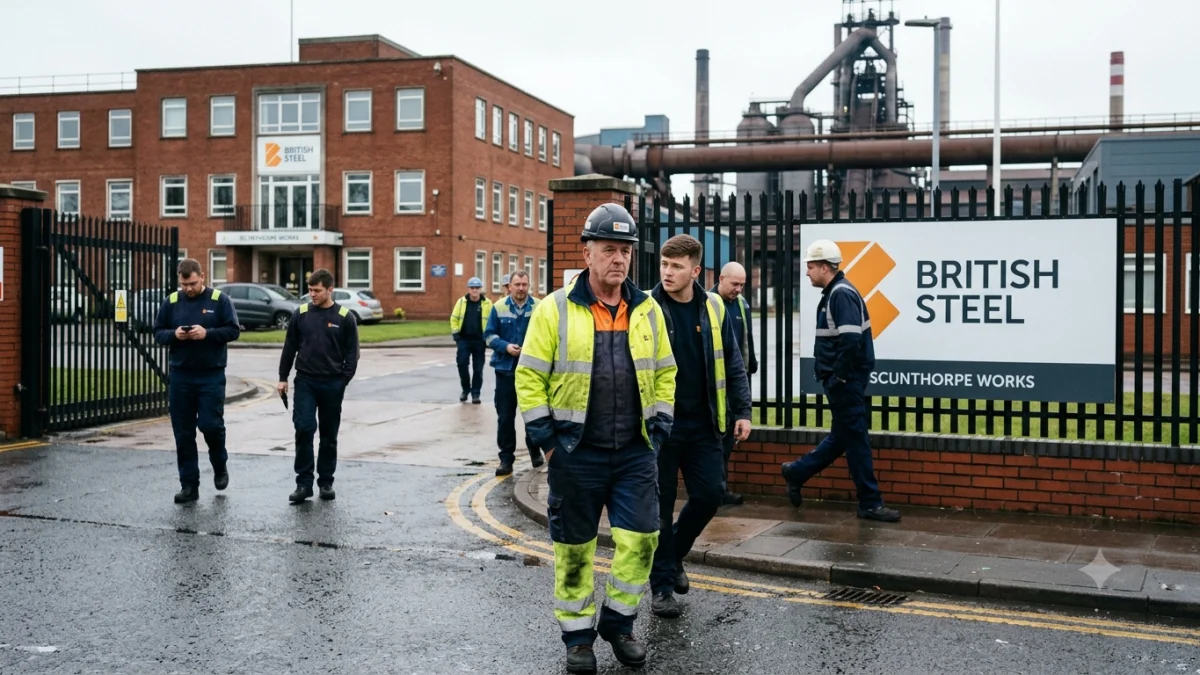


For much of the past year, the blast furnaces at British Steel's Scunthorpe works have stood at the center of an argument reaching far beyond the plant's gates. While politicians debated industrial strategy and diplomats traded warnings over investment, workers continued reporting for shifts at the site that represents Britain's last remaining primary steelmaking operation, waiting for clarity about the future of their jobs.
That uncertainty has not disappeared with the British government's decision to bring British Steel into public ownership. Instead, it has entered a new phase—one in which employees know the furnaces will continue operating for now, but still await answers about how the business will become financially sustainable, how it will modernize, and what the transition will mean for thousands of families whose livelihoods depend on steel.


The nationalization, completed on July 16, was presented by the government as a move made in the national interest to preserve domestic steelmaking capability, protect supply chains and safeguard skilled employment. Ministers said the decision followed months of government intervention after concerns that former owner Jingye, the Chinese steelmaker that acquired British Steel in 2020, could close the Scunthorpe blast furnaces. The government said more than 2,700 direct jobs at the site, along with thousands more across suppliers and contractors, depended on keeping production alive.
For workers in North Lincolnshire, however, the story is measured less in legislation than in everyday routines. Scunthorpe has been shaped by steelmaking for generations, and many families count multiple relatives who have worked at the plant. Employment at the works supports local businesses, transport companies, engineering firms and service industries across the region.
Those connections help explain why the debate over British Steel has become more than a dispute over ownership. It has become a question about whether heavy industry still has a long-term place in Britain's economy.
Government officials argue that preserving domestic production is essential for infrastructure, construction, rail projects and national security. The Department for Business and Trade said public ownership creates an opportunity to stabilize the business while developing a commercially sustainable, lower-carbon future. The Steel Industry (Nationalisation) Act became law on July 15, allowing ownership to transfer the following day.
Industry representatives have broadly welcomed the intervention while cautioning that nationalization alone does not resolve the sector's underlying challenges. British steelmakers continue to face high energy costs, international competition and years of global overcapacity that have reduced profitability across the industry. Government support, including trade protections and investment measures, has sought to address those pressures, but ministers acknowledge that a long-term commercial strategy remains necessary.
The dispute has also evolved into an international disagreement.
Jingye has demanded compensation, arguing that the British government's actions unfairly deprived it of its investment and damaged confidence among foreign investors. The company has begun discussions under the China-UK bilateral investment treaty and has indicated it is considering international arbitration. Beijing has criticized the nationalization and urged Britain to resolve the matter fairly, saying it will monitor developments closely.
British ministers reject the suggestion that the move was arbitrary. They argue intervention became necessary after efforts to secure the company's future failed and maintain that an independent valuation process will determine any compensation owed under British law.
For employees, those legal and diplomatic arguments remain largely outside their control.
What matters more immediately is whether the plant receives the investment needed to remain competitive in a global industry undergoing rapid technological change. Steelmakers across Europe are increasingly shifting toward lower-emission production methods, including electric arc furnaces, as governments pursue climate goals and companies seek to reduce costs over time. Any transition at Scunthorpe is expected to require significant capital, careful planning and workforce adaptation.
The government has appointed a new leadership team to oversee British Steel during public ownership, saying its priorities include stabilizing operations and developing a commercially viable, low-carbon future. Officials have also emphasized that preserving Britain's ability to produce virgin steel remains strategically important while longer-term decisions are made.
The significance extends beyond a single employer.
According to government figures, Britain's steel sector supports tens of thousands of direct jobs and many more across supply chains. Communities built around steelmaking have experienced decades of restructuring, making the fate of remaining plants especially consequential for regional economies.
The Scunthorpe works has survived ownership changes, financial crises and repeated questions about its future. Each episode has reinforced how closely industrial policy and community identity remain intertwined.
Now, with British Steel once again under public ownership, workers face a familiar balance of relief and uncertainty. The immediate threat to production has eased, but the larger challenge—creating a profitable, competitive steel business capable of supporting future generations of skilled employment—has yet to be resolved.
As negotiations over compensation continue between London and Jingye, and policymakers consider the next stage of Britain's industrial strategy, the blast furnaces continue operating. For the people whose working lives revolve around them, that continuity offers stability for today, even as the long-term future of British steel remains a work in progress.