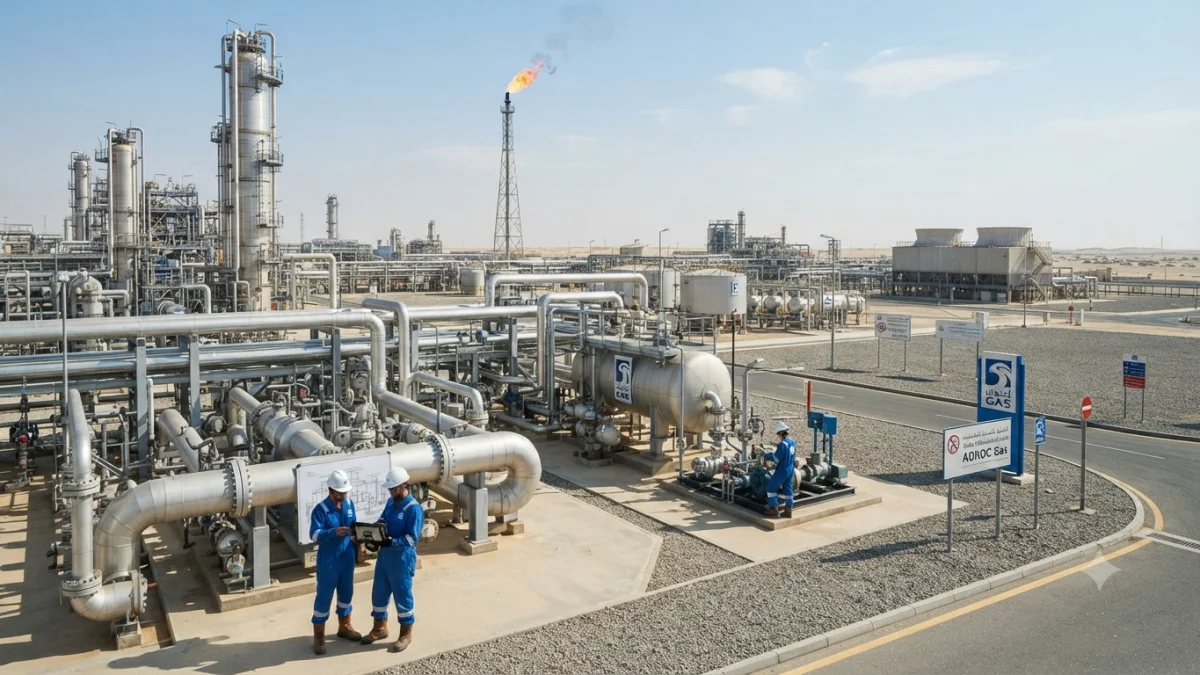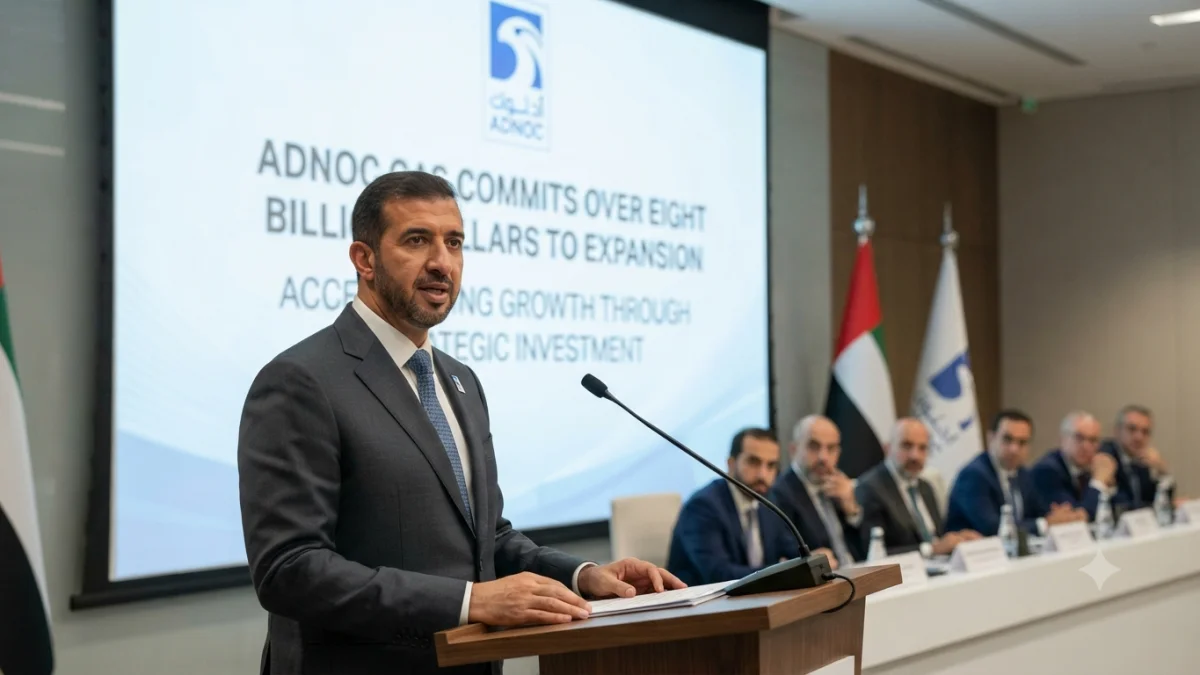


ADNOC Gas’ decision to award $8.2 billion in contracts for the next phases of its Rich Gas Development project marks a significant acceleration of the United Arab Emirates’ strategy to expand gas processing and capture more value from its domestic resources, even as regional conflict and disruption to shipping through the Strait of Hormuz weigh on the company’s near-term earnings.
The contracts, announced alongside ADNOC Gas’ second-quarter results on Monday, cover the second and third phases of the project. Wison Engineering will build a new gas-processing train at the Habshan complex under the $3.9 billion Phase 2 contract, while Tecnimont, part of Italy’s Maire, will build a natural-gas-liquids fractionation train at Ruwais under a $4.3 billion Phase 3 contract. Together with about $5 billion already committed to Phase 1, the Rich Gas Development project has reached a total investment of $13.2 billion.


The significance extends beyond the size of the contracts. ADNOC Gas is positioning gas processing as a core growth business at a time when the UAE is seeking to increase the value extracted from its gas resources while expanding LNG and downstream industries. The company says the new facilities will increase processing capacity and improve recovery of higher-value liquids for export, while providing additional feedstock for domestic industrial and petrochemical customers.
The investment also represents a substantial commitment relative to ADNOC Gas’ existing earnings base. The company generated record net income of $5.2 billion in 2025, according to its annual report, while its second-quarter 2026 net income fell 52% year-on-year to $665 million. The decline reflected disruption to sales associated with the closure of the Strait of Hormuz, although earnings exceeded the company’s guidance range of $400 million to $600 million.
That contrast illustrates the central business calculation behind the expansion. ADNOC Gas is committing capital to long-lived infrastructure despite unusually difficult operating conditions in its immediate region. The company expects to invest about $28 billion between 2026 and 2030 and has raised its target for EBITDA growth to 60% by 2030 compared with 2023, from an earlier goal of more than 40% growth by 2029.
A major source of resilience is the company’s domestic market. Reuters reported that roughly $1 billion of ADNOC Gas’ $1.7 billion first-half net income came from domestic customers. Chief Financial Officer Peter van Driel described the domestic business as the backbone of operational results. ADNOC Gas supplies about 60% of the UAE’s sales-gas requirements, giving the company an important role in the country’s industrial and energy system beyond its international exports.
The expansion also fits into a broader upstream-to-downstream strategy by Abu Dhabi National Oil Company. ADNOC has been advancing new gas developments that can provide additional feedstock for processing. In July, ADNOC announced a $6.2 billion final investment decision for the Umm Shaif Gas Cap, which is expected to unlock more than 600 million standard cubic feet per day of gas. ADNOC has also been developing the Bab Gas Cap, expected to provide additional gas and associated liquids.
The downstream side of the strategy is equally important. ADNOC said in July that 90% of the 9.6 million-tonne-per-year capacity of the Ruwais LNG project had been committed to international buyers through long-term arrangements. The project is scheduled to begin commercial operations in 2028 and is expected to more than double ADNOC Gas’ existing operated LNG production capacity once incorporated into its portfolio.
For ADNOC Gas, however, the expansion does not remove near-term risks. The company said maritime disruption through the Strait of Hormuz continued to affect product liftings during the second quarter and has assumed continued disruption in its third-quarter outlook. It expects third-quarter net income of $600 million to $800 million and full-year 2026 net income of $3.5 billion to $4 billion if maritime operations are fully restored by the fourth quarter and pricing conditions normalize.
Operational recovery is another issue being monitored. ADNOC Gas said security-related incidents at its Habshan complex in April temporarily disrupted operations, but gas supply has since recovered to 85%, ahead of its year-end target. The company has also said it is examining alternatives in response to the shipping disruption, without providing details.
The immediate confirmed picture, therefore, is one of aggressive long-term investment alongside significant short-term operational and geopolitical constraints. The $8.2 billion awards advance ADNOC Gas’ capacity expansion and form part of a $28 billion five-year investment program, while the company continues to manage the effects of disrupted maritime trade and recover infrastructure affected by regional security incidents. Investors and customers will be watching the restoration of Hormuz shipping, the recovery of Habshan operations and the execution of the Rich Gas Development phases as the principal near-term indicators of whether the planned expansion can translate into the company’s targeted growth.