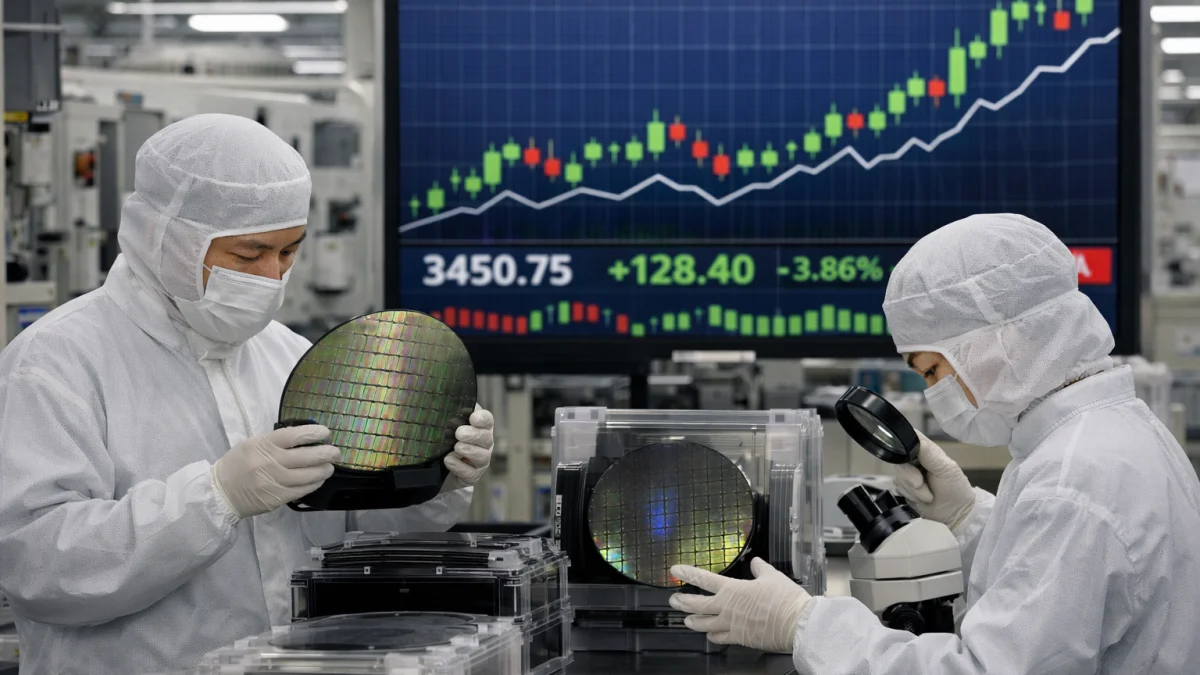


Strong demand for artificial intelligence infrastructure is reinforcing confidence across the semiconductor industry, even as broader equity markets remain volatile and investors weigh macroeconomic uncertainty, inflation data and shifting monetary policy expectations. The latest evidence comes from semiconductor equipment maker ASML, which raised its 2026 financial outlook after reporting stronger-than-expected quarterly results, adding to expectations that demand for advanced chips remains resilient across the AI supply chain.
The revised outlook is significant because ASML occupies a critical position in global semiconductor manufacturing. As the world's only supplier of extreme ultraviolet (EUV) lithography systems required to produce the most advanced chips, the company's order trends provide an early indication of investment plans by leading chipmakers including Taiwan Semiconductor Manufacturing Co. (TSMC), Samsung Electronics and major memory manufacturers. Strong demand for ASML's equipment therefore offers insight into future production capacity rather than simply reflecting current sales.


ASML increased its projected 2026 revenue to between 43 billion and 45 billion euros after reporting quarterly revenue and net income above analyst expectations. Chief Executive Christophe Fouquet attributed the stronger outlook to customers accelerating capacity expansion to meet sustained AI-related demand. The company also announced plans to increase production capacity for both EUV and deep ultraviolet (DUV) systems by roughly 30% over the next two years, aiming to reduce manufacturing bottlenecks that have constrained supply as investment in AI computing infrastructure has accelerated.
The announcement reinforces a broader pattern seen throughout the semiconductor sector during the past year. Cloud computing providers, technology companies and enterprise customers continue investing heavily in AI data centers, driving demand for advanced processors, high-bandwidth memory and increasingly sophisticated manufacturing technologies. Those investments extend beyond chip designers to foundries, equipment suppliers and materials companies, creating a broad-based expansion across much of the semiconductor value chain.
Attention has also focused on TSMC, whose earnings are widely viewed by investors as another important measure of AI-related demand. Analysts have projected another quarter of record profitability, supported by strong demand for advanced manufacturing technologies, including leading-edge process nodes and advanced chip packaging used in AI accelerators. Expectations that TSMC could raise its own annual growth outlook have further strengthened confidence that spending by major AI chip customers remains robust despite broader economic uncertainty.
The optimism surrounding AI has nevertheless unfolded against a more complicated market backdrop. Semiconductor shares have experienced periods of sharp volatility despite generally improving corporate fundamentals. Investors continue balancing strong earnings expectations against concerns over equity valuations, inflation trends, interest-rate policy and geopolitical risks affecting global technology supply chains. Market reactions have therefore often reflected broader shifts in investor sentiment rather than changes in underlying demand for advanced semiconductors.
Export controls remain another important factor shaping industry prospects. Restrictions led by the United States continue to limit exports of the most advanced semiconductor technologies to China, affecting sales opportunities for some manufacturers. Even so, ASML indicated that demand for less advanced DUV systems from Chinese customers remains substantial, illustrating that while trade restrictions are altering market dynamics, they have not eliminated demand for semiconductor manufacturing equipment.
Industry analysts note that expanding manufacturing capacity carries strategic importance beyond near-term financial performance. AI demand has repeatedly outpaced production capabilities for advanced chips, contributing to supply constraints across processors and memory products. Increased investment in lithography equipment and fabrication capacity could gradually ease those bottlenecks, although bringing new manufacturing facilities and equipment fully online typically requires several years. As a result, today's capital spending decisions are expected to influence semiconductor supply well beyond 2026.
The sector's outlook also reflects confidence that AI investment is broadening rather than depending on a single customer or application. Demand now spans hyperscale cloud providers, enterprise AI deployments, custom processors, memory products and networking infrastructure. This diversification has strengthened expectations that semiconductor demand may remain resilient even if growth moderates in individual market segments. At the same time, analysts caution that the pace of future expansion will continue to depend on sustained capital expenditure by major technology companies and broader economic conditions.
For investors, the latest forecasts suggest that AI remains one of the strongest structural growth drivers within the global technology industry, helping offset uncertainty affecting wider financial markets. Strong guidance from key suppliers indicates that investment plans throughout the semiconductor ecosystem remain intact despite short-term market fluctuations.
The current confirmed picture is one of continued strength in AI-related semiconductor demand, supported by higher revenue forecasts, expanding manufacturing capacity and expectations of robust earnings across major industry participants. Markets are now closely monitoring upcoming earnings from leading chipmakers, additional corporate guidance on AI capital spending, macroeconomic indicators and developments in global trade policy to assess whether the industry's current growth trajectory can be sustained.