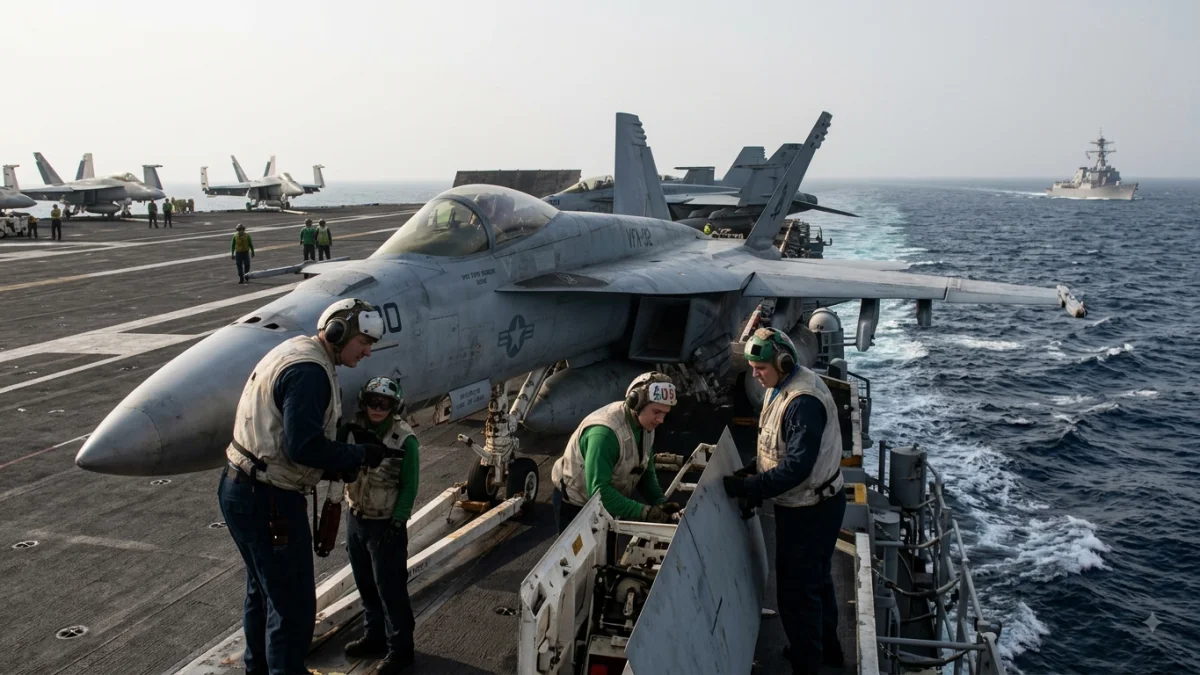


Extended Carrier Deployments Strain U.S. Forces in Iran Conflict
The U.S. Navy is moving the aircraft carrier USS George Washington toward the Middle East to relieve the USS Abraham Lincoln, which has remained deployed for more than 240 consecutive days as part of U.S. military operations against Iran. The planned rotation comes as scrutiny intensifies over the strain imposed on sailors by an unusually prolonged period at sea, exposing a broader challenge for Washington: sustaining a high-tempo regional campaign without exhausting the personnel and ships needed for longer-term military readiness.


The immediate issue is not whether the United States can maintain a carrier presence. Defense Secretary Pete Hegseth said the Navy can sustain its blockade of Iranian ports indefinitely by rotating ships in and out of the region. The more consequential question is how much operational and personnel pressure that rotation creates elsewhere in the fleet, particularly when the conflict has already required repeated extensions of deployments.
The Lincoln's deployment illustrates the problem. The carrier left San Diego in November 2025 and was subsequently redirected from the Indo-Pacific to the Middle East as tensions with Iran escalated. It has supported combat operations and the continuing maritime campaign around the Strait of Hormuz. Reports from U.S. media have described concerns among sailors and their families over mental-health pressures, limited opportunities to go ashore and shortages of some basic supplies. The Navy has disputed or sought to qualify some of those accounts, while acknowledging that the crew has been operating under significant pressure.
President Donald Trump's response on Aug. 14 underscored the disagreement over how serious the strain has become. Trump rejected the suggestion that the Lincoln had been deployed too long, saying its time at sea was “not nearly long enough.” Hegseth likewise argued that reports about conditions aboard the carrier had been misrepresented. At the same time, the administration is sending the George Washington to replace the Lincoln, indicating that the Navy nevertheless recognizes the need to rotate the force.
That distinction matters because an aircraft carrier is not simply a floating weapons platform. Its effectiveness depends on thousands of sailors, an embarked air wing, escorts, logistics and maintenance. Prolonged operations increase demands on personnel while postponing maintenance and training cycles that normally follow deployments. The Navy's recent experience shows how exceptional such extensions can become. The USS Gerald R. Ford returned in May after an 11-month deployment lasting 326 days, during which its strike group sailed more than 57,700 nautical miles and conducted 23 at-sea replenishments.
The current Iran campaign also comes after years in which the Navy has been asked to maintain commitments across multiple theaters. Public Navy tracking in July showed substantial numbers of U.S. ships deployed or underway globally. At the same time, the service must preserve carrier availability for other contingencies, including in the Indo-Pacific. Sending the George Washington from the Pacific toward the Middle East therefore represents more than a personnel rotation: it demonstrates the trade-offs created when a regional conflict consumes scarce high-end naval assets.
There is also an equipment dimension. Extended deployments can defer scheduled maintenance and reduce the time crews have to reset, train and prepare for subsequent missions. The Washington Post reported in April that the Ford's departure from the Middle East was driven partly by its need for repairs after roughly 10 months at sea, illustrating the tension between maintaining combat power in an active theater and preserving the fleet's longer-term availability.
For the Pentagon, rotating carriers offers a way to preserve pressure on Iran while avoiding keeping the same crew indefinitely in a demanding operational environment. But it does not eliminate the underlying burden. A replacement carrier still requires its own crew, escorts, aircraft, fuel, ammunition and logistical support, while the relieved force must eventually undergo maintenance and recovery.
The confirmed situation is therefore one of continued U.S. naval commitment alongside an effort to rotate forces after an unusually long deployment. The Navy has not publicly indicated that the Lincoln's mission represents a permanent change to normal deployment standards, and officials continue to dispute some reports about conditions aboard the ship. What remains under scrutiny is whether the pace and duration of the Iran operation can be sustained without creating wider personnel, maintenance and readiness pressures across the fleet. The movement of the George Washington, the eventual return and condition of the Lincoln, and Pentagon assessments of fleet readiness will provide the clearest indicators of how Washington is managing that balance.