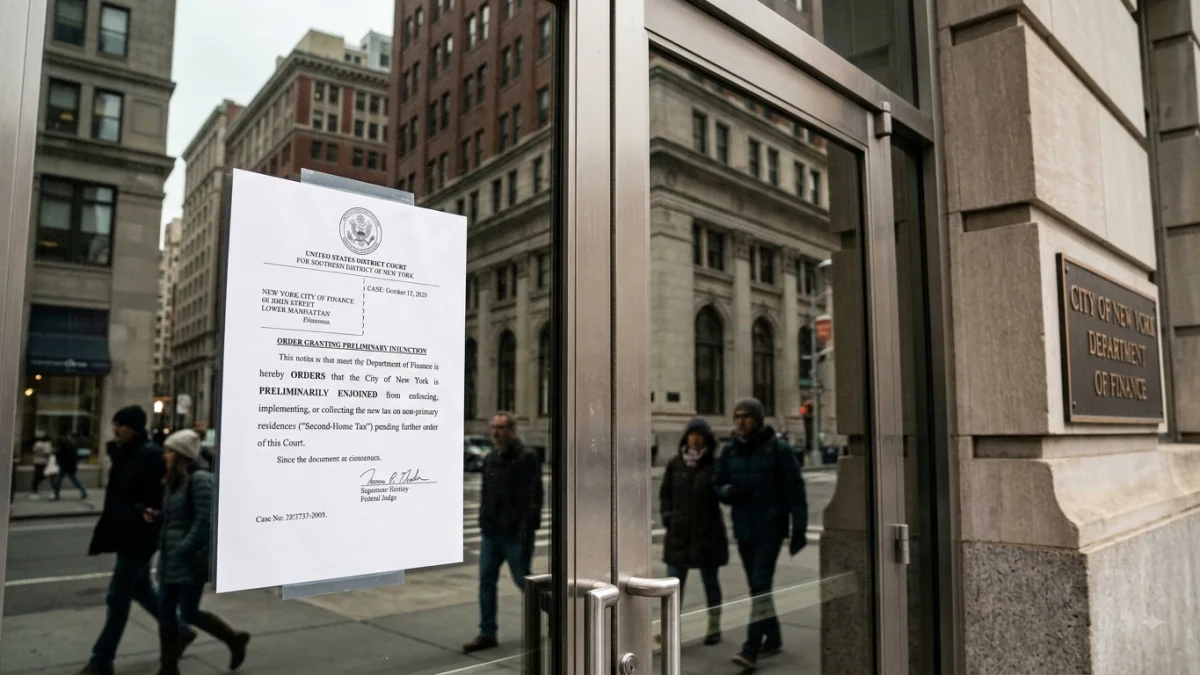


NEW YORK — A New York state appeals court has temporarily lifted a lower-court order that had paused New York City’s rollout of a new tax on luxury second homes, allowing the city to continue implementing the levy while the legal dispute proceeds, according to court reporting and legal filings. The judge who initially halted the rollout was a New York state Supreme Court justice, not a federal judge.
The tax, commonly known as the pied-à-terre surcharge, applies to certain non-primary residences, including one- to three-family homes valued at $5 million or more and condominium and cooperative apartments subject to the applicable $1 million threshold. The measure was included in New York’s 2026 state budget and is expected by city officials to raise about $500 million annually beginning in fiscal year 2027.


The dispute centers on how the city identified properties and notified owners during the initial rollout. The Department of Finance published a database containing roughly 900,000 property records for review and mailed about 17,000 notices to owners who could potentially be liable for the surcharge. Homeowners challenging the process argue that the city failed to make sufficient use of available records to determine primary residency before sending notices, placing an inappropriate burden on property owners to establish exemptions.
On Aug. 10, Staten Island Supreme Court Justice Wayne Ozzi temporarily restrained the city’s enforcement efforts after homeowners sued over the rollout. The order also required the city to remove the publicly posted list and suspend the mailed notifications, according to reports on the proceedings. The city appealed, arguing that the pause threatened the implementation schedule and the administration of the new tax.
The city has defended the tax itself and said its outreach was intended to identify properties that may require further review rather than establish that every listed owner owed the surcharge. Mayor Zohran Mamdani said in July that the administration was committed to ensuring the tax applied only to qualifying second homes.
The Department of Finance adopted rules governing the surcharge effective July 14, establishing the administrative framework for properties that do not serve as primary residences.
As of Aug. 14, the appeals process has allowed the rollout to proceed temporarily, while the underlying legal challenge remains unresolved. Further court proceedings are expected as the parties contest the city’s implementation of the tax.