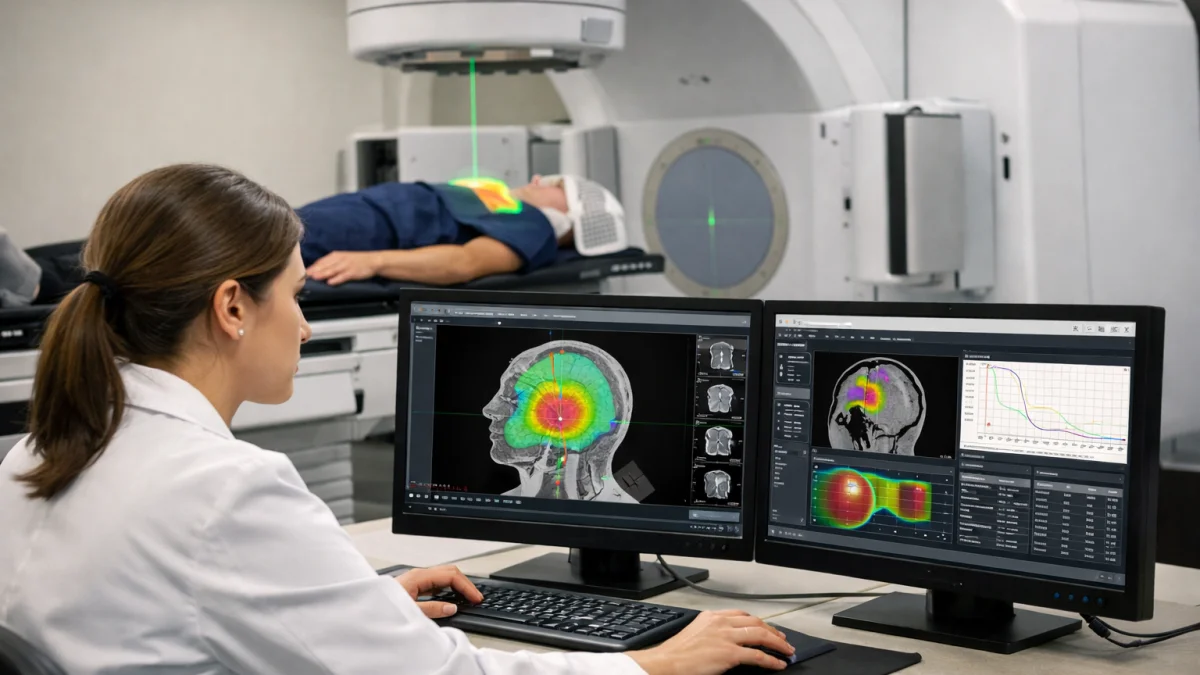
CHICAGO — New artificial intelligence tools are expanding capabilities in radiation therapy planning, with healthcare companies, researchers and cancer specialists reporting advances that could help streamline treatment preparation while maintaining clinical oversight, according to recent regulatory filings and published studies.
The latest developments come as healthcare providers seek ways to reduce the time-intensive process of designing radiation treatment plans for cancer patients. Earlier this month, the U.S. Food and Drug Administration granted 510(k) clearance to GE HealthCare’s MIM Contour ProtégéAI+ 2.0 software, an AI-enabled auto-contouring system designed to assist radiation oncology teams in treatment planning. The company said the updated software introduces additional imaging models, including tools for brain and pelvic anatomy, aimed at expanding clinical applications.
Radiation therapy planning typically requires clinicians to identify tumors and surrounding organs on medical images before determining how radiation doses should be delivered. Industry experts and researchers say AI-based contouring and planning tools can automate portions of that process, potentially reducing workload and improving consistency across cases.
“The FDA clearance includes a Predetermined Change Control Plan,” GE HealthCare said in a statement, adding that the framework is intended to support future software updates and expanded clinical functionality. The company said the software is designed to help care teams reduce planning time and focus on patient care.
Research published in 2026 has also highlighted broader efforts to incorporate AI into radiation oncology workflows. A perspective article in the journal npj Digital Medicine described what researchers called “Human-Centric Intelligent Treatment Planning,” an approach that combines AI-assisted plan generation with physician oversight and established clinical guidelines. The authors said the goal is to improve efficiency while keeping clinicians responsible for final treatment decisions.
Separate studies published this year have examined deep-learning systems for automated treatment planning and cloud-based planning platforms. Researchers reported that such systems may help generate treatment plans more efficiently for selected cancer types, although they emphasized the need for continued clinical validation and quality assurance before broader adoption.
Experts have also noted that AI applications in radiation oncology extend beyond contouring and planning. Recent reviews have examined AI-assisted motion tracking during MRI-guided radiotherapy and the use of large language models for workflow support, documentation and plan evaluation. Researchers cautioned that additional testing is required before many of these technologies become routine in clinical practice.
As of June 22, healthcare providers and regulators continued evaluating new AI-based radiation therapy tools. While adoption is increasing in some cancer centers, clinicians and researchers have said human review remains an essential component of treatment planning, and details regarding the pace of wider implementation remain unclear.