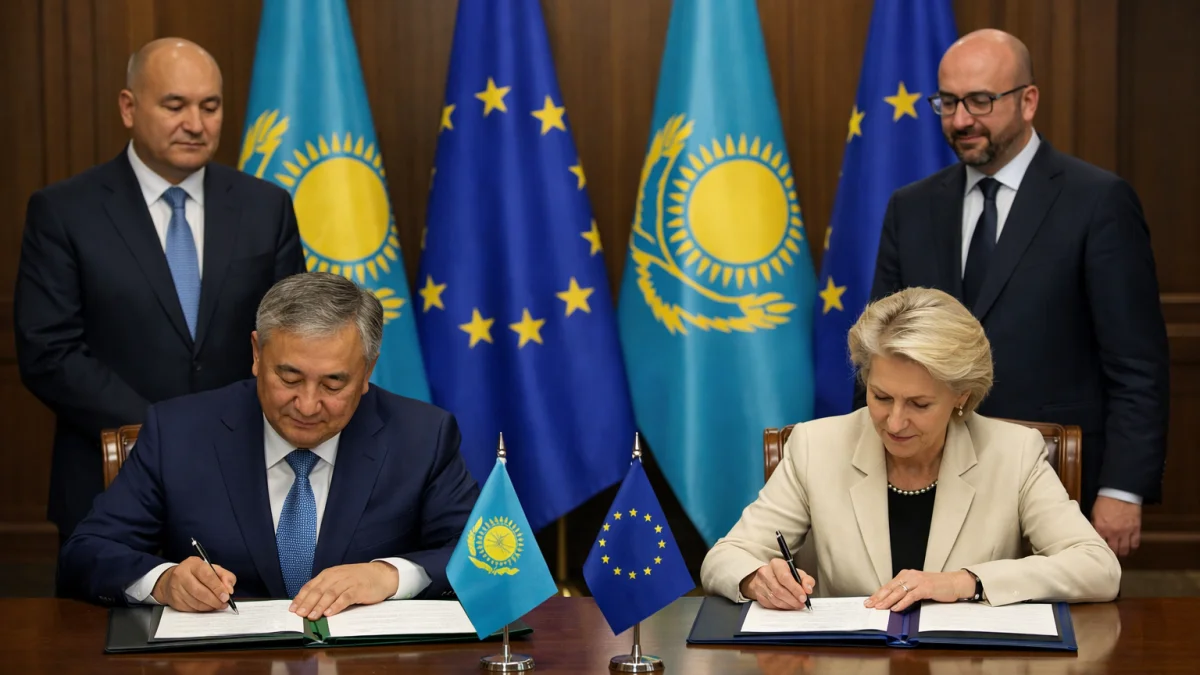


ASTANA — Kazakhstan and the European Union signed an expanded strategic partnership agreement on Monday, deepening cooperation on sustainable development, critical raw materials and green energy initiatives.
The agreement builds on existing frameworks, including the Enhanced Partnership and Cooperation Agreement (EPCA) and a 2022 memorandum on raw materials, batteries and renewable hydrogen. Officials from both sides described the move as advancing joint efforts in environmental sustainability and economic diversification.


Kazakhstan’s President Kassym-Jomart Tokayev and senior EU representatives participated in the signing ceremony in Astana. The pact emphasizes collaboration in critical raw materials supply chains, renewable energy projects and climate resilience measures, aligning with broader EU global gateway strategies.
EU officials highlighted Kazakhstan’s role as a key partner in diversifying supply sources for materials essential to the green transition. The expanded partnership includes provisions for technology transfer, joint investments and capacity building in sustainable mining and hydrogen production.
“This partnership represents the next chapter in our strategic relations, focusing on shared goals of green transformation and resilient supply chains,” an EU representative said in remarks following the signing.
The agreement comes amid ongoing implementation of the 2025-2026 roadmap for the raw materials partnership. It follows years of negotiations and builds on record bilateral trade figures, which reached nearly $50 billion in 2024 according to Kazakh officials.
Kazakhstan, rich in critical minerals, has positioned itself as a reliable supplier for European industries transitioning away from fossil fuels. The EU views the country as central to its efforts to secure diversified, sustainable sources of raw materials amid global supply chain challenges.
Both sides have committed to environmental standards, including responsible mining practices and support for Kazakhstan’s decarbonization goals. Details on specific financial commitments or project timelines remain unclear at this stage.
The signing also coincides with broader EU-Central Asia engagement on water, energy and climate issues. Earlier in 2026, high-level meetings in the region addressed regional connectivity and sustainable infrastructure.
Kazakh authorities and EU diplomats expressed satisfaction with the outcome, noting it strengthens long-term ties without altering existing trade balances. Further technical discussions are expected in the coming months to operationalize new provisions.
The agreement is expected to enter into force following necessary ratifications, with monitoring mechanisms to track progress on environmental and economic benchmarks.