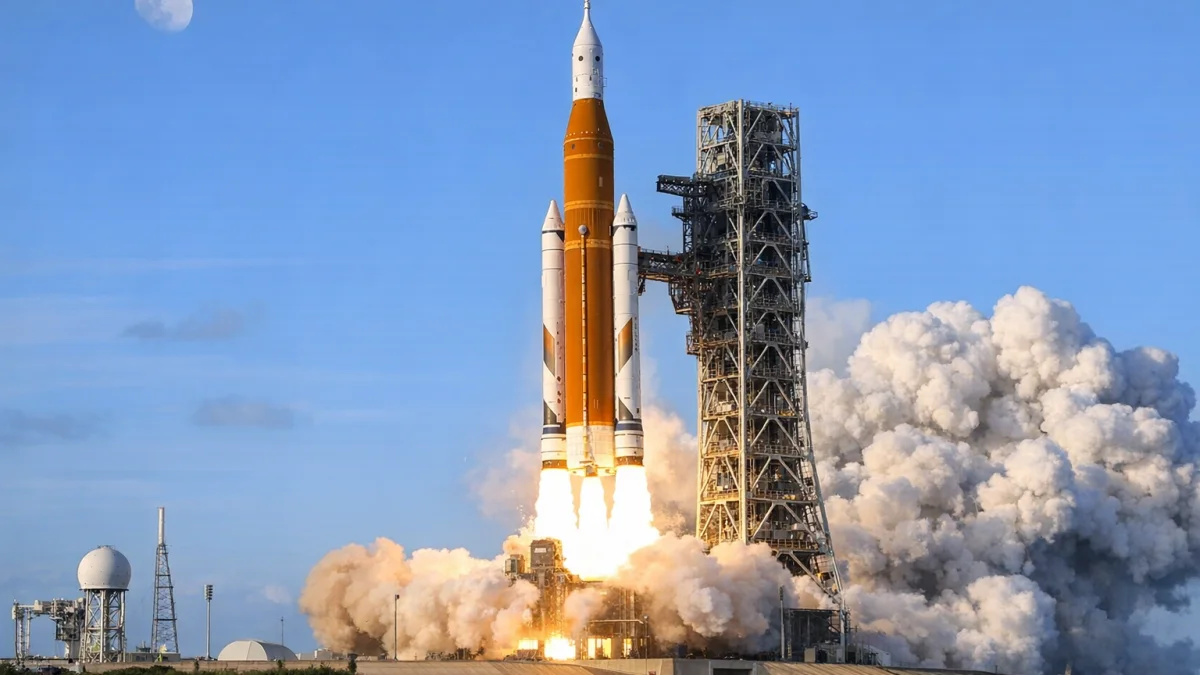


CAPE CANAVERAL, Fla. — NASA on Wednesday launched its Artemis II mission, sending four astronauts on a crewed journey around the Moon for the first time since 1972, the U.S. space agency said.
The spacecraft lifted off at about 6:24 p.m. Eastern Time from the Kennedy Space Center in Florida, according to NASA, marking the first time humans have been sent beyond low-Earth orbit in more than five decades. The mission carries three NASA astronauts and one Canadian astronaut aboard the Orion capsule, launched by the Space Launch System rocket.


NASA said the Artemis II crew — Reid Wiseman, Victor Glover, Christina Koch, and Canadian Space Agency astronaut Jeremy Hansen — is expected to spend about 10 days in space, traveling around the Moon without landing and returning to Earth with a planned ocean splashdown.
“This is a major step forward in our effort to return humans to the Moon and eventually go beyond,” NASA officials said in a statement ahead of the launch.
The mission follows the uncrewed Artemis I test flight in 2022 and is designed to evaluate the Orion spacecraft’s life-support systems, navigation, and communication capabilities with astronauts on board, NASA said.
During the flight, the crew is expected to travel more than 250,000 miles (about 400,000 km) from Earth, a distance comparable to or exceeding that reached during the Apollo era, according to NASA and media reports.
Officials said Artemis II is a key milestone in NASA’s broader Artemis program, which aims to establish a sustained human presence on and around the Moon later this decade. Future missions, including Artemis III, are planned to attempt lunar landings, NASA said.
The launch drew large crowds along Florida’s Space Coast, with local authorities and media estimating hundreds of thousands of spectators gathered to witness the historic liftoff.
NASA officials said weather conditions were favorable at the time of launch, with backup opportunities available in the coming days if needed.
As of Wednesday evening, the Orion spacecraft was in flight and performing initial mission operations, NASA said, with further updates expected as the crew proceeds on its planned trajectory around the Moon.