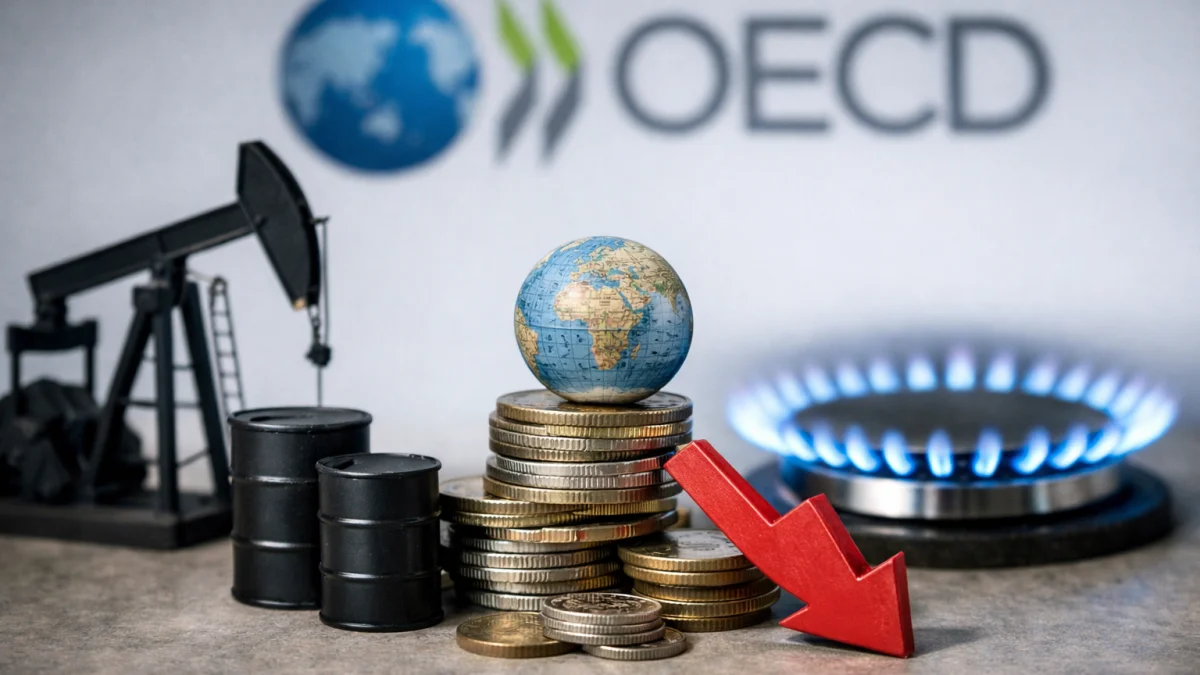


PARIS — The Organisation for Economic Co-operation and Development warned on Wednesday that an ongoing energy crisis linked to Middle East tensions threatens to weaken the global growth outlook.
In its latest Economic Outlook released in Paris, the OECD cut its global growth forecast for 2026 to 2.8 percent from a previous projection of 2.9 percent, citing rising energy prices and supply disruptions. The organisation said growth is projected to slow from 3.4 percent in 2025 before recovering to 3.1 percent in 2027 under a baseline scenario.


The Paris-based body highlighted risks from prolonged disruptions to energy flows from the Gulf region, particularly through the Strait of Hormuz. Under a more severe “prolonged disruption” scenario, global growth could slow to 2.1 percent in 2026 and 1.8 percent in 2027, levels associated with major past economic crises.
“Energy prices pose the biggest near-term risk,” the report stated, noting sharp increases in oil, natural gas and fertiliser prices triggered by the conflict.
The OECD said higher energy costs are fuelling inflation and pressuring household budgets and business expenses, particularly in energy-importing economies. Developing countries face greater challenges as households spend a larger share of income on energy and food.
The warning comes as commodity prices have risen significantly since late February 2026 amid geopolitical tensions. The baseline forecast assumes energy exports from the Gulf return to pre-conflict levels by the third quarter of 2026.
Major economies are expected to see uneven impacts. The United States is projected to see growth ease to 2.0 percent in 2026, while the euro area and other regions face downward revisions. The OECD noted that persistent high prices could prompt central banks to adjust interest rates further.
OECD Secretary-General Mathias Cormann emphasised the need for careful policy responses. "Governments must balance support for vulnerable households with fiscal sustainability while avoiding measures that distort energy markets," he said in remarks accompanying the report.
The organisation also released an updated energy support measures tracker, documenting government interventions to cushion the impact on households and firms. It cautioned that broad, open-ended subsidies used in previous crises carried high fiscal costs and could delay necessary adjustments.
As of Thursday, energy markets remained volatile with no immediate resolution in sight to the underlying tensions affecting supply routes. The OECD said details of potential further policy responses by member governments remain unclear.
The report urged stronger international cooperation on energy security and diversification to build resilience against future shocks.