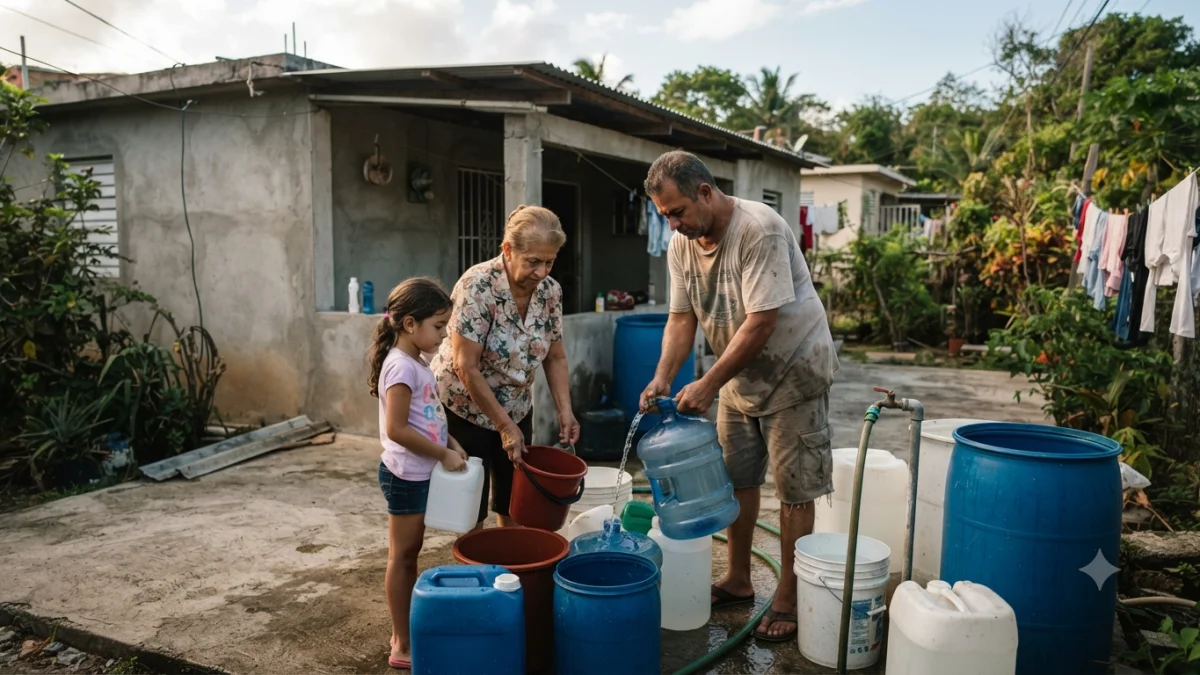


In Puerto Rico, families are learning to organize daily life around a new calendar: two days with running water, two days without it.
The rotating cuts began on Friday in parts of San Juan and six other municipalities as authorities confronted critically low supplies in the Carraízo reservoir. More than 180,000 customers are expected to lose water for 48 hours at a time under the current schedule, with the rationing planned to continue at least through August.


For households accustomed to preparing for hurricanes, the routines are familiar but the trigger is different. Instead of waiting for a storm to pass, residents are being asked to plan around an extended absence of rain.
The change has immediate consequences for basic health needs: drinking, cooking, bathing, cleaning and sanitation. Puerto Rico's Health Department has previously warned residents during water interruptions about safe storage and consumption, while maintaining surveillance for illnesses associated with contaminated water or inadequate sanitation. The water authority is now advising residents to boil water for at least three minutes after service returns because interruptions can create contamination risks.
For some Puerto Ricans, however, the new rationing schedule does not mark the beginning of the water crisis.
Bryan Pérez, a resident of the Villa Kennedy public housing complex in San Juan, was photographed by the Associated Press in June carrying a five-gallon water jug to his apartment. The image captured a problem that had already been spreading through communities before the drought-driven rationing began.
Community leader Marcia Soler París, 61, told the AP that her neighborhood had already endured severe shortages for months. The formal rationing schedule, she said, meant little to residents who were struggling to get water even before the new cuts.
“It’s chaos,” Soler París said, questioning how people could prepare for rationing when they did not have reliable water already. She said she was particularly concerned about bedridden and older residents who could not carry heavy containers to their homes.
That divide — between a planned interruption and an interruption that arrives unpredictably — has become central to the island's water problem.
The drought has made an already fragile system harder to manage. San Juan recorded its driest July since records began more than 120 years ago, according to the National Weather Service. By early August, nearly 68% of Puerto Rico was experiencing drought conditions, according to the U.S. Drought Monitor, while federal drought officials had documented declining streamflows, groundwater levels and reservoir supplies.
Federal drought officials said conditions had deteriorated sharply through May, June and July after a wetter-than-normal late winter and early spring. Their July assessment found severe drought across much of southern Puerto Rico and moderate drought over large portions of the island. Forecast models gave Puerto Rico more than a 70% chance of below-normal rainfall and above-normal temperatures from August through October.
The forecast offers little certainty to families trying to decide how much water to store.
Governor Jenniffer González has said she does not know how long rationing will be necessary. “This situation is out of our hands,” she said in a statement, attributing the crisis to the climate conditions the island has been facing.
The water authority has divided affected communities into two zones, alternating service every 48 hours. Water trucks are being deployed, with priority given to hospitals and long-term care facilities. The authority has also asked households to conserve water during periods when service is available and to avoid nonessential uses such as washing cars or watering lawns.
For public-health officials, the challenge extends beyond finding enough water to drink.
Interrupted service can complicate hygiene and sanitation, particularly for people who need assistance with bathing, toileting or cleaning. Puerto Rico's Health Department said during an earlier major interruption this year that its environmental-health division inspected water tankers to ensure safe transport of potable water and that epidemiologists were monitoring for increases in illnesses associated with contaminated water.
The current drought also exposes the limits of relying on household reserves. Some Puerto Rican homes have cisterns or other storage systems, but access to such infrastructure varies. For residents without sufficient storage, a 48-hour interruption can turn water from an ordinary utility into something that must be collected, carried and rationed.
And the shortage is not occurring in isolation.
Puerto Rico has faced water rationing before. During an earlier crisis, about 400,000 utility customers received water only every third day. The island's present system has also been weakened by long-standing infrastructure problems. San Juan Mayor Miguel Romero sued the Water and Sewer Authority in May over previous outages, while González has acknowledged decades of inadequate investment and maintenance.
That history complicates the explanation of the current crisis. The drought has reduced the amount of water available, but some communities had already experienced prolonged interruptions unrelated to the weather. The Associated Press reported that thousands of residents had faced shortages for as long as a year before the present rationing measures.
Luis González Delgado, president of Puerto Rico's water and sewer authority, has acknowledged the immediate problem in simpler terms: “There’s just not enough water.” He has warned that rationing could spread to additional communities if conditions deteriorate.
For families, that uncertainty makes the schedule itself part of daily life. Laundry, cooking and cleaning must be fitted into the hours when water flows. Containers have to be filled before the next cutoff. Drinking water must be kept separate and protected. When the supply returns, residents must take precautions before treating it as safe.
Meanwhile, the weather offers no reliable timetable for relief. Federal forecasters expect drought conditions to persist or expand into the fall, with strengthening El Niño conditions projected to suppress some of the tropical weather systems that normally contribute rainfall to the region.
Puerto Rico's water crisis therefore reaches beyond the question of how much water remains in a reservoir. It is a test of whether families, public-health services and an aging distribution system can maintain basic routines when an essential service becomes intermittent.
For residents such as Soler París, the most vulnerable households are the clearest measure of that test. Her concern about people who cannot carry their own water points to a problem that a rationing timetable cannot solve by itself: when water becomes something that must be stored, moved and managed by hand, the burden falls differently on different households.
And as the island enters August with no assurance of rain, that burden is being measured not simply in gallons, but in the ability to keep everyday life — and basic health — going until the taps run again.