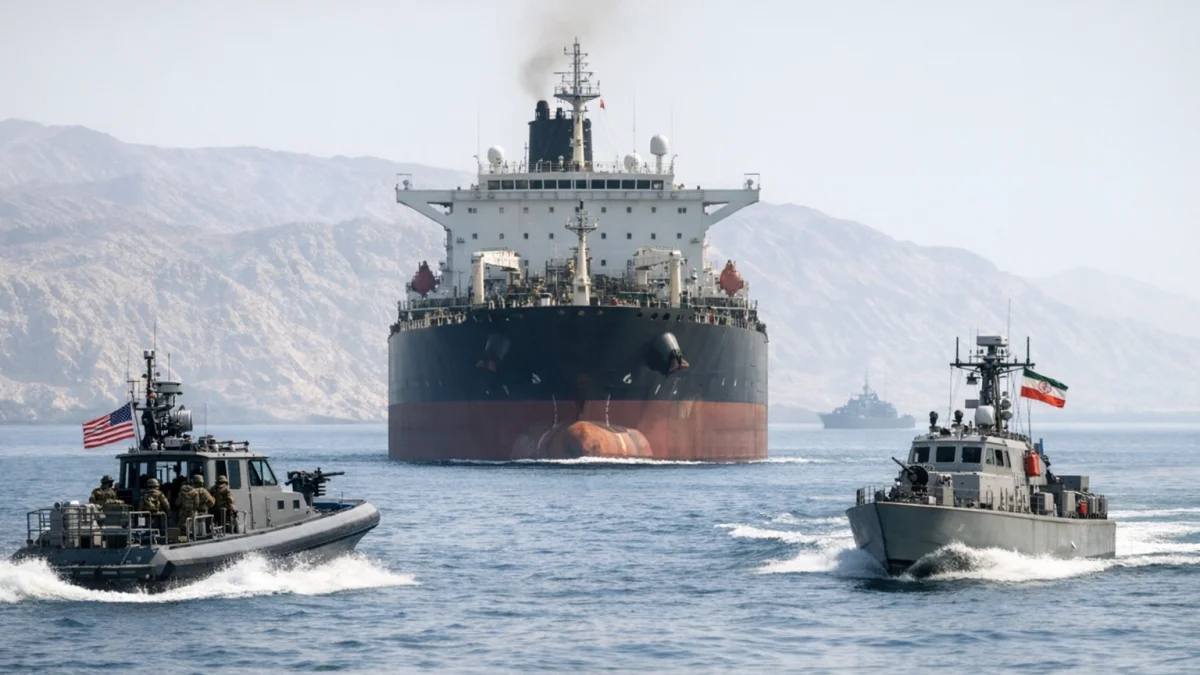


DUBAI — Shipping traffic through the Strait of Hormuz remained heavily restricted on Thursday despite a two-week ceasefire agreement between the United States and Iran announced on Tuesday, maritime tracking data and officials said.
Only a handful of vessels, including a tanker and several dry bulk carriers, have been allowed to pass through the strategic waterway since the truce took effect, according to shipping monitors. Iran’s Islamic Revolutionary Guard Corps stated that shipping largely stopped after Israeli strikes on Lebanon on Wednesday, which Tehran described as a violation of the ceasefire framework.


The ceasefire, mediated in part by Pakistan, included provisions for the reopening of the Strait of Hormuz, a narrow chokepoint through which about one-fifth of global oil and gas trade normally passes. U.S. President Donald Trump said the agreement was contingent on the “complete, immediate, and safe opening” of the strait. Iranian officials indicated they would permit limited passage under their control, potentially starting Thursday or Friday ahead of planned talks in Islamabad.
A senior Iranian official told Reuters that the strait could be opened in a “limited” manner under Iranian oversight if progress was made on a framework for negotiations. However, as of Thursday, traffic remained at a near standstill, with shipping companies reporting ongoing uncertainty over permitting requirements and coordination with Iranian authorities.
The restrictions followed Iran’s response to Israeli airstrikes in Lebanon on Wednesday that targeted Hezbollah positions. Iran’s Foreign Minister Abbas Araghchi accused the U.S. of violating ceasefire terms by allowing the attacks to continue, stating on X: “The Iran–U.S. Ceasefire terms are clear and explicit: the U.S. must choose -- ceasefire or continued war via Israel. It cannot have both.”
U.S. officials and Israeli Prime Minister Benjamin Netanyahu maintained that the truce applied only to direct U.S.-Iran hostilities and did not cover Israel’s operations against Hezbollah in Lebanon. The White House demanded that Iran reopen the strait without restrictions or tolls, describing any continued closure as unacceptable.
Iranian media and officials had earlier signaled a temporary closure of the waterway in retaliation for the Lebanese strikes. Shipping data showed minimal movements in the 24 hours after the ceasefire announcement, with some reports indicating that Iran was allowing no more than a limited number of vessels per day.
The broader context involves more than a month of regional conflict that began with escalations involving Iran, the U.S., Israel and allied groups, leading to disruptions in Gulf shipping. Pakistan’s Prime Minister Shehbaz Sharif stated that the ceasefire applied “everywhere, including Lebanon and elsewhere,” a position Iran has cited but which the U.S. and Israel have disputed.
As of Thursday evening, diplomats were preparing for talks between U.S. and Iranian officials scheduled to begin in Pakistan this weekend. Iranian authorities indicated forces remained on alert, while U.S. officials said American troops would stay in position in the region until full compliance with the agreement.
The status of shipping through the Strait of Hormuz continued to evolve, with details on exact volumes and conditions remaining unclear as monitoring continued.