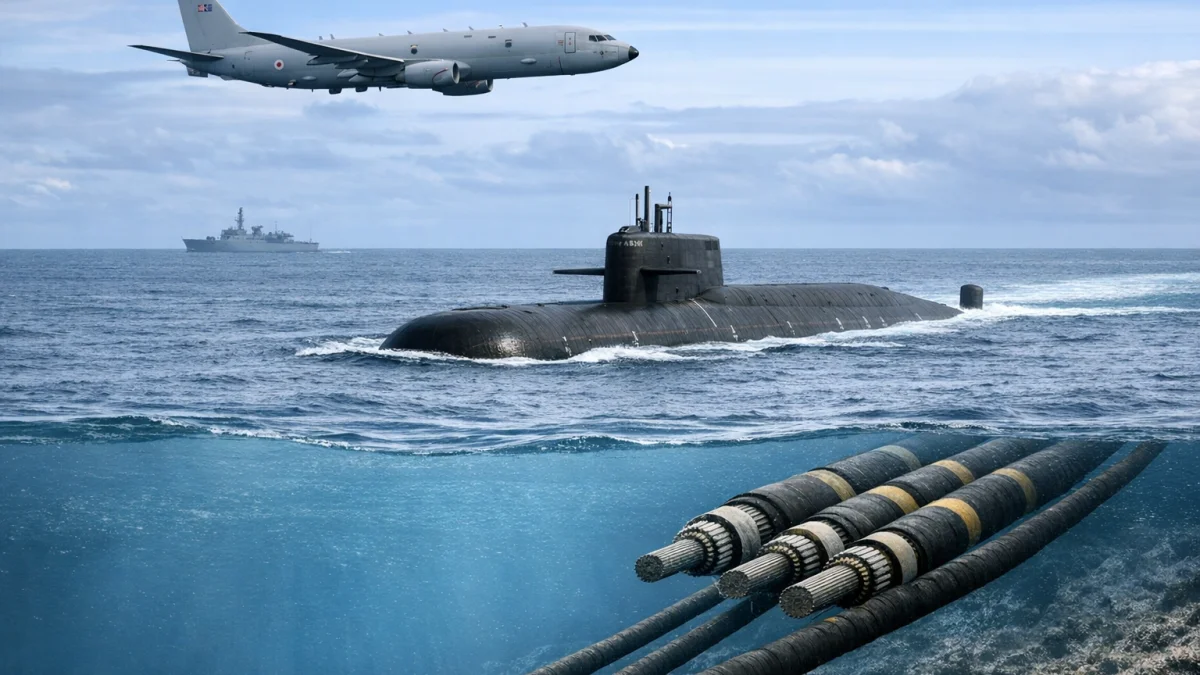


LONDON — The United Kingdom tracked three Russian submarines operating near vital undersea cables and pipelines in the North Atlantic for more than a month, forcing them to retreat, Defence Secretary John Healey said on Thursday.
A Royal Navy Type 23 frigate, HMS St Albans, along with Royal Air Force P-8 maritime patrol aircraft and support vessels including RFA Tidespring, monitored the Russian vessels around the clock with involvement from allies, including Norway. The operation involved more than 500 British personnel and saw aircraft fly over 450 hours while the frigate covered several thousand nautical miles, Healey told a Downing Street press conference.


Healey described the activity as a covert Russian operation involving one Akula-class attack submarine acting as a diversion while two Gugi-class spy submarines from Russia’s deep-sea research directorate conducted surveillance over critical infrastructure. Subsea fibre optic cables carry over 99% of international data traffic, including voice calls and internet data, making them essential for global communications.
“In response to the Russian submarines, I can confirm that I deployed our Armed Forces to track and deter any malign activity by these vessels,” Healey said. “A Royal Navy warship and Royal Air Force P-8 aircraft alongside allies ensured that the Russian submarines were monitored 24/7.”
The submarines eventually retreated toward Russia after sustained monitoring, according to the UK Ministry of Defence. Healey directed a message to Russian President Vladimir Putin: “We see your activity over our cables and our pipelines. And you should know that any attempt to damage them will not be tolerated, and will have serious consequences.”
The incident forms part of a broader pattern of increased Russian naval activity in the region. UK officials have previously noted a resurgence in Russian submarine and underwater operations, including efforts to map undersea infrastructure. This has prompted the development of the Atlantic Bastion programme, which combines crewed warships, aircraft and uncrewed autonomous systems with AI to enhance protection of cables and pipelines in the North Atlantic.
No damage to the infrastructure was reported, and details on the precise location and exact duration beyond “more than a month” remained limited in official statements.
As of Thursday, the Russian submarines had left the immediate area of UK interest, the Ministry of Defence said. UK and allied forces continued monitoring operations in the North Atlantic to safeguard critical undersea infrastructure.