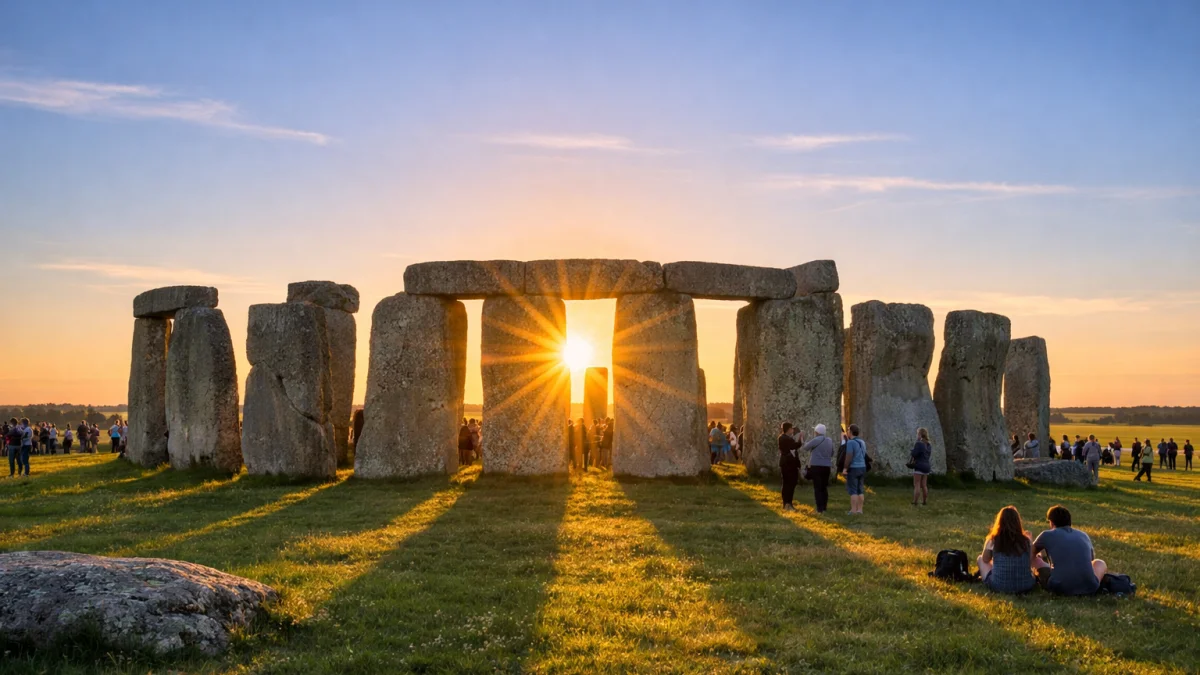


LONDON — Communities across the Northern Hemisphere marked the summer solstice over the weekend, as the annual astronomical event brought the longest day and shortest night of the year to countries across Europe, North America and much of Asia, according to astronomical agencies and observatories.
The solstice occurred on June 21, marking the beginning of astronomical summer in the Northern Hemisphere and astronomical winter in the Southern Hemisphere. Astronomers said the event takes place when Earth’s Northern Hemisphere is tilted most directly toward the sun, resulting in the greatest amount of daylight for locations north of the equator.


“The June solstice marks the longest day north of the equator and the shortest day in the south,” the astronomy information service Time and Date said in an explanation of the event.
Public celebrations were held in several countries, including at Stonehenge in southern England, where visitors gathered before sunrise to observe the alignment between the ancient monument and the rising sun. Similar seasonal festivals and cultural observances took place elsewhere in Europe, including traditional midsummer events in Nordic countries.
According to astronomers, the solstice is a precise moment rather than an all-day event. It occurs when the sun reaches its northernmost position relative to Earth, appearing directly above the Tropic of Cancer. The phenomenon results from Earth’s axial tilt of about 23.5 degrees rather than changes in the planet’s distance from the sun.
Scientists noted that daylight duration varies significantly by latitude. Areas near the Arctic Circle experienced nearly continuous daylight, while locations closer to the equator saw comparatively smaller seasonal differences. At the North Pole, the sun remained above the horizon throughout the period, while the South Pole remained in continuous darkness, according to astronomical organizations.
Meteorological agencies and astronomy groups used the occasion to provide educational information about seasonal changes, the distinction between astronomical and meteorological seasons, and the role of Earth’s orbit and tilt in shaping annual weather patterns.
The summer solstice has been observed for centuries by civilizations around the world and continues to hold cultural and religious significance in some communities. Historians and heritage organizations said gatherings linked to the event remain among the most widely recognized seasonal traditions.
As of Sunday, celebrations had concluded in many locations, while astronomical organizations noted that daylight hours in the Northern Hemisphere would gradually begin to shorten in the weeks ahead, even as summer continues through September. Officials reported no major disruptions associated with the observances, and seasonal events remained ongoing in some regions.