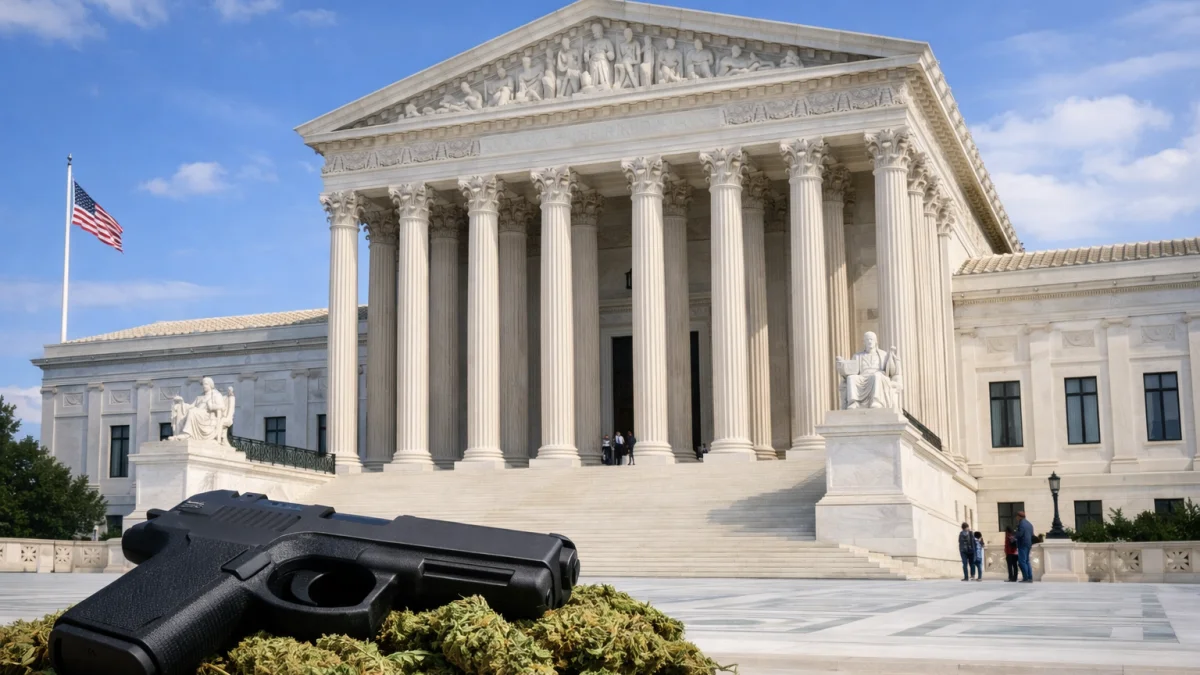


WASHINGTON — The U.S. Supreme Court on Thursday limited the application of a federal law banning gun possession by unlawful drug users, ruling unanimously that it cannot be used to prosecute a Texas man who regularly smoked marijuana.
In a 9-0 decision in *United States v. Hemani*, the justices held that the law, as applied to Ali Danial Hemani, violated his Second Amendment rights. Hemani, a dual U.S.-Pakistani citizen, admitted to using marijuana about every other day when authorities found a legally purchased Glock pistol and marijuana in his home.


The case centered on 18 U.S.C. § 922(g)(3), part of a 1968 federal law that prohibits firearm possession by anyone who is an “unlawful user of or addicted to any controlled substance.” Justice Neil Gorsuch wrote the opinion, stressing the ruling’s narrow scope.
Gorsuch noted that the government must show a risk of dangerous behavior tied to drug use for such restrictions to apply, rather than imposing a categorical ban based on marijuana use alone. The decision referenced historical traditions under the Second Amendment and marijuana’s widespread acceptance, including its reclassification by the federal government.
The ruling comes amid shifting state laws legalizing marijuana in many jurisdictions. It does not broadly invalidate the statute and leaves intact prohibitions for addicts or those whose drug use demonstrably poses a public safety threat.
The Trump administration had defended the law’s application. Critics, including gun-rights advocates and civil liberties groups, argued it overreached. The American Civil Liberties Union, which represented Hemani, welcomed the outcome.
“This unanimous 9-0 decision makes it clear that the government cannot make it a crime for people to own a gun, which the Supreme Court has held is a fundamental constitutional right, simply because they use marijuana,” said Cecillia Wang, the ACLU’s legal director.
The decision also drew attention because the same statute was used to prosecute Hunter Biden, though the court’s narrow holding may not fully shield similar cases involving other substances.
Legal experts said the ruling could affect prosecutions of casual marijuana users who own firearms but is unlikely to eliminate all restrictions in the area. Details on broader implementation remain subject to lower court proceedings and future cases.
As of Friday, the Justice Department had no immediate public comment on next steps following the decision.