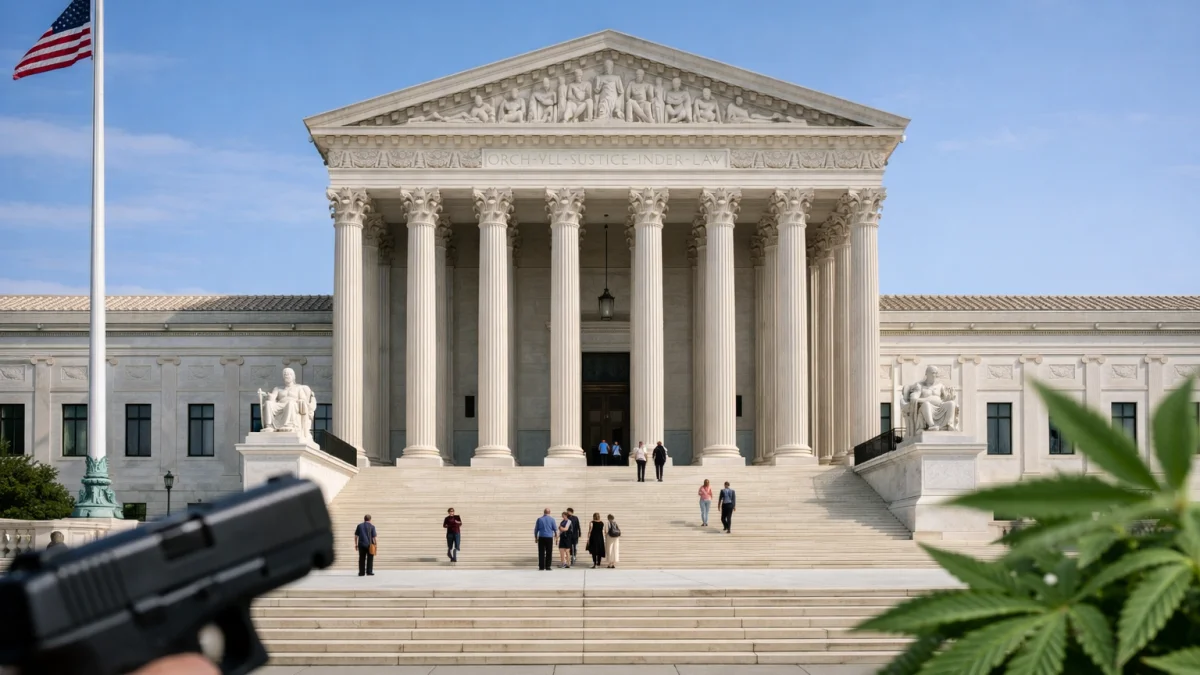


WASHINGTON — The U.S. Supreme Court ruled unanimously that a federal gun law used to prosecute a Texas man who regularly used marijuana was unconstitutional as applied in his case, limiting the government's ability to broadly bar firearm possession by people based solely on unlawful drug use. The decision, issued on June 18 and drawing continued attention on Monday, centered on the prosecution of Ali Danial Hemani under a provision of federal law that prohibits firearm possession by unlawful users of controlled substances.
Writing for the court, Justice Neil Gorsuch said the government's application of the law violated the Second Amendment rights of Hemani, who acknowledged using marijuana several times a week but was not accused of using a firearm while intoxicated or of engaging in other criminal conduct involving the weapon. The ruling did not strike down the statute entirely but narrowed how it may be enforced.


“We appreciate that drugs and guns can sometimes make for a dangerous mix,” Gorsuch wrote. However, the court concluded that the government had failed to show that disarming Hemani was consistent with the nation's historical tradition of firearm regulation.
The case, known as United States v. Hemani, arose after federal agents found a pistol and marijuana during a search of Hemani's Texas residence. Prosecutors charged him under a provision of the 1968 Gun Control Act that bars firearm possession by unlawful users of controlled substances. Hemani challenged the law, arguing that it violated constitutional protections for gun ownership.
The federal government defended the law, arguing that drug use can impair judgment and increase risks associated with firearm possession. The Supreme Court, however, found that the government's historical analogies, including restrictions aimed at habitual drunkards, did not justify such a broad prohibition when applied to a person not shown to be dangerous.
Several justices wrote separate opinions agreeing with the outcome while emphasizing the narrow scope of the ruling. According to the court's opinion, the decision does not address restrictions on people who are addicted to drugs, currently intoxicated, or otherwise shown to pose a danger to themselves or others.
The ruling is expected to affect future prosecutions under the federal statute, particularly in cases involving marijuana users. Marijuana remains illegal under federal law, although its use has been legalized or decriminalized in many U.S. states.
The Justice Department has not announced any immediate changes to enforcement policy following the decision. Details of how lower courts will apply the ruling in future cases remain unclear.