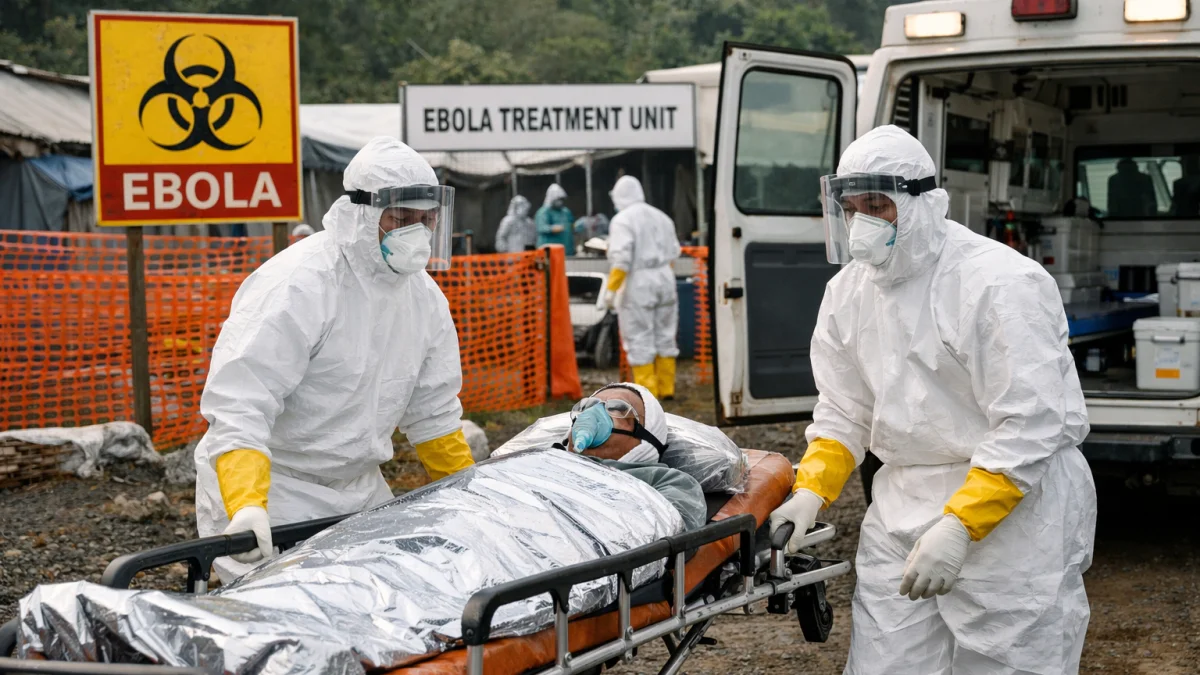


KINSHASA — A rapidly growing Ebola outbreak in the Democratic Republic of the Congo has surpassed 1,100 confirmed cases, prompting renewed concern from international health agencies as officials warn that transmission continues to outpace response efforts in parts of the country.
Congo’s communications ministry said in a situation report released on Wednesday that the number of confirmed Ebola cases had risen to 1,118, including 291 deaths. The outbreak is centered in the country’s eastern provinces and involves the Bundibugyo strain of the virus, for which there is no approved vaccine or treatment.


The World Health Organization (WHO) said this week that the outbreak remains “fast-moving” and has recorded more than 1,000 infections in Congo, along with additional cases in neighboring Uganda. WHO Director-General Tedros Adhanom Ghebreyesus said response teams continue to face operational challenges, including insecurity and threats against healthcare workers.
“The outbreak is still outpacing the response,” Tedros told reporters during a media briefing on Tuesday, according to WHO. Health officials said the virus circulated for months before it was formally detected in May, complicating efforts to identify chains of transmission and contain its spread.
According to WHO, the outbreak remains concentrated in Ituri province, which accounts for the vast majority of confirmed infections. Cases have also been reported in North Kivu and South Kivu provinces. Health authorities have expanded testing capacity and intensified contact-tracing efforts, though access remains difficult in some conflict-affected areas.
International concern increased after France confirmed its first Ebola case linked to the current outbreak. French authorities said on Wednesday that a doctor returning from a humanitarian mission in Congo tested positive for the virus and was placed in isolation. Officials said the risk to the broader public remained low and that contact-tracing efforts were underway.
WHO said Uganda has reported a smaller number of cases connected to transmission originating in Congo. As of mid-June, Ugandan authorities had not reported widespread community transmission, according to the agency.
The outbreak has unfolded in a region affected by armed conflict and large-scale population displacement. WHO and Congolese health authorities have reported incidents targeting medical personnel and health facilities, which have disrupted surveillance and treatment operations.
Health officials said testing capacity has increased substantially in recent weeks, allowing laboratories to process a backlog of samples and improve detection of new cases. Authorities cautioned that some recent increases in case numbers reflect improved reporting rather than newly acquired infections alone.
As of June 25, WHO and Congolese authorities continued to expand response measures, while international agencies warned that sustained funding, security and community cooperation would be critical to slowing the outbreak’s spread.