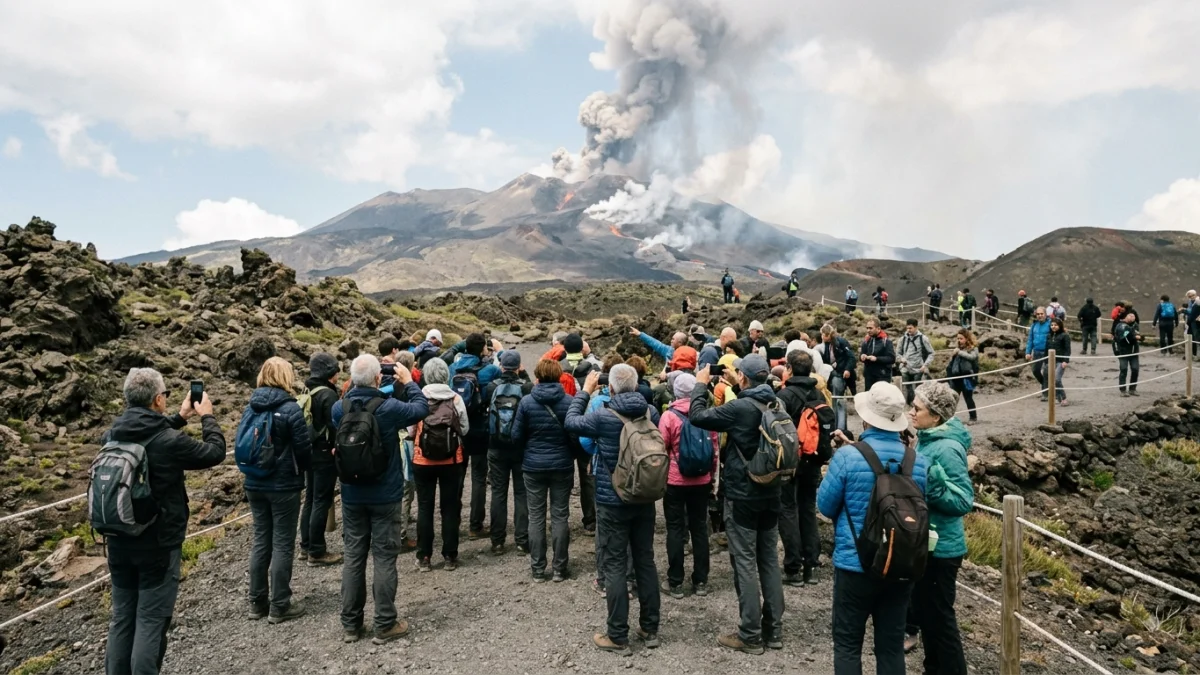


CATANIA — Tourists gathered on the slopes of Mount Etna on Thursday to watch lava and volcanic emissions from Sicily’s active volcano, even as ash from renewed activity disrupted air travel and authorities urged visitors to observe safety restrictions.
Images of glowing lava moving down the volcano’s slopes have drawn visitors seeking views of the eruption, according to local media reports. The activity has coincided with the peak summer tourism season in Sicily, increasing attention around the volcano and its surrounding areas.


Mount Etna, one of Europe’s most active volcanoes, has been showing renewed activity since late July. The National Institute of Geophysics and Volcanology (INGV) said in a July 30 update that effusive activity had begun in the upper Valle del Leone at an elevation of about 2,700 metres, while Strombolian activity continued at the Voragine crater. Lava was also being emitted into the Northeast Crater, accompanied by ash moving southwest.
The renewed volcanic activity has had consequences beyond the mountain itself. An ash cloud from Etna drifted roughly 220 km south toward Malta on Tuesday, disrupting flights and prompting the cancellation of 19 flights, while others were delayed, Reuters reported. Catania airport, one of Sicily’s busiest, also temporarily restricted operations because of the ash.
Italian authorities have maintained heightened monitoring of Etna. The Civil Protection Department raised the volcano’s alert level to yellow in June and entered a pre-alert phase, specifically citing the potential presence of hikers at high elevations and the possibility that volcanic activity could intensify rapidly.
The concentration of visitors around an active volcano has renewed attention on the risks faced by tourists who approach areas affected by lava, ash or other volcanic hazards. Authorities have previously emphasized the need for visitors and local organizations to follow restrictions and civil protection instructions when volcanic activity changes.
Etna’s activity can fluctuate rapidly, and its aviation status has also changed repeatedly during periods of heightened activity. INGV records show aviation alerts reaching red during episodes of increased activity in late July before being lowered again.
As of Thursday, tourists continued gathering to observe the eruption from permitted areas while volcanic activity and its effects on aviation remained under monitoring.