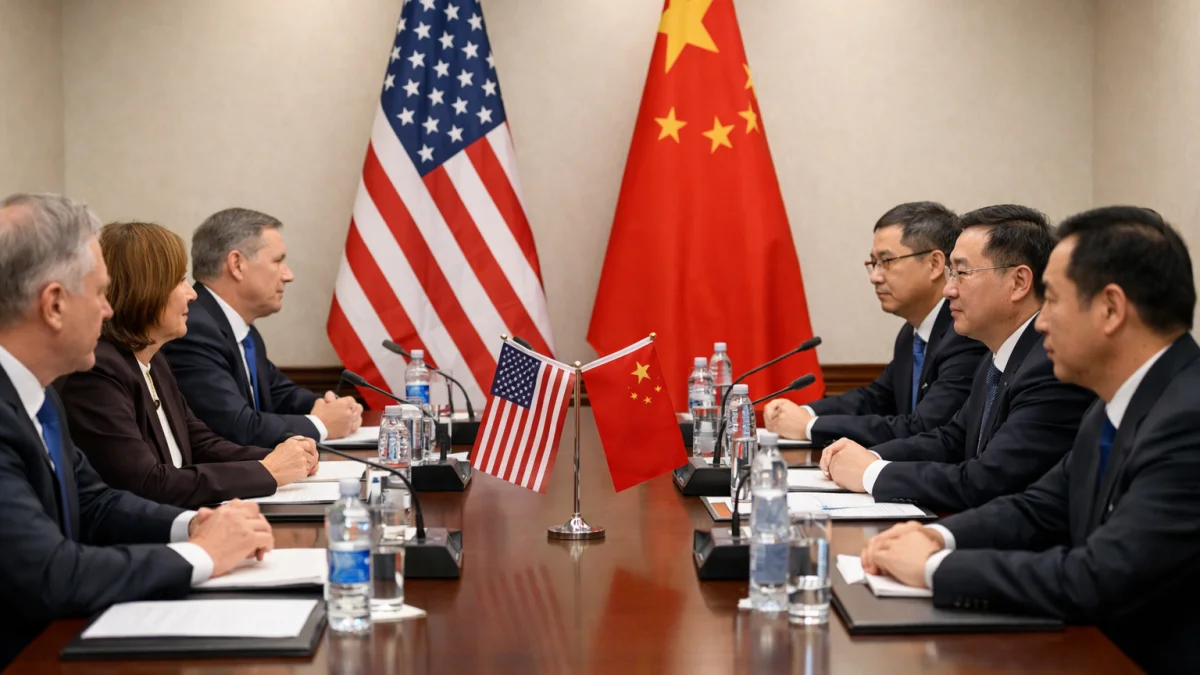


WASHINGTON — Senior U.S. and Chinese officials are set to hold follow-up trade discussions this week as both sides work to implement agreements reached during a May summit between President Donald Trump and Chinese President Xi Jinping.
The talks come amid efforts to manage bilateral economic relations following the leaders' meeting in Beijing, where the two sides established new mechanisms including the U.S.-China Board of Trade and the U.S.-China Board of Investment.


U.S. officials described the upcoming meetings as focused on operational details of the framework agreed upon earlier. A White House fact sheet released after the May summit outlined commitments including China's pledge to purchase at least $17 billion per year of U.S. agricultural products through 2028, in addition to prior soybean commitments.
"These discussions build on the constructive outcomes from the leaders' summit," a U.S. Treasury official said, speaking on condition of anonymity to discuss ongoing negotiations. Details of the schedule and specific agenda for this week's talks remain unclear.
The May summit produced consensus on several issues aimed at enhancing stability in the economic relationship between the world's two largest economies. These included steps to address U.S. concerns regarding access to critical minerals and Chinese commitments related to agricultural and industrial goods.
Trade relations between the U.S. and China have fluctuated in recent years, with periods of heightened tariffs and restrictions followed by efforts to de-escalate tensions. Earlier rounds of negotiations in 2025, including talks in locations such as Geneva, London, and elsewhere, addressed tariff levels, export controls, and other issues.
The newly established Board of Trade is intended to serve as a forum for managing bilateral trade in non-sensitive goods, while the Board of Investment provides a platform for discussing investment-related matters, according to statements from both governments.
U.S. Commerce Secretary Howard Lutnick and other officials have previously characterized similar discussions as productive, though both sides have emphasized the need for continued dialogue on implementation.
Chinese officials have similarly affirmed commitments to the agreements reached in Beijing. The foreign ministry has stated that China intends to deliver on its pledges, while calling for both parties to abide by the consensus.
Markets have closely watched developments in U.S.-China trade relations, with potential implications for global supply chains, agricultural exports, and technology sectors. However, officials from both countries have avoided providing specific timelines for further outcomes beyond the immediate follow-up talks.
The resumption of discussions this week represents the latest step in ongoing efforts to maintain predictability in the bilateral economic relationship. Further details on any agreements or progress are expected to emerge in the coming days, according to government readouts.