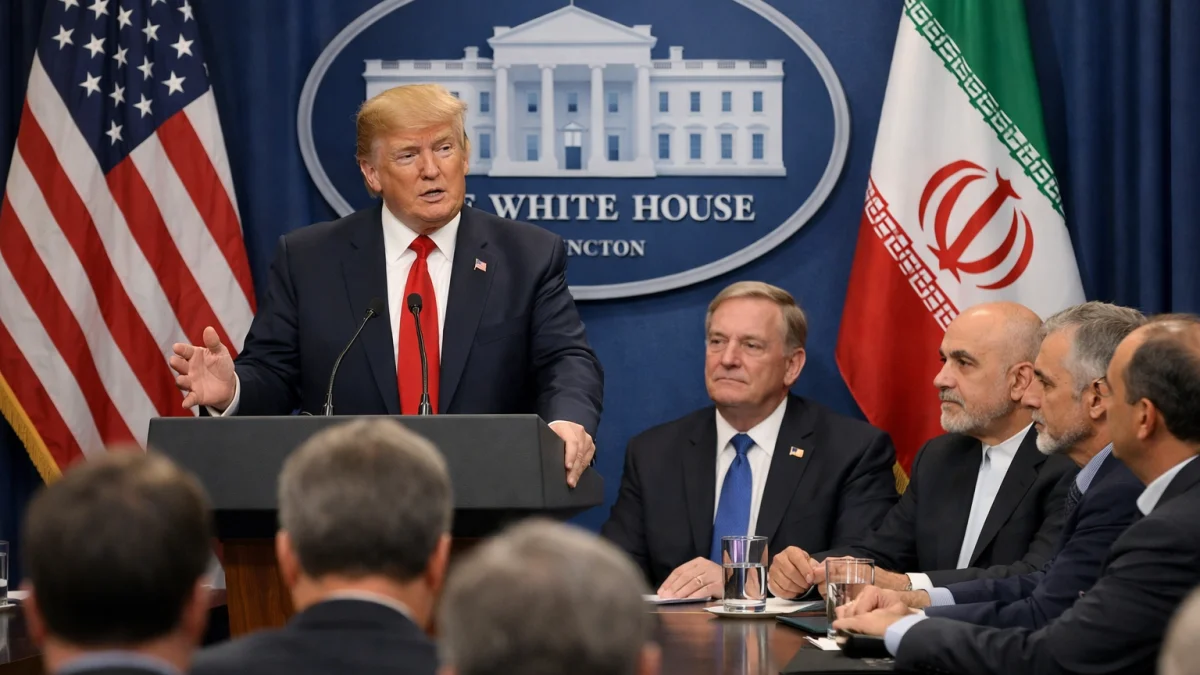


WASHINGTON — U.S. President Donald Trump said on Thursday he canceled planned military strikes against Iran, citing progress in high-level peace talks aimed at ending the ongoing conflict, the White House and officials confirmed.
Trump announced the decision in a post on Truth Social, stating that discussions with Iranian leadership had reached the highest levels and received approval from multiple parties involved. The cancellation came hours after he had threatened additional strikes following recent exchanges of attacks between U.S. and Iranian forces.


“Based on the fact that discussions with the Islamic Republic of Iran have been brought to the highest level of Iranian leadership and approved, I have, as President of the United States of America, cancelled the scheduled strikes and bombings against Iran this evening,” Trump wrote. He added that discussions and final points had been approved by the United States, Israel, Saudi Arabia, the United Arab Emirates, Qatar, Turkey, Pakistan, Bahrain, Kuwait, Jordan, Egypt and others.
The move followed a day of heightened tensions, during which the U.S. carried out strikes on Iranian targets and Iran responded with attacks on U.S. allies in the region. The naval blockade in the Strait of Hormuz remains in effect until a final agreement is reached, according to U.S. officials.
Negotiations between the U.S. and Iran have been underway for months amid the broader conflict that escalated earlier in 2026. Indirect talks have focused on reopening shipping lanes in the Strait of Hormuz, which has seen sharply reduced traffic due to military actions and restrictions.
A senior Iranian source, quoted by media, described recent developments as showing progress in negotiations despite the military exchanges. U.S. officials have not provided further details on the specific terms under discussion.
The cancellation was welcomed by some regional partners, though Iranian state media offered a more cautious assessment, with officials emphasizing their positions on key issues such as sanctions and security guarantees. Details of any potential signing ceremony or final framework remained unclear as of Friday.
Energy markets reacted to the announcement, with oil prices declining amid hopes for reduced disruptions in the region. Trump has repeatedly stated that a comprehensive deal would need to address Iran's nuclear program and regional security concerns.
As of Friday morning, U.S. and Iranian negotiators continued indirect communications, according to officials familiar with the matter. The White House said further updates on the status of talks would be provided in the coming days. Search and monitoring operations related to recent military activities were ongoing.