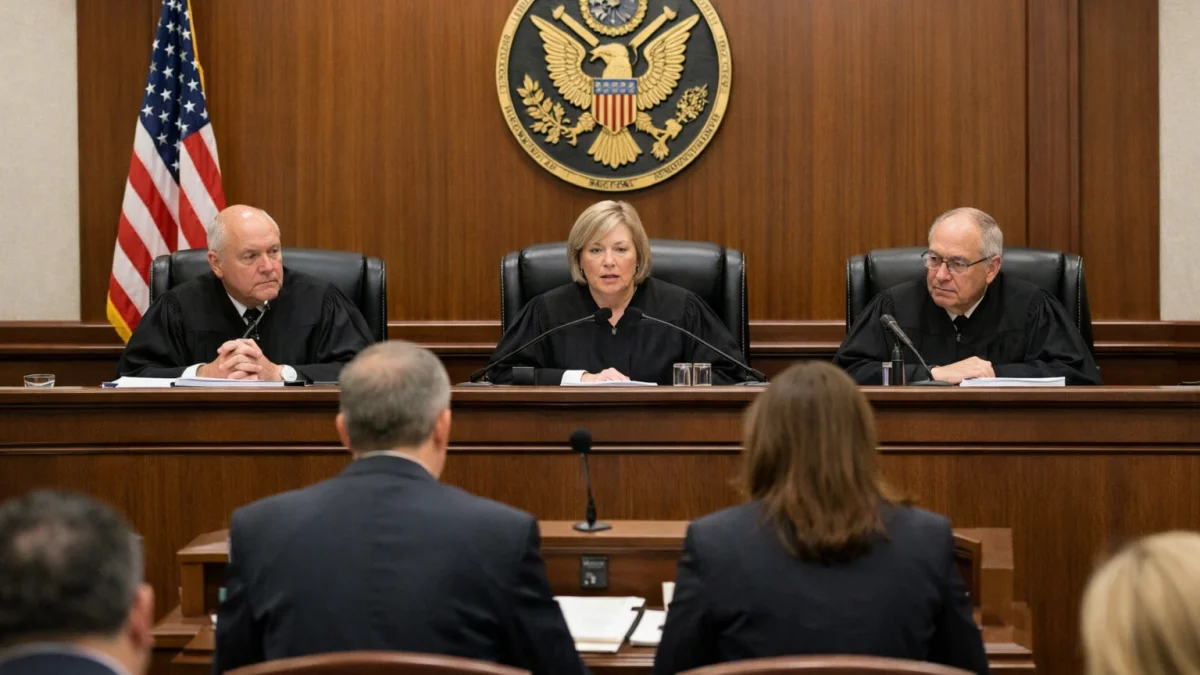


WASHINGTON — A U.S. appeals court on Friday heard arguments in a legal challenge to President Donald Trump’s plan to construct a large ballroom at the White House, testing the limits of presidential authority over federal property.
The case centers on the Trump administration’s demolition of the White House’s East Wing in October 2025 and subsequent construction of a roughly 90,000-square-foot (8,360-square-meter) ballroom estimated to cost about $400 million. Preservationists sued, arguing the project requires congressional approval and that the executive branch lacks authority to proceed without it.


Justice Department attorney Yaakov Roth told a three-judge panel of the U.S. Court of Appeals for the District of Columbia Circuit that construction had advanced too far to halt and that courts have no role in second-guessing the project on national security grounds. “Architectural preference should not take precedence over national security concerns,” Roth said, citing evidence that the old East Wing was inadequate for protecting the president and White House leadership.
Judge Patricia Millett questioned the government’s position, asking whether it implied that even complete lawlessness by the executive could not be stopped by the courts. Roth replied that, on the theories presented, that would be correct, according to a Reuters report on the proceedings.
A lawyer for the National Trust for Historic Preservation, Thaddeus Heuer, countered that the president has no “free-floating” power to build without appropriations from Congress. “They just don’t want to go to Congress,” Heuer said, urging the court to halt construction and allow lawmakers to determine the site’s future.
U.S. District Judge Richard Leon, a Republican appointee, had previously blocked above-ground construction while permitting underground work to continue, ruling that no federal statute authorizes the president to build the ballroom without congressional approval.
The appeals court panel — consisting of Judges Patricia Millett and Bradley Garcia, both Democratic appointees, and Judge Neomi Rao, a Trump appointee — allowed construction to proceed pending its decision. A ruling is expected in the coming weeks and could be appealed to the U.S. Supreme Court.
The ballroom project is part of broader efforts by Trump to reshape parts of Washington, including plans for a large arch near the National Mall and renovations to the Kennedy Center. A separate federal judge recently ordered Trump to remove his name from the Kennedy Center and blocked related renovation plans.
The National Trust for Historic Preservation contends that courts have never permitted a president to usurp congressional powers over federal property based solely on claims of necessity. The administration maintains the project addresses legitimate security needs.
Details of the final scope and timeline remain subject to the ongoing litigation. Trump has previously indicated the ballroom could open around September 2028.
The case highlights recurring tensions between executive action and congressional authority over federal spending and property, a dynamic seen in multiple challenges to Trump administration policies since he took office in January 2025. No immediate resolution is expected, and the appeals court has not indicated when it will issue its opinion.